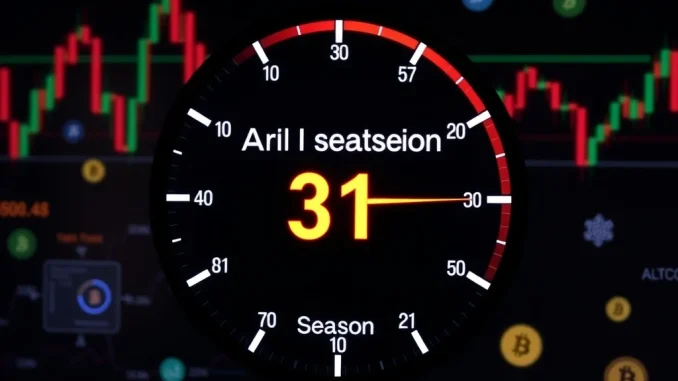
The **cryptocurrency market** is constantly evolving. Investors closely monitor various metrics to understand market sentiment and potential shifts. Recently, the **Altcoin Season Index** experienced a notable four-point drop, landing at 48. This sudden decline has certainly captured the attention of many crypto enthusiasts. It suggests a potential shift in momentum away from altcoins. Furthermore, it raises questions about the current state of **altcoin performance** relative to Bitcoin.
Understanding the Altcoin Season Index
The **Altcoin Season Index** is a crucial tool. CoinMarketCap created it to measure market conditions. Specifically, it helps determine whether altcoins or Bitcoin currently lead the market. A score closer to 100 indicates a stronger altcoin season. Conversely, a lower score suggests Bitcoin dominance. This index is not just a random number. Instead, it reflects significant market activity. Many traders use it to guide their investment decisions.
To declare an **Altcoin Season**, 75% of the top 100 cryptocurrencies must outperform Bitcoin. This calculation excludes stablecoins and wrapped tokens. These assets typically do not reflect true market sentiment. The performance comparison spans the past 90 days. Therefore, the index offers a broad, long-term perspective. It avoids short-term market noise. Consequently, the index provides a more reliable indicator of prevailing trends. This methodology ensures a robust measure of market leadership.
What the Drop to 48 Signifies for Altcoin Performance
The recent four-point drop to 48 signals a significant shift. Previously, the index was closer to the threshold for an **Altcoin Season**. Now, it suggests that fewer altcoins are outperforming Bitcoin. This movement indicates a cooling period for altcoins. Investors often see such a drop as a sign of increasing **Bitcoin performance**. When Bitcoin gains strength, capital tends to flow into it. This often happens at the expense of smaller altcoins. Therefore, the decline is a clear indicator. It highlights a changing dynamic within the **cryptocurrency market**.
Historically, market cycles often show patterns. Periods of strong Bitcoin growth are followed by altcoin surges. However, the current data suggests the opposite trend. The index implies that Bitcoin is currently consolidating its position. This could lead to a phase of relative stability for Bitcoin. Meanwhile, altcoins might experience more volatility or slower growth. Understanding these shifts is vital for making informed investment choices. It helps investors anticipate future market movements.
Factors Influencing the Cryptocurrency Market Shift
Several factors can influence the **Altcoin Season Index**. Macroeconomic conditions often play a role. For example, interest rate changes or global economic instability can impact investor sentiment. Regulatory news also has a profound effect. Positive or negative developments can cause significant market reactions. Furthermore, Bitcoin halving events often precede major market shifts. These events reduce the supply of new Bitcoin. They can trigger price appreciation. Consequently, Bitcoin’s dominance often increases during these periods.
Technological advancements also drive market trends. New innovations in blockchain technology can boost specific altcoins. Conversely, a lack of development can hinder their growth. Investor sentiment is another key driver. Fear, uncertainty, and doubt (FUD) can lead to widespread selling. On the other hand, positive news can fuel buying frenzies. Therefore, a combination of these elements likely contributed to the recent drop. It is rarely just one single factor. Instead, it is a complex interplay of forces. All these elements shape the current **cryptcoin market** landscape.
Analyzing Bitcoin Performance and Market Dominance
A lower **Altcoin Season Index** typically coincides with stronger **Bitcoin performance**. Bitcoin often acts as a safe haven asset within the crypto space. During periods of uncertainty, investors tend to move capital into Bitcoin. Its larger market capitalization and perceived stability make it attractive. This movement can suppress altcoin prices. It also increases Bitcoin’s market dominance. When Bitcoin’s dominance rises, it means a larger share of the total crypto market value belongs to Bitcoin. This metric is closely watched by analysts.
Bitcoin’s price movements can also set the tone for the entire market. A strong Bitcoin rally often draws attention and capital. This can initially pull funds away from altcoins. However, if Bitcoin sustains its gains, some of that capital may eventually flow back into altcoins. This phenomenon is known as the ‘trickle-down effect.’ Therefore, the current index drop suggests we are in a phase where Bitcoin is asserting its leadership. This is a critical period for assessing overall market health. It also helps predict future trends. Investors must monitor Bitcoin’s trajectory carefully.
Navigating the Current Altcoin Season
The current index score of 48 does not mean altcoins are doomed. Rather, it indicates a period requiring careful strategy. Investors should reassess their portfolios. They must consider the potential for continued **Bitcoin performance**. Diversification remains crucial. Holding a mix of Bitcoin and promising altcoins can mitigate risks. Researching individual altcoin projects is also vital. Focus on projects with strong fundamentals. Look for clear use cases and active development teams. This approach helps identify resilient assets.
Furthermore, managing risk is paramount. Avoid making impulsive decisions based on short-term fluctuations. The **cryptocurrency market** is inherently volatile. Setting stop-loss orders can protect capital. It prevents significant losses during downturns. Staying informed about market news is equally important. Follow reputable sources and analysis. This helps in understanding broader trends. It also assists in adapting strategies as conditions change. The goal is to navigate these market cycles wisely. Patience and a long-term perspective are key. They help investors weather any storm. These strategies are particularly important during periods of uncertainty.
Future Outlook for the Altcoin Season Index
The **Altcoin Season Index** is dynamic. It can change quickly. Several catalysts could push the index higher again. For instance, a significant innovation in a major altcoin could spark renewed interest. A sustained period of Bitcoin consolidation could also lead to capital rotation. As Bitcoin’s price stabilizes, investors might seek higher returns in altcoins. This could trigger a new wave of **altcoin performance**. Moreover, broader market adoption of specific blockchain technologies would be beneficial. This would attract more users and investment.
However, further drops are also possible. Negative regulatory news or a global economic downturn could impact the entire **cryptocurrency market**. Investors should monitor key indicators. Watch Bitcoin’s dominance chart closely. Pay attention to overall market sentiment. Look for signs of institutional interest in altcoins. These factors will likely determine the index’s future direction. Ultimately, the crypto market is cyclical. What goes down often comes back up. Therefore, understanding these cycles is crucial for long-term success. It helps investors prepare for various scenarios.
The recent drop in the **Altcoin Season Index** serves as a vital market signal. It highlights a period where **Bitcoin performance** is likely taking precedence. While this may dampen immediate **altcoin performance**, it also offers a chance for strategic reassessment. The **cryptocurrency market** is always shifting. Investors who remain informed and adaptable are best positioned for future success. Continue to monitor the index and market trends. This will help you make sound investment choices. Remember, market cycles are a natural part of the crypto landscape.
Frequently Asked Questions (FAQs)
Q1: What exactly is the Altcoin Season Index?
A1: The **Altcoin Season Index** is a metric created by CoinMarketCap. It measures whether market conditions favor altcoins or Bitcoin. A higher score (closer to 100) indicates an altcoin season, while a lower score suggests Bitcoin dominance.
Q2: How is an Altcoin Season declared?
A2: An **Altcoin Season** is declared when 75% of the top 100 cryptocurrencies (excluding stablecoins and wrapped coins) have outperformed Bitcoin over the past 90 days. This provides a comprehensive view of market trends.
Q3: What does a drop in the Altcoin Season Index mean for my investments?
A3: A drop, like the recent fall to 48, suggests that fewer altcoins are currently outperforming Bitcoin. This often indicates a period of stronger **Bitcoin performance**. Investors might consider reassessing their altcoin holdings and potentially diversifying into Bitcoin or stable assets.
Q4: What factors can influence the Altcoin Season Index?
A4: Many factors can influence the index. These include macroeconomic conditions, regulatory news, Bitcoin halving events, technological advancements in specific altcoins, and overall investor sentiment within the **cryptocurrency market**.
Q5: Is an Altcoin Season still possible with the index at 48?
A5: While 48 is below the 75 threshold for an official **Altcoin Season**, the index is dynamic. Market conditions can change. New innovations or a period of Bitcoin consolidation could lead to capital flowing back into altcoins, potentially raising the index again in the future.
Q6: How can I stay informed about the Altcoin Season Index and market changes?
A6: You can monitor the **Altcoin Season Index** directly on CoinMarketCap. Additionally, following reputable crypto news sources, market analysts, and keeping an eye on **Bitcoin performance** and overall **cryptocurrency market** trends will help you stay informed.