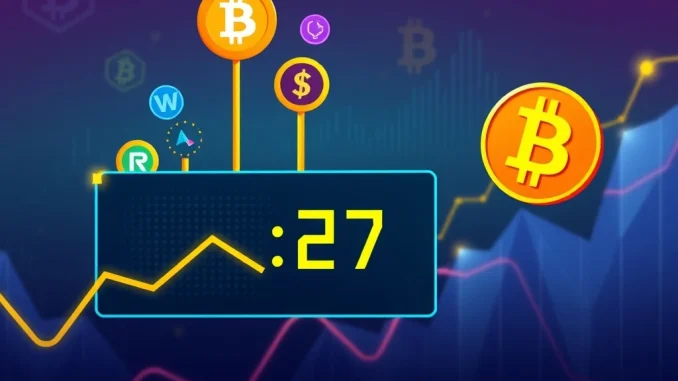
The **Altcoin Season Index** currently stands at 67. This figure remains unchanged from the previous day. For many investors, this number sparks interest. It offers a snapshot of current market dynamics. Understanding this index is crucial for navigating the broader **cryptocurrency market** effectively.
Understanding the Altcoin Season Index
CoinMarketCap provides the **Altcoin Season Index**. This metric helps investors gauge market sentiment. It measures a specific condition within the top 100 cryptocurrencies. Specifically, it tracks whether 75% of these assets have outperformed Bitcoin. Stablecoins and wrapped coins are excluded from this calculation. The measurement period spans the preceding 90 days. A higher reading, closer to 100, suggests more favorable conditions for altcoins. Conversely, a lower number points towards Bitcoin’s dominance.
This index provides a clear benchmark. It simplifies complex market movements. Traders often use it to inform their **crypto trading** strategies. It indicates when altcoins might offer better returns. However, it is just one tool among many. Therefore, comprehensive research remains vital for all investment decisions.
Defining Altcoin Season vs. Bitcoin Season
The **Altcoin Season Index** helps define distinct market periods. An **altcoin season** occurs when 75% of the top 100 altcoins outperform Bitcoin. This condition must hold over a 90-day period. During such times, capital often flows from Bitcoin into various altcoins. Consequently, these alternative cryptocurrencies see significant price increases. This shift can present lucrative opportunities for investors.
Conversely, a **Bitcoin season** signifies the opposite trend. Here, Bitcoin’s performance surpasses that of most altcoins. This often happens during periods of market uncertainty. Investors may seek the relative stability of Bitcoin. Thus, capital moves back into Bitcoin. Understanding these cycles is key for strategic asset allocation. Both seasons offer unique challenges and opportunities for investors in the **cryptocurrency market**.
What the Steady 67 Reading Implies for Bitcoin Performance
The **Altcoin Season Index** holding steady at 67 offers important insights. A reading of 67 suggests a mixed market. It indicates that altcoins are generally performing well. However, they have not yet reached full altcoin season criteria. For an official altcoin season, the index needs to hit 75 or higher. This current stability shows sustained interest in altcoins. Nevertheless, Bitcoin still holds significant influence. Its **Bitcoin performance** remains a critical benchmark. The index’s current level suggests a cautious optimism. It points to a market where altcoins are gaining traction. Yet, Bitcoin has not been entirely overshadowed. Investors should monitor both segments carefully. This balance is typical in evolving crypto markets.
The 67 mark is significant. It implies a strong underlying current for altcoins. Many individual altcoins are likely outperforming Bitcoin. However, not enough have done so to trigger a full altcoin season. This scenario often precedes larger market shifts. Therefore, traders often watch these levels closely. They anticipate potential breakouts or consolidations.
Factors Influencing the Cryptocurrency Market and Altcoin Season
Several factors drive the **cryptocurrency market** and influence altcoin seasons. Understanding these elements is crucial. Market sentiment plays a significant role. Positive news or technological breakthroughs can boost altcoin prices. Conversely, regulatory concerns or macroeconomic shifts can dampen enthusiasm. Bitcoin dominance also directly impacts the index. When Bitcoin’s market share increases, altcoins often struggle. Conversely, a decrease in Bitcoin dominance typically favors altcoins.
Technological advancements are another key driver. New projects with innovative solutions attract investment. These often lead to increased adoption and price appreciation. Institutional adoption also provides a strong catalyst. When major institutions invest in altcoins, it legitimizes the sector. This can draw in more retail investors. Finally, broader economic conditions affect the entire market. Interest rate changes or inflation concerns can influence investor behavior. All these factors collectively shape the landscape. They determine whether we are in an **altcoin season** or a Bitcoin season. Astute investors consider these broader trends. This helps them make informed **crypto trading** decisions.
Historical Trends and What They Tell Us About Altcoin Season Index
Examining historical data provides valuable context. The **Altcoin Season Index** has fluctuated over time. Past altcoin seasons have often followed periods of Bitcoin consolidation. After Bitcoin achieves new all-time highs, investors sometimes seek higher returns. They then move capital into smaller, more volatile assets. This pattern has repeated across various market cycles. For example, 2017 and early 2021 saw pronounced altcoin rallies. During these times, the index likely reached much higher levels. These periods were characterized by explosive growth in many altcoins. They offered significant gains for early investors.
However, these rallies are rarely sustained indefinitely. Market corrections inevitably follow. Bitcoin often reasserts its dominance during downturns. This leads to a ‘Bitcoin season’. Therefore, understanding these historical cycles is paramount. It helps in managing expectations. It also aids in developing robust **crypto trading** strategies. The current reading of 67 suggests a mid-cycle environment. It indicates a period of potential growth for altcoins. Yet, it also signals the need for vigilance. The market can shift quickly. Past performance does not guarantee future results.
Navigating the Cryptocurrency Market with the Altcoin Season Index
The **Altcoin Season Index** serves as a valuable guide for investors. It helps in formulating **crypto trading** strategies. When the index is high, investors might consider increasing their altcoin exposure. This could involve diversifying portfolios into promising projects. Conversely, a low index suggests caution. It might be a time to hold more Bitcoin. Or perhaps to re-evaluate altcoin holdings. However, the index is not a standalone trading signal. It should be used in conjunction with other analyses. Technical analysis, fundamental research, and risk management are all crucial.
Investors should also consider their personal risk tolerance. Altcoins are often more volatile than Bitcoin. They carry higher potential for both gains and losses. Therefore, careful position sizing is essential. Regular portfolio rebalancing also helps. This ensures alignment with market conditions. The index offers a broad market overview. It helps investors understand the prevailing winds. Yet, individual altcoin performance can vary widely. Thus, diligent research on specific assets remains vital.
Risks and Considerations in an Evolving Cryptocurrency Market
Investing in the **cryptocurrency market** always involves risks. This holds true even during an **altcoin season**. Volatility is a primary concern. Altcoins, especially smaller ones, can experience rapid price swings. These movements can be sudden and significant. Market liquidity can also be an issue. Some altcoins have lower trading volumes. This can make large trades difficult to execute. Furthermore, regulatory changes pose ongoing uncertainty. Governments worldwide are still developing their crypto frameworks. New regulations could impact specific altcoins or the entire market.
Security risks are also prevalent. Hacking incidents and scams remain a threat. Investors must protect their digital assets carefully. Diversification helps mitigate some of these risks. Spreading investments across different altcoins reduces single-asset exposure. Setting stop-loss orders can limit potential losses. Moreover, continuous learning is essential. The crypto space evolves rapidly. Staying informed helps investors adapt. Despite the potential rewards, a cautious approach is always recommended. This protects capital and promotes sustainable **crypto trading** practices.
The Road Ahead for Altcoins and Bitcoin Performance
The **Altcoin Season Index** at 67 points to an interesting phase. It suggests a sustained period of altcoin strength. This strength could potentially lead to a full **altcoin season**. However, several factors will influence future movements. Global economic conditions will play a significant role. Inflation, interest rates, and geopolitical events can all impact crypto. Technological developments within the altcoin space are also critical. Innovations in DeFi, NFTs, and Web3 could drive new waves of adoption. Increased institutional interest in specific altcoins would also be a strong catalyst.
Bitcoin’s role also remains central. Its price action often dictates overall market sentiment. A strong **Bitcoin performance** can provide a stable foundation. This stability often allows altcoins to flourish. Conversely, a significant Bitcoin correction can drag altcoins down. Therefore, investors should monitor both segments. The interplay between Bitcoin and altcoins defines market cycles. The current index reading suggests a period of opportunity. However, it also demands informed decision-making. Remaining adaptable will be key for navigating the path ahead.
Conclusion: Monitoring the Altcoin Season Index for Informed Decisions
The **Altcoin Season Index** currently sits at 67. This figure indicates a healthy, yet not fully realized, altcoin environment. It means a significant portion of altcoins are outperforming Bitcoin. This suggests ongoing investor interest in alternative cryptocurrencies. Understanding the index helps in making informed decisions. It highlights periods where altcoins might offer better returns. Conversely, it signals when Bitcoin might be the safer bet. However, this index is merely one tool. It must be combined with thorough research and risk management. The dynamic **cryptocurrency market** demands constant vigilance. By staying informed, investors can better position themselves. They can capitalize on potential opportunities while mitigating risks in their **crypto trading** endeavors.
Frequently Asked Questions (FAQs)
What exactly is the Altcoin Season Index?
The Altcoin Season Index, provided by CoinMarketCap, measures if 75% of the top 100 cryptocurrencies (excluding stablecoins and wrapped coins) have outperformed Bitcoin over the last 90 days. A reading closer to 100 indicates market conditions are more favorable for altcoins.
What does an Altcoin Season mean for investors?
An altcoin season suggests that a broad range of altcoins are seeing significant gains relative to Bitcoin. For investors, this period can offer opportunities for higher returns, but also comes with increased volatility and risk. It often encourages diversification into various altcoin projects.
How is the Altcoin Season Index calculated?
The index is calculated by assessing the performance of the top 100 cryptocurrencies by market capitalization (excluding stablecoins and wrapped coins) against Bitcoin over the preceding 90 days. If 75% or more of these altcoins have outperformed Bitcoin, the index moves higher towards 100.
Why is the Altcoin Season Index important for crypto trading?
The index provides a broad market sentiment indicator. It helps traders understand whether the overall market trend favors altcoins or Bitcoin. This information can be used to adjust portfolio allocations and develop more effective crypto trading strategies, although it should not be the sole basis for decisions.
What does an index reading of 67 signify?
A reading of 67 indicates that a substantial number of altcoins are outperforming Bitcoin, but not enough to meet the 75% threshold for an official ‘altcoin season’. It suggests a strong, ongoing interest in altcoins, but also that Bitcoin still maintains significant influence in the market.
Are there risks associated with an Altcoin Season?
Yes, while altcoin seasons offer potential for high returns, they also come with increased risks. Altcoins are generally more volatile than Bitcoin, and some may lack liquidity. Investors should conduct thorough research, manage their risk exposure, and be aware of potential market corrections.