Understanding the broader economic landscape is vital for cryptocurrency investors. Macroeconomic factors, such as statements from the Federal Reserve and discussions around inflation, significantly influence market sentiment. Therefore, investors closely watch developments regarding the inflation outlook and central bank policies. Recent comments from Federal Reserve Chair Jerome Powell offer a glimpse into these crucial considerations, particularly concerning the tariff impact on prices.
Jerome Powell’s Cautious Stance on Tariff Impact
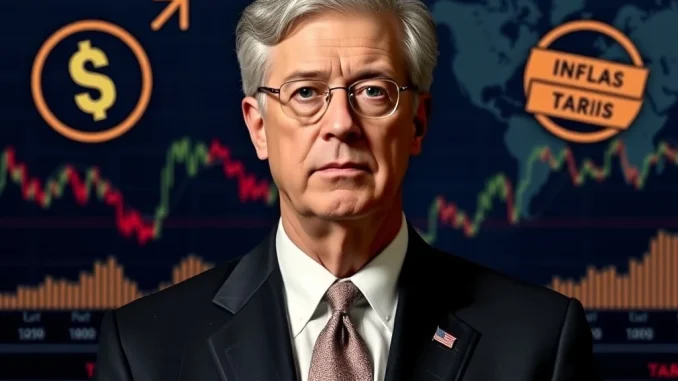
Federal Reserve Chair Jerome Powell recently addressed the ongoing debate surrounding tariffs and their effect on inflation. He indicated that the impact requires continued observation. Powell acknowledged the potential for tariffs to influence prices. However, he also suggested that this effect would likely be short-term. This perspective forms the Fed’s current base case scenario. Therefore, the central bank maintains a vigilant watch on economic data.
Specifically, Powell’s remarks highlight a nuanced understanding. He noted that while tariffs can increase costs for businesses, these increases do not always translate directly into sustained consumer price hikes. Instead, companies may absorb some costs or find alternative supply chains. Consequently, the long-term tariff impact on the broader economy remains a subject of careful analysis.
Understanding the Federal Reserve’s Inflation Outlook
The Federal Reserve operates with a dual mandate. It aims to achieve maximum employment and maintain price stability. Price stability essentially means controlling inflation. The Fed targets an average inflation rate of 2 percent over time. Therefore, any factors that could disrupt this target receive significant attention from policymakers.
Tariffs introduce a layer of complexity to this mission. They can act as a tax on imported goods, making them more expensive. This cost can then pass to consumers, pushing up the inflation outlook. Conversely, a strong dollar or weak demand might offset some of these inflationary pressures. The Fed must weigh these various forces. This complex balancing act shapes monetary policy decisions.
Key aspects of the Fed’s approach include:
- Data Monitoring: The Fed constantly analyzes various economic indicators.
- Forward Guidance: Policymakers communicate their expectations and intentions.
- Flexible Response: The Fed adjusts policy based on evolving conditions.
Ultimately, these actions aim to foster overall economic stability.
Global Trade Tensions and Economic Stability
The backdrop to Powell’s comments involves broader global trade tensions. These tensions have led to the imposition of various tariffs across different sectors. Such policies often create uncertainty in international markets. This uncertainty can deter business investment and disrupt global supply chains. Furthermore, it directly impacts the costs of goods and services.
For example, tariffs on steel or aluminum increase manufacturing costs for domestic industries. These industries then face a choice: absorb the costs, pass them to consumers, or seek new suppliers. Each option carries implications for prices and profitability. Thus, the overall economic stability can be affected by these trade disputes. Policymakers must carefully assess these widespread effects.
The Short-Term vs. Long-Term Tariff Impact
Jerome Powell emphasized the expectation of a short-term tariff impact on inflation. This distinction is crucial for understanding the Fed’s strategy. Short-term price spikes might occur as businesses adjust to new trade policies. However, these effects may dissipate over time if supply chains adapt or if trade tensions ease. The Fed’s base case suggests this transitory nature.
Nevertheless, the possibility of longer-term effects exists. Sustained tariffs could lead to more permanent shifts in production and consumption patterns. If businesses onshore production or reconfigure supply networks extensively, structural changes could impact prices more enduringly. Therefore, the Federal Reserve commits to further observation. This ongoing monitoring ensures that any prolonged effects on the inflation outlook are properly addressed.
Implications for Financial Markets and Beyond
Statements from the Federal Reserve Chair always resonate across financial markets. Investors in traditional assets, and increasingly in cryptocurrencies, scrutinize these remarks. Powell’s cautious optimism regarding the tariff impact can influence sentiment. It suggests that the Fed does not foresee an immediate, sustained inflationary spiral due to trade policies. This can contribute to a sense of relative economic stability.
For crypto markets, which often react sensitively to macro news, this perspective offers context. A stable economic environment, free from severe inflationary pressures, generally supports investor confidence. Conversely, prolonged uncertainty or rising inflation could prompt investors to seek alternative assets or reduce risk exposure. Thus, monitoring the Fed’s stance on inflation and trade remains essential for all market participants.
Federal Reserve Chair Jerome Powell’s recent comments underscore the complexity of assessing tariffs’ influence on inflation. While the current expectation points to a short-term impact, the need for continued vigilance is clear. The Federal Reserve will keep monitoring economic indicators closely. This ensures the pursuit of price stability and broader economic health. Ultimately, these ongoing observations will shape future monetary policy decisions and maintain economic stability in an evolving global landscape.
Frequently Asked Questions (FAQs)
Q1: What did Jerome Powell say about tariffs and inflation?
Federal Reserve Chair Jerome Powell stated that the impact of tariffs on inflation needs further monitoring. He added that the base case scenario is for the effect to be short-term. This suggests a temporary influence rather than a lasting inflationary pressure.
Q2: Why is the Federal Reserve monitoring the tariff impact?
The Federal Reserve aims to maintain price stability as part of its dual mandate. Tariffs can increase import costs, potentially affecting consumer prices and the overall inflation outlook. Therefore, the Fed monitors these effects to guide its monetary policy decisions.
Q3: What does ‘short-term impact’ mean in this context?
A ‘short-term impact’ means that while tariffs might cause immediate price increases or cost adjustments for businesses, these effects are expected to be temporary. They may dissipate as companies adapt supply chains or as trade tensions evolve, rather than leading to sustained inflation.
Q4: How do tariffs affect economic stability?
Tariffs can create uncertainty in global trade, disrupt supply chains, and increase costs for businesses. This can impact consumer spending, business investment, and overall economic growth. Therefore, they are a significant factor in assessing overall economic stability.
Q5: How does the Federal Reserve’s inflation outlook affect cryptocurrency?
The Federal Reserve’s inflation outlook and monetary policy decisions influence the broader financial markets. A stable economic environment, with controlled inflation, generally supports investor confidence across all asset classes, including cryptocurrencies. Conversely, high inflation or economic uncertainty can lead to market volatility.
Q6: What is the Federal Reserve’s dual mandate?
The Federal Reserve’s dual mandate involves two primary goals: achieving maximum employment and maintaining price stability. Price stability refers to controlling inflation, typically targeting an average rate of 2 percent over time.