Investors closely monitor signals from the Federal Reserve, especially regarding economic stability. Recently, Fed Chair Jerome Powell issued a significant warning. He stated that **tariff-driven inflation** is likely to persist. This expectation extends through the current year and well into next year. Such an outlook has broad implications across financial markets, including the dynamic cryptocurrency space. Understanding these economic forces is crucial for informed decision-making.
Jerome Powell’s Stance on Persistent Price Increases
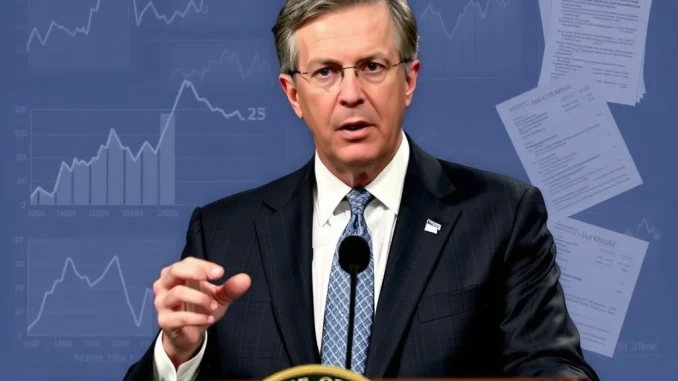
During a recent address, **Jerome Powell** articulated the Federal Reserve’s updated perspective on inflationary pressures. He highlighted that certain price increases are not transitory. Instead, they represent a more enduring challenge. Specifically, Powell pointed to tariffs as a primary driver. These trade barriers impose additional costs on imported goods. Consequently, businesses often pass these costs onto consumers. This process contributes directly to higher consumer prices.
Powell’s comments underscore a shift in the Fed’s assessment. Initially, many officials viewed rising inflation as a temporary phenomenon. They attributed it to supply chain disruptions and surging demand post-pandemic. However, the persistent nature of tariff impacts suggests a different scenario. The Fed now anticipates these effects will linger. This means consumers and businesses should prepare for sustained elevated prices. Such a forecast carries significant weight for future economic planning.
Understanding Tariff-Driven Inflation
To grasp the full impact, it helps to understand **tariff-driven inflation**. Tariffs are taxes imposed on imported goods and services. Governments implement them for various reasons, including:
- Protecting domestic industries.
- Generating revenue.
- Influencing trade relations.
When tariffs are applied, foreign goods become more expensive. Domestic producers may also raise their prices. They do this to match the increased cost of imports. This creates a ripple effect throughout the economy. Ultimately, it leads to higher costs for everyday items. Consumers feel this directly in their wallets. Businesses face increased operational expenses. Therefore, tariffs are a direct contributor to overall price levels.
The current situation is complex. Geopolitical tensions often lead to new tariffs or the continuation of existing ones. These policies have a direct link to the inflation experienced by households. It is not just about a few goods. Instead, it affects a wide range of products. This broad impact is what concerns the **Federal Reserve**. They aim to maintain price stability. Persistent tariff effects make this goal more challenging.
The Federal Reserve’s Challenging Economic Outlook
The **Federal Reserve** faces a delicate balancing act. Its dual mandate involves achieving maximum employment and stable prices. Persistent inflation, especially from external factors like tariffs, complicates this mission. If inflation remains high, the Fed might consider various monetary policy responses. These actions could include interest rate adjustments. Higher rates can cool down an overheating economy. They make borrowing more expensive. This, in turn, can reduce consumer spending and business investment.
However, raising rates too aggressively carries risks. It could slow economic growth too much. This might even trigger a recession. Powell’s cautious tone reflects this dilemma. He acknowledges the external pressures. Yet, the Fed must still act to control inflation. This challenging **economic outlook** demands careful consideration. Policy decisions will significantly shape the nation’s financial future. Furthermore, these decisions often ripple into global markets, affecting international trade and investment flows.
Impact on the Broader Economy and Financial Markets
Persistent **price increases** have widespread effects. For consumers, it means reduced purchasing power. Their money simply buys less. This can lead to decreased consumer confidence. It may also result in slower retail sales. Businesses, too, feel the strain. Higher input costs erode profit margins. They might delay expansion plans or reduce hiring. This could slow overall economic growth.
Financial markets react swiftly to such pronouncements. Bond yields might fluctuate. Equity markets could show volatility. Investors typically seek safe havens during periods of uncertainty. This could include certain commodities or even specific types of cryptocurrencies. However, the overall sentiment usually becomes more cautious. Therefore, investors must remain vigilant. They need to adapt their strategies to changing economic conditions. The interplay between traditional finance and emerging digital assets becomes more critical during these times.
Navigating the Future: Economic Outlook and Policy Responses
Looking ahead, the **economic outlook** remains clouded by these inflationary concerns. The Fed’s path forward will be crucial. They must communicate their intentions clearly. This helps to manage market expectations. Analysts will closely watch incoming economic data. Key indicators include:
- Consumer Price Index (CPI) reports.
- Producer Price Index (PPI) figures.
- Employment statistics.
These data points will inform the Fed’s next steps. Any policy adjustments will be designed to curb inflation. At the same time, they will aim to support sustainable growth. It’s a delicate balance requiring constant evaluation. Moreover, global trade policies can change. New tariffs might emerge. Old ones could be rescinded. Each change directly influences the inflation trajectory.
For cryptocurrency investors, this means paying attention to macroeconomic trends. High inflation can sometimes drive demand for alternative assets. Some view cryptocurrencies like Bitcoin as a hedge against inflation. Yet, their volatility also presents risks. The broader economic environment significantly influences their performance. Thus, understanding the Fed’s stance on **tariff-driven inflation** is more important than ever. It provides context for market movements. It also helps anticipate potential shifts in investor sentiment. Ultimately, prudence and adaptability are key for all market participants.
The path ahead will require careful navigation from policymakers. It will also demand resilience from businesses and consumers. Powell’s warning is a reminder of the complex economic forces at play. These forces shape our financial landscape. They also influence the value of both traditional and digital assets. Therefore, staying informed about these developments is essential for everyone.
Frequently Asked Questions (FAQs)
Q1: What exactly did Jerome Powell say about inflation?
A1: Fed Chair Jerome Powell stated that he expects price increases stemming from tariffs to persist through this year and into next year. This indicates a more enduring inflationary pressure than previously thought.
Q2: How do tariffs contribute to inflation?
A2: Tariffs are taxes on imported goods. When applied, they increase the cost of these goods for importers. These higher costs are often passed on to consumers and businesses, leading to overall higher prices across the economy, which is known as tariff-driven inflation.
Q3: What does this mean for the Federal Reserve’s monetary policy?
A3: Persistent tariff-driven inflation complicates the Federal Reserve’s goal of maintaining price stability. It may lead the Fed to consider measures like adjusting interest rates to cool down the economy, though this involves balancing inflation control with economic growth.
Q4: How might persistent price increases affect consumers?
A4: For consumers, persistent price increases mean their purchasing power decreases. Their money buys less, which can lead to reduced consumer confidence and potentially impact their spending habits on various goods and services.
Q5: What is the broader economic outlook given Powell’s warning?
A5: The economic outlook suggests continued inflationary pressures driven by tariffs. This could lead to a more cautious approach from businesses and consumers, and the Federal Reserve will likely remain vigilant, making data-dependent decisions to manage both inflation and economic growth.
Q6: How does this relate to cryptocurrency markets?
A6: Macroeconomic factors like inflation and the Federal Reserve’s policy responses significantly influence cryptocurrency markets. Some investors view cryptocurrencies as a hedge against inflation, while others see them as risk assets that could be affected by broader economic slowdowns or tighter monetary policies.