Imagine a digital currency, born from innovative technology and community vision, now commanding a valuation that surpasses some of the world’s most established financial institutions. This isn’t a futuristic fantasy; it’s today’s reality. **Ethereum**, the world’s second-largest **cryptocurrency** by **market cap**, has achieved an astonishing milestone, exceeding the combined valuations of banking giant HSBC and payment leader American Express. This monumental shift signals a pivotal moment for **blockchain** technology and its growing integration into the global financial system, challenging traditional perceptions of wealth and value.
Ethereum’s Historic Ascent: Redefining Financial Power
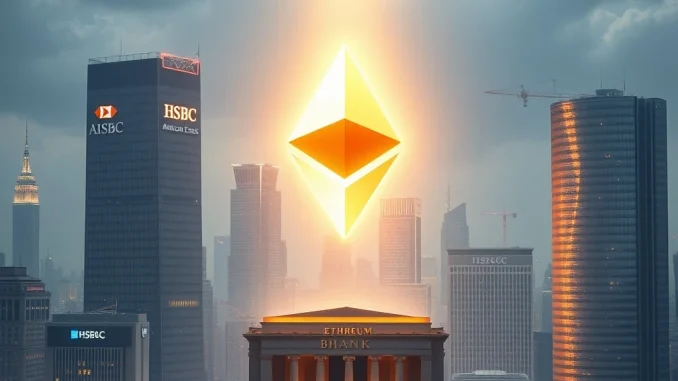
The financial world is abuzz with the news: **Ethereum**’s market capitalization has soared past the combined valuation of HSBC Holdings PLC and American Express Co. This significant achievement, first highlighted by Whale Insider and quickly amplified across various blockchain platforms, underscores a profound turning point. With its market cap crossing an impressive $1.4 trillion, Ethereum now significantly outweighs HSBC’s $1.1 trillion and American Express’s $380 billion valuations. This positions Ethereum not just as a speculative digital asset, but as a foundational infrastructure player in a market landscape traditionally dominated by legacy institutions.
This development reflects a crucial transition for Ethereum. Its value is increasingly underpinned by its utility as the backbone of decentralized applications (dApps), rather than solely by speculative trading. Unlike traditional financial entities whose value is tied to their vast networks of branches, customer deposits, and payment processing fees, Ethereum’s worth is derived from its role as a programmable platform supporting a myriad of innovative services.
Market Cap Comparison: A New Financial Order
To put this into perspective, consider the sheer scale of this achievement:
- Ethereum (ETH): ~$1.4 trillion
- HSBC Holdings PLC: ~$1.1 trillion
- American Express Co.: ~$380 billion
This comparison vividly illustrates how digital assets, particularly those built on robust **blockchain** frameworks, are rapidly gaining ground and asserting their dominance in the global financial arena.
The Blockchain Backbone: Powering Decentralized Finance (DeFi)
What drives Ethereum’s immense value? It’s not just a digital coin; it’s a global computer. Ethereum serves as the foundational layer for a vast ecosystem of decentralized finance (**DeFi**) applications and smart contract solutions. These include everything from decentralized lending protocols and insurance platforms to peer-to-peer exchanges and enterprise-grade solutions that leverage the transparency and immutability of **blockchain** technology.
The network’s continuous evolution has further solidified its appeal. Its adoption of an energy-efficient Proof-of-Stake (PoS) consensus mechanism, known as ‘The Merge,’ dramatically reduced its environmental footprint and improved its security. Furthermore, the ongoing development and widespread adoption of scalability-enhancing Layer-2 solutions, such as rollups, have significantly increased transaction throughput and reduced fees, making the network more accessible and efficient for users worldwide. These technological advancements are critical to its growth and its ability to handle the increasing demand for decentralized services.
Understanding the Evolving Cryptocurrency Landscape
Analysts are closely watching this trend. Blockchain analytics firm OneSafe notes that this milestone represents a structural shift in investor priorities, moving beyond short-term market fluctuations to a recognition of long-term utility. This perspective suggests that investors are increasingly valuing the fundamental infrastructure that **Ethereum** provides, rather than just its price volatility.
The event also coincides with broader macroeconomic and institutional trends. Discussions on platforms like Reddit’s Daily Crypto Discussion suggest that potential central bank rate cuts could amplify **cryptocurrency** demand. Lower borrowing costs might incentivize speculative capital flows into alternative assets like crypto, further bolstering their appeal as a hedge against traditional financial uncertainties. While this remains a forward-looking hypothesis, it aligns with Ethereum’s trajectory as a robust digital asset.
Leading cryptocurrency exchange Binance characterized this achievement as a “huge” step toward mainstream adoption. Binance emphasizes Ethereum’s pivotal role in reshaping cross-border payments, supply chain management, and decentralized financial systems. This endorsement from a major industry player highlights the growing consensus that Ethereum is not just a niche technology but a transformative force.
Despite these significant gains, the broader crypto market has experienced volatility. For instance, PandaForecast reported a 2.2% decline in global crypto **market capitalization** to $3.85 trillion, though this data pertains to a separate timeframe and does not directly conflict with Ethereum’s recent milestone. This divergence underscores the sector’s complexity, where individual asset performance can often diverge from overall market conditions, reinforcing Ethereum’s strength.
What Does This Market Cap Milestone Mean for Traditional Finance?
Ethereum’s ascent inevitably raises questions about how traditional financial institutions like HSBC and American Express are adapting to these powerful digital competitors. While both institutions have explored crypto-related services – such as stablecoin partnerships, blockchain payment trials, and distributed ledger technology (DLT) initiatives – their core operations remain deeply rooted in legacy banking models. Their vast, centralized infrastructures and regulatory burdens present significant challenges in pivoting to a decentralized paradigm.
The fact that Ethereum’s valuation now rivals these established giants suggests a growing narrative where **blockchain**-based systems are increasingly viewed not just as innovative technologies, but as viable, scalable alternatives to centralized networks. This parity in **market cap** forces a re-evaluation of how financial services will be delivered in the future. It highlights the potential for decentralized systems to offer greater efficiency, transparency, and accessibility, particularly in areas like cross-border transactions and peer-to-peer finance.
The Road Ahead: Navigating the Future of Digital Assets
As the **cryptocurrency** market continues to evolve, several factors will play pivotal roles in shaping its future. Regulatory frameworks are still developing globally, and their clarity will significantly impact institutional adoption and mainstream integration. Macroeconomic conditions, including inflation, interest rates, and global economic stability, will also influence investor sentiment and capital flows into digital assets.
For now, **Ethereum**’s ascent marks a fundamental recalibration of market priorities. Digital assets are no longer seen as fringe investments or niche technologies. They are legitimate contenders for capital in an increasingly digitized financial landscape. This milestone serves as a powerful testament to the transformative potential of **blockchain** technology and the growing recognition of its utility beyond speculative trading. It invites both seasoned investors and curious newcomers to consider the profound implications of this new era of finance.
Frequently Asked Questions (FAQs)
1. What is Ethereum’s recent market cap milestone?
Ethereum’s market capitalization has surpassed the combined valuation of traditional financial giants HSBC Holdings PLC and American Express Co., reaching over $1.4 trillion.
2. Why is Ethereum’s market cap surge significant?
This surge is significant because it signals a shift from Ethereum being seen primarily as a speculative asset to being recognized as a foundational utility-driven platform for decentralized finance (DeFi) and smart contract applications, challenging traditional financial structures.
3. How does Ethereum’s value differ from traditional financial institutions?
Unlike traditional institutions whose value is tied to centralized banking services and physical infrastructure, Ethereum’s value is derived from its role as a decentralized network powering dApps, smart contracts, and its ecosystem’s utility, efficiency, and security.
4. What role do Layer-2 solutions play in Ethereum’s growth?
Layer-2 solutions significantly enhance Ethereum’s scalability and efficiency by processing transactions off the main blockchain, reducing fees and increasing throughput. This makes the network more practical for widespread adoption and a wider range of applications, contributing to its overall value.
5. How are traditional financial institutions responding to crypto’s rise?
Traditional financial institutions like HSBC and American Express have explored crypto-related services and blockchain trials, but their core operations remain rooted in legacy models. Ethereum’s valuation parity suggests they face increasing pressure to adapt to the growing influence of decentralized alternatives.
6. What factors might influence Ethereum’s future trajectory?
Ethereum’s future trajectory will be significantly influenced by evolving regulatory frameworks, broader macroeconomic conditions (like interest rates), continued technological advancements (e.g., further scalability solutions), and the ongoing adoption of decentralized applications.