In the fiercely competitive world of electric vehicles (EVs) and cutting-edge artificial intelligence, a recent showdown in China has sent ripples across the global automotive industry. Tesla’s Full Self-Driving (FSD) system, a cornerstone of its technological prowess, recently faced off against 35 formidable Chinese EV competitors in a demanding highway safety evaluation. The results were nothing short of remarkable, underscoring Tesla’s current lead in advanced driver-assist technology. For anyone following the evolution of smart vehicles and the impact of AI, this test provides a compelling snapshot of where the industry stands.
The Ultimate EV Safety Showdown: How Tesla FSD Stood Out
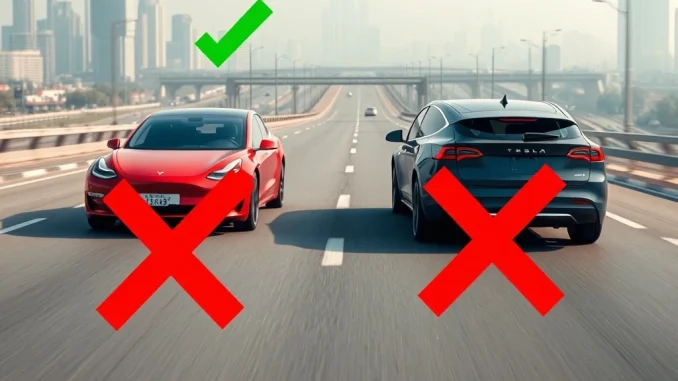
The highly anticipated highway evaluation, orchestrated by Dcar (ByteDance’s automotive division) and China’s state broadcaster CCTV, aimed to rigorously assess Level 2 driver-assist technologies. Simulating complex, high-risk scenarios on both expressways and urban roads, the test pushed participating vehicles to their limits. Out of 36 contenders, Tesla’s Model 3 and Model X emerged victorious, successfully navigating an impressive five out of six challenging test conditions. This performance immediately positioned Tesla FSD at the forefront of the pack.
In stark contrast, several prominent Chinese rivals faced significant hurdles:
- BYD’s Denza Z9GT: Failed three challenges.
- Huawei-supported Aito M9: Also failed three challenges.
- Xiaomi’s SU7: Cleared only one of the six demanding test conditions.
These stark differences sparked widespread discussion on Chinese social media, with some critics questioning the test methodology. However, the undeniable results highlighted Tesla’s robust hardware and software integration, particularly its latest Tesla Hardware 4.0 platform, as a significant advantage in real-world EV safety scenarios.
Decoding Tesla’s Edge in Autonomous Driving Despite Hurdles
How did Tesla achieve such a dominant performance, especially when operating in a market with unique challenges? Elon Musk himself attributed this success to Tesla’s global data-driven approach. This strategy allows Tesla to leverage vast amounts of driving data collected worldwide to refine its algorithms, creating a more robust and adaptable autonomous driving system. However, this global advantage comes with a peculiar twist in China.
Musk highlighted a significant “quandary” for the company: “Due to laws against data export, Tesla achieved the top results in China despite having no local training data.” This means Tesla cannot export data collected in China for AI training, limiting its ability to specifically refine algorithms for China’s distinct road conditions and driving behaviors. Yet, the test results demonstrated the system’s remarkable adaptability to complex environments, proving that its core capabilities are exceptionally strong, even without country-specific data optimization. This ability to perform globally, despite localized data restrictions, is a testament to the fundamental strength of Tesla’s driver-assist tech.
The Rapid Rise of Chinese EVs: Bridging the Driver-Assist Tech Gap
While Tesla currently holds a lead, it’s crucial to acknowledge the incredible progress made by China’s domestic EV industry. Brands like BYD and Xiaomi have made rapid strides in developing their own advanced driver-assist technologies. The sheer pace of innovation within the Chinese EVs market is breathtaking, fueled by massive investments and a tech-savvy consumer base.
However, industry experts, including Wang Yao of the China Association of Automobile Manufacturers, openly acknowledge that local firms still trail Tesla in core capabilities. Specific areas where Tesla maintains an edge include:
- Multi-lane highway navigation: The ability to smoothly and safely handle complex highway maneuvers.
- Pedestrian detection: Advanced systems for identifying and reacting to pedestrians in varied environments.
- Overall system reliability: Consistency in performance across diverse and unpredictable scenarios.
To close this gap, Chinese EV producers are aggressively accelerating AI-driven innovations, often forming strategic partnerships with leading tech firms like Huawei. Xiaomi CEO Lei Jun, for instance, has publicly praised Tesla’s “pioneering work,” signaling a clear recognition of the need for continuous improvement and innovation within the domestic industry.
Navigating China’s Regulatory Landscape for Autonomous Driving
The timing of this test coincided with heightened scrutiny of autonomous driving safety within China. A tragic Xiaomi SU7 crash on a highway in March, which resulted in three fatalities, prompted immediate regulatory responses. Regulators have since banned the use of terms like “smart driving” and “autonomous driving” in marketing materials, aiming to curb exaggerated claims and manage public expectations. Furthermore, the public security ministry has clarified legal responsibilities for Level 2 systems, issuing stern warnings to drivers against overreliance on semi-autonomous features.
These measures reflect broader concerns about safety and consumer expectations in a rapidly evolving market. Despite the cautionary notes, recent studies consistently show that driver-assist systems are the most in-demand feature for EV purchases in China, highlighting a strong consumer appetite for advanced vehicle intelligence. Balancing innovation with stringent EV safety regulations remains a critical challenge for all players in the market.
The High-Stakes Race: Market Dynamics and the Future of EV Safety
Tesla’s impressive performance in the Dcar/CCTV test has undoubtedly bolstered investor confidence, with stock prices showing a positive reaction after the results were made public. However, the company operates within a fiercely competitive market where Chinese EV producers are not standing still. The innovation race is intensifying, with local brands leveraging their deep understanding of domestic road networks and consumer preferences to refine their systems.
Consider the broader market dynamics:
- BYD’s Ascent: BYD recently surpassed Tesla in annual sales, demonstrating the formidable scale and market acceptance of domestic brands.
- Xiaomi’s Resilience: Despite the March accident, Xiaomi’s latest SUV has attracted strong initial demand, indicating consumer resilience and continued interest in their offerings.
The test results underscore the evolving dynamics in China’s EV sector. While Tesla’s global data edge currently provides a significant performance advantage, local competitors are rapidly catching up, focusing on localized adaptability. The outcome also highlights the critical importance for companies like Tesla to seek regulatory approval for transferring Chinese data for algorithm training, which could further unlock their system’s potential in this unique market. For now, these results firmly position Tesla as a benchmark in driver-assist technology, even as the market’s innovation race intensifies with every passing month.
Frequently Asked Questions (FAQs)
1. What was the Dcar/CCTV EV safety test about?
The Dcar (ByteDance’s automotive division) and China’s state broadcaster CCTV conducted a highway evaluation of Level 2 driver-assist technologies. The test simulated high-risk scenarios on expressways and urban roads to assess the performance and safety of various electric vehicle autonomous driving systems.
2. How did Tesla FSD perform compared to Chinese EVs in the test?
Tesla’s Full Self-Driving (FSD) system, in its Model 3 and Model X, outperformed 35 Chinese EV competitors. Tesla successfully navigated five out of six test conditions, placing it at the top. In contrast, Chinese rivals like BYD’s Denza Z9GT and Huawei-supported Aito M9 each failed three challenges, while Xiaomi’s SU7 cleared only one.
3. What challenges does Tesla face regarding data for its autonomous driving system in China?
Tesla faces regulatory hurdles in China, specifically laws against data export. This means Tesla cannot transfer data collected from its vehicles in China back to its global servers for AI training, which limits its ability to refine algorithms specifically for China-specific road conditions and driving behaviors. Despite this, Tesla FSD still performed exceptionally well.
4. How are Chinese regulators addressing autonomous driving safety?
Following incidents like a fatal Xiaomi SU7 crash, Chinese regulators have heightened scrutiny on autonomous driving safety. Measures include banning marketing terms like “smart driving” and “autonomous driving” to prevent over-promising, and clarifying legal responsibilities for Level 2 systems to warn drivers against overreliance on semi-autonomous features.
5. What does this test mean for the future of the EV driver-assist market in China?
The test underscores Tesla’s current lead as a benchmark in driver-assist technology, driven by its global data approach and advanced hardware. However, it also highlights the rapid progress and fierce competition from Chinese EV brands, who are accelerating AI innovations and leveraging their understanding of domestic road networks. The market will likely see continued intense innovation, with a focus on both performance and localized adaptability.