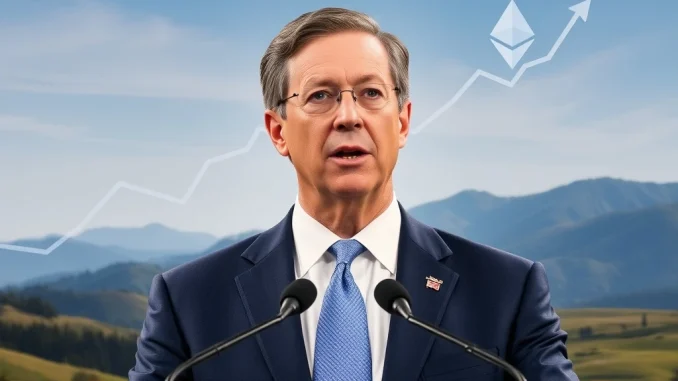
Are you a crypto investor wondering how the big moves in traditional finance ripple through your digital assets? Well, buckle up, because a recent announcement from the U.S. Federal Reserve is sending clear signals across all markets, including the volatile world of cryptocurrencies. The news? Federal Reserve Chair Jerome Powell has confirmed his commitment to staying in his role. This isn’t just a personnel update; it’s a powerful signal of ongoing Fed Policy, aiming to bolster Market Stability and continue the crucial Inflation Fight that has been a defining feature of the global economy. Let’s dive into what this means for you and your digital portfolio.
Jerome Powell’s Unwavering Resolve: A Pillar of Continuity
The financial world often thrives on predictability, and Jerome Powell‘s decision to remain at the helm of the U.S. Federal Reserve provides just that. His confirmation, initially shared by Watcher Guru on X, eliminates a significant layer of uncertainty that could have otherwise rattled investors. Since taking office in 2018, Powell has navigated the Fed through unprecedented challenges, from the rapid economic adjustments during the COVID-19 pandemic to the aggressive interest rate hikes initiated in 2022 to combat surging inflation. His continued leadership signals that the central bank’s current strategic direction will likely persist, focusing on its dual mandate of achieving price stability and maximum employment.
This continuity is crucial because it reduces the risk of abrupt policy shifts, which are notorious for creating market turbulence. When investors and businesses can anticipate the central bank’s stance, they can plan with greater confidence, leading to a more predictable economic environment. For cryptocurrency markets, which are inherently sensitive to broader macroeconomic cues, this predictability can be a double-edged sword, as we’ll explore further.
How Fed Policy Shapes Market Stability
The Federal Reserve’s actions, collectively known as Fed Policy, are the bedrock upon which much of global financial Market Stability rests. Under Powell’s continued guidance, the Fed is expected to maintain its hawkish stance on inflation, aiming to bring it down to the targeted 2% level. This commitment often translates into a ‘higher-for-longer’ interest rate environment and ongoing quantitative tightening (QT), where the Fed reduces its balance sheet by letting bonds mature without reinvesting the proceeds.
Here’s how these policies impact markets:
- Interest Rates: Higher federal funds rates increase the cost of borrowing for banks, which in turn affects consumer and business loans. This can cool down economic activity and reduce inflationary pressures.
- Quantitative Tightening (QT): By shrinking its balance sheet, the Fed effectively removes liquidity from the financial system. Less liquidity means less capital available to flow into riskier assets.
- Investor Confidence: A clear, consistent policy direction from the Fed helps to anchor investor expectations, preventing speculative bubbles or sudden crashes driven by uncertainty.
While these measures are designed to achieve broader economic stability, their direct impact on asset valuations, particularly in speculative sectors, is profound.
The Ongoing Inflation Fight: A Central Bank’s Mission
At the core of the Fed’s current strategy is the relentless Inflation Fight. Persistent inflation, driven by a complex interplay of supply chain disruptions, robust consumer demand, and wage pressures, has been a major concern for economies worldwide. Jerome Powell‘s resolve to remain in his post underscores the Fed’s commitment to seeing this fight through, even if it means maintaining restrictive monetary policy longer than some might anticipate.
The Fed continuously monitors key economic indicators to gauge its progress:
| Indicator | Significance for Inflation Fight |
|---|---|
| Consumer Price Index (CPI) | Measures changes in the prices of goods and services purchased by consumers, indicating overall inflation. |
| Personal Consumption Expenditures (PCE) | The Fed’s preferred inflation gauge, reflecting consumer spending patterns. |
| Labor Market Data | Unemployment rates, wage growth, and job openings provide insights into labor market tightness, a key driver of wage inflation. |
| Global Economic Conditions | International events, supply chain health, and geopolitical stability can significantly influence domestic inflation. |
Powell’s experience, honed during the 2008 financial crisis and the 2020 pandemic, will be invaluable in balancing the need to control inflation with the imperative of maintaining financial stability.
Implications for Cryptocurrency Markets
Cryptocurrency Markets are particularly susceptible to changes in liquidity and interest rates, making Jerome Powell‘s continued leadership and the ongoing Fed Policy highly relevant. When interest rates are low and liquidity is abundant, capital tends to flow into higher-risk, higher-reward assets like Bitcoin and Ethereum. Conversely, when rates rise and liquidity tightens, as is the case under the current Fed regime, these speculative assets often face headwinds.
Here’s what Powell’s continuity likely means for crypto:
- Prolonged ‘Higher-for-Longer’ Rates: The expectation of sustained high interest rates means that the cost of capital remains elevated, potentially reducing investor appetite for volatile crypto assets.
- Continued Liquidity Drainage: Quantitative tightening will likely persist, continuing to pull money out of the broader financial system, which can directly impact capital flows into crypto.
- Short-to-Medium Term Pressure: These factors suggest that crypto valuations might remain under pressure in the short to medium term as investors favor less risky assets or traditional investments with more attractive yields.
- Long-Term Potential: However, if Powell’s leadership successfully guides the economy through a disinflationary path without a severe recession, it could eventually foster a stable economic environment. Such stability is beneficial for all asset classes, including cryptocurrencies, as it builds confidence and allows for organic growth based on fundamentals rather than speculative surges.
Understanding these dynamics is key for anyone participating in the digital asset space.
Actionable Insights for Investors Amidst Market Stability
Given the confirmed Fed Policy continuity and the ongoing Inflation Fight, what should investors, especially those in cryptocurrency markets, do? The key takeaway is to remain vigilant and adaptable. Market Stability, while generally positive, doesn’t mean an absence of volatility, especially in the short term.
Here are some actionable insights:
- Stay Attuned to Economic Data: Closely monitor inflation reports (CPI, PCE), labor market statistics, and GDP figures. These will offer clues about the Fed’s next moves.
- Heed Fed Communications: Jerome Powell‘s speeches and the Federal Open Market Committee (FOMC) statements are critical. They provide direct insights into the central bank’s thinking and future policy adjustments.
- Reassess Risk Exposure: With the potential for prolonged high rates and reduced liquidity, evaluate your portfolio’s risk exposure. Consider whether your current allocation aligns with your risk tolerance in this environment.
- Diversify Your Portfolio: Diversification across different asset classes can help mitigate risks. In crypto, focus on projects with strong fundamentals, clear utility, and robust development, rather than purely speculative plays.
- Focus on Long-Term Fundamentals: For crypto investors, this means looking beyond daily price swings and focusing on the underlying technology, adoption rates, and ecosystem growth of projects. Projects solving real-world problems are more likely to thrive in a mature market.
This consistent policy trajectory, while potentially challenging for some speculative assets in the near term, ultimately provides a clearer roadmap for businesses and consumers, fostering greater confidence in the overall financial system.
Conclusion: Navigating the Future with Powell at the Helm
Jerome Powell‘s decision to remain as Chair of the U.S. Federal Reserve sends a powerful message of continuity and commitment. It signals that the central bank will steadfastly continue its Inflation Fight, leveraging consistent Fed Policy to ensure long-term Market Stability. While this might imply a ‘higher-for-longer’ interest rate environment and reduced liquidity for cryptocurrency markets in the short to medium term, the predictability it offers is ultimately beneficial. Investors are encouraged to stay informed, adapt their strategies, and focus on fundamental value as the global economy navigates these complex waters under experienced leadership. This sustained approach aims to pave the way for a more stable and predictable economic future for everyone.
Frequently Asked Questions (FAQs)
Q1: What does Jerome Powell’s non-resignation mean for the average consumer?
A1: For the average consumer, Powell’s continued leadership signals a commitment to bringing down inflation. This means that while interest rates on loans (like mortgages or credit cards) might remain elevated for a while, the long-term goal is to stabilize prices, making everyday goods and services more affordable and predictable.
Q2: How does the Fed’s ‘higher-for-longer’ interest rate policy impact the economy?
A2: A ‘higher-for-longer’ interest rate policy aims to cool down an overheating economy by making borrowing more expensive. This can slow down spending and investment, which helps to reduce demand and bring down inflation. However, it also carries the risk of slowing economic growth and potentially increasing unemployment if not managed carefully.
Q3: Why are cryptocurrency markets particularly sensitive to Fed policy?
A3: Cryptocurrency markets are highly sensitive to Fed policy because they are often considered speculative, high-risk assets. When the Fed tightens monetary policy (raises rates, reduces liquidity), capital tends to flow out of riskier assets and into safer investments. Conversely, when policy is looser, more capital flows into crypto, driving prices up.
Q4: What is quantitative tightening (QT) and how does it affect markets?
A4: Quantitative tightening (QT) is a monetary policy tool where the Federal Reserve reduces the size of its balance sheet by letting government bonds and other assets mature without reinvesting the proceeds. This effectively removes money from the financial system, reducing overall liquidity. Less liquidity can make it harder for businesses and consumers to borrow, and it tends to put downward pressure on asset prices, including stocks and cryptocurrencies.
Q5: What should crypto investors prioritize in this environment?
A5: Crypto investors should prioritize understanding the macroeconomic landscape, focusing on projects with strong fundamentals and real-world utility, and reassessing their risk exposure. Diversification within their crypto portfolio and considering long-term holding strategies over short-term speculation can also be beneficial in a period of tighter monetary policy.