The cryptocurrency world is buzzing with excitement as Tron (TRX) makes headlines, surging to an impressive yearly high. For investors and enthusiasts alike, this isn’t just another price pump; it’s a clear signal of shifting dynamics within the broader digital asset landscape, driven by significant developments in the Tron (TRX) ecosystem and beyond. Let’s dive into the factors propelling this altcoin’s remarkable ascent and what it means for the future of digital finance.
The Driving Forces Behind Tron (TRX)’s Ascent: A Look at Crypto ETFs and Legislative Boosts
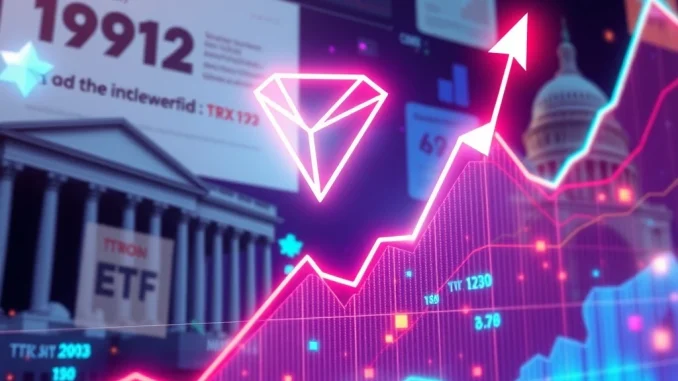
Tron (TRX) has truly reinvigorated its position in the cryptocurrency market, reaching a remarkable yearly high of $0.3344. This surge isn’t coincidental; it’s a culmination of several powerful factors. A major catalyst has been the increasing adoption and trading volumes of Crypto ETFs. These exchange-traded funds have opened new avenues for institutional and retail investors to gain exposure to digital assets without directly holding the cryptocurrencies themselves. This ease of access has funneled substantial capital into the market, benefiting established projects like Tron.
- Institutional Inflow: The approval of various crypto-related ETFs has unlocked a floodgate of institutional capital, eager to diversify portfolios with digital assets. This growing appetite from traditional finance brings significant liquidity and credibility to the crypto space.
- Retail Participation: Spot ETF trading volumes reflect heightened demand from individual investors, indicating growing mainstream acceptance and accessibility of digital assets for everyday traders.
- Market Confidence: The very existence and success of these ETFs signal a maturation of the cryptocurrency market, building confidence among traditional investors who previously shied away from direct crypto investments due to perceived complexity or risk.
Beyond ETFs, favorable legislative developments in the U.S. have played a crucial role. The approval of the GENIUS Act and the progression of anti-CBDC (Central Bank Digital Currency) legislation have been interpreted as significant steps toward regulatory clarity. This clarity is vital for attracting larger institutional players who require a predictable legal framework to operate within. For a platform like Tron, which boasts a $28.13 billion market cap and operates on an energy-efficient proof-of-stake model, such legislative tailwinds are incredibly bullish, potentially unlocking even more institutional capital and fostering wider adoption.
Navigating the Broader Cryptocurrency Market: Where Does Tron (TRX) Fit In?
Tron (TRX)’s recent performance isn’t an isolated event; it aligns perfectly with broader trends observed across the entire cryptocurrency market. We’ve seen major cryptocurrencies like Bitcoin (BTC), Ripple (XRP), and Binance Coin (BNB) also achieve record highs, indicating a robust bullish sentiment that extends beyond just a few assets. This rising tide lifts many boats, but Tron’s unique value proposition allows it to stand out amidst the general market upswing.
Over the past month, TRX has seen an impressive 19% rise, building on a staggering 142% gain since July 2024. While its current price of $0.30 remains 26% below its 2024 peak of $0.4313, analysts remain optimistic about its future trajectory. What makes Tron particularly appealing in this vibrant market environment?
- Operational Scalability: Tron’s architecture is designed for high throughput and low transaction costs, making it an ideal foundation for decentralized applications (dApps) across various sectors, from gaming to decentralized finance.
- Real-World Utility: Unlike many speculative projects, Tron has established a robust ecosystem with practical applications in gaming, entertainment, and decentralized finance (DeFi). This tangible utility provides a strong foundation for its value, moving beyond mere speculation.
- Active Community: On-chain data reveals that over 94% of TRX holders remain active, underscoring a committed and growing participation base. This high level of engagement is crucial for network health, adoption, and sustained development.
This sustained activity and focus on utility differentiate Tron from projects that rely solely on market hype or fleeting trends, positioning it as a long-term player in the evolving digital economy. Its ability to attract and retain users through practical applications is a key strength.
Altcoin Performance: How Does Tron (TRX) Stack Up Against Its Peers?
When we examine the current landscape of altcoin performance, Tron (TRX) presents a compelling case, showcasing distinct advantages over many competitors. Many newer entrants, despite significant presale figures, often struggle with widespread adoption and a lack of established utility. For instance, BlockDAG, while boasting a $350 million presale, is still in its nascent stages regarding practical use cases and ecosystem development, relying heavily on future promises.
In contrast, Tron’s value proposition is firmly anchored in its mature platform and proven real-world applications. It’s not just a promise of future technology; it’s a functioning ecosystem with a track record of delivering. Consider how it compares to some of its notable peers:
| Cryptocurrency | Primary Focus | Tron’s Relative Advantage |
|---|---|---|
| Tron (TRX) | Gaming, Entertainment, DeFi, High Throughput, Content Sharing | Mature ecosystem, proven utility, energy efficiency, large user base. |
| BlockDAG | New Entrant, Scalability, Decentralized Applications | Lacks widespread adoption and established utility compared to Tron’s existing dApp ecosystem. |
| Cardano (ADA) | Scalable, Secure, Sustainable Blockchain Infrastructure, Academic Research | Focuses on long-term infrastructure development; Tron has a more mature and active dApp ecosystem for end-users. |
| Polkadot (DOT) | Interoperability, Multi-chain Framework, Parachains | Excellent for connecting blockchains and enabling cross-chain communication; Tron offers a more developed end-user application layer and direct consumer engagement. |
While projects like Cardano (ADA) and Polkadot (DOT) are crucial for building the foundational infrastructure of the decentralized web, Tron excels in providing a robust, user-friendly platform for applications that directly engage consumers. This focus on practical, everyday use cases gives TRX a distinct edge in attracting and retaining users, translating into consistent demand and bolstering its altcoin performance.
The Future Shaped by US Crypto Legislation: What’s Next for Digital Assets?
The ongoing evolution of US Crypto Legislation is perhaps one of the most critical factors influencing the long-term trajectory of the digital asset space. The recent legislative shifts, such as the GENIUS Act and the push against CBDCs, are not merely bureaucratic formalities; they represent a fundamental shift in how regulators view and interact with cryptocurrencies. These developments signal a move towards greater clarity and potentially, broader acceptance within the traditional financial system.
For Tron (TRX) and the broader cryptocurrency market, clearer regulatory frameworks can:
- Boost Institutional Confidence: Defined rules and regulations reduce uncertainty, making it safer and more attractive for large financial institutions to invest and operate within the crypto space. This influx of capital can significantly stabilize and grow the market.
- Foster Innovation: A predictable regulatory environment encourages developers and entrepreneurs to build new projects and applications, knowing the ground rules. This certainty can lead to a surge in creative and impactful blockchain solutions.
- Enhance Consumer Protection: Well-crafted legislation can protect investors from scams, fraudulent activities, and market manipulation, thereby increasing public trust and encouraging wider participation in digital assets.
- Legitimize the Asset Class: As governments engage more directly with crypto through legislation, it lends legitimacy to digital assets as a recognized and regulated financial instrument, moving them further into the mainstream.
However, the regulatory landscape remains dynamic and subject to change. While current developments are positive, potential future changes or stricter interpretations could still pose challenges. The market’s reaction to these legislative shifts highlights the growing importance of government policy in shaping the future of decentralized technologies. Investors must remain vigilant, as policy decisions can significantly impact asset valuations and market sentiment.
Challenges and Considerations for Tron (TRX)
Despite the current bullish momentum and strong altcoin performance, it’s crucial for investors to remain aware of potential headwinds. The cryptocurrency market is inherently volatile, and Tron (TRX) is not immune to these fluctuations. Here are some key challenges and risks to consider:
- Bitcoin Volatility: A sharp correction in Bitcoin (BTC), which often acts as the market’s benchmark and gravitational pull, could trigger a broader downturn across altcoins, including TRX. Bitcoin’s movements frequently dictate the overall market sentiment.
- ETF Inflow Slowdown: While Crypto ETFs inflows have been a major driver, any significant slowdown or reversal in these trends could dampen market enthusiasm and price appreciation for digital assets. Institutional capital can be fickle and sensitive to broader economic shifts.
- Profit-Taking: After substantial gains, some long-term holders or short-term traders might engage in profit-taking, leading to temporary price pullbacks. This is a natural market cycle, but it can create short-term volatility.
- Regulatory Uncertainties (Founder-Related): Analysts caution that regulatory scrutiny tied to Tron’s founder, Justin Sun, could pose risks. While Tron operates as a decentralized network, the historical association and past regulatory challenges for its founder could introduce unforeseen pressures or reputational concerns.
- Competition: The blockchain space is highly competitive, with new projects constantly emerging. Tron must continue to innovate and expand its ecosystem to maintain its edge against rivals.
Despite these concerns, technical indicators suggest resilience if TRX can maintain key support levels. Its strong community, active development, and real-world utility provide a solid foundation that could help it weather market storms, provided macroeconomic conditions remain favorable and its ecosystem continues to expand.
The Future Outlook for Tron (TRX)
Forecasts for Tron (TRX) vary, reflecting the inherent unpredictability of the cryptocurrency market. Some analysts project a short-term target of $0.3170 by late July 2025, contingent on sustained market momentum and continued positive sentiment driven by factors like Crypto ETFs and favorable US Crypto Legislation. However, long-term outcomes will depend on a broader confluence of factors, including overall crypto sentiment, global macroeconomic conditions, and the continued evolution of regulatory frameworks worldwide.
For investors looking to navigate this dynamic landscape, it’s essential to:
- Monitor Regulatory Developments: Stay informed about new legislation and regulatory stances in major economies, as these can significantly impact market stability and growth.
- Track Adoption Trends: Observe the growth in users, dApp activity, partnerships, and developer engagement within the Tron ecosystem. Real-world adoption is a key indicator of long-term viability.
- Assess Macroeconomic Factors: Global economic stability, inflation rates, interest rate policies, and geopolitical events can all influence investor appetite for risk assets like cryptocurrencies.
- Diversify Portfolios: As with any investment, diversification can help mitigate risks associated with the volatility of individual assets.
The trajectory of Tron, and indeed many altcoins, reflects a broader shift in investor preferences. There’s a growing inclination towards projects that demonstrate tangible utility, consistent innovation, and real-world integration, rather than purely speculative ventures. As institutional adoption continues to accelerate, assets like TRX that can prove their value through practical applications are increasingly poised to outperform and solidify their position in the digital economy.
Conclusion: Tron’s Resurgence Signals a Maturing Market
Tron (TRX)‘s impressive rally to a yearly high is more than just a fleeting moment of success; it’s a powerful testament to the increasing maturity of the cryptocurrency market. Fueled by the robust growth of Crypto ETFs and a more favorable landscape shaped by US Crypto Legislation, Tron’s strong altcoin performance highlights the market’s growing appreciation for projects with real utility and an active ecosystem. While challenges and volatility remain inherent, Tron’s foundational strengths, operational scalability, and strategic positioning within the broader digital asset space suggest a promising path forward. For investors looking for assets with tangible value and long-term potential, Tron (TRX) offers a compelling case in this evolving digital frontier, solidifying its place as a significant player.
Frequently Asked Questions (FAQs)
Q1: What is Tron (TRX) and what are its main uses?
A1: Tron (TRX) is a decentralized blockchain platform founded by Justin Sun. It operates on a proof-of-stake consensus mechanism and is primarily known for its applications in decentralized finance (DeFi), gaming, and entertainment. Its goal is to build a truly decentralized internet and infrastructure for dApps, offering high throughput and low transaction costs.
Q2: How have Crypto ETFs influenced Tron’s recent price surge?
A2: Crypto ETFs (Exchange-Traded Funds) provide an accessible way for institutional and retail investors to gain exposure to cryptocurrencies without directly owning them. The increased adoption and trading volumes of these ETFs have funneled significant capital into the broader crypto market, benefiting assets like Tron (TRX) by boosting overall market liquidity and investor confidence.
Q3: What role does US Crypto Legislation play in the cryptocurrency market?
A3: US Crypto Legislation, such as the GENIUS Act and anti-CBDC bills, aims to provide regulatory clarity for digital assets. This clarity is crucial for attracting institutional investment, fostering innovation, and enhancing consumer protection. Favorable legislation reduces uncertainty, making the market more appealing and stable for both investors and developers, which positively impacts altcoin performance.
Q4: How does Tron’s Altcoin Performance compare to other cryptocurrencies?
A4: Tron (TRX) stands out among altcoins due to its established ecosystem and real-world utility in gaming, entertainment, and DeFi. Unlike some newer, speculative projects that rely on hype, Tron’s value is anchored in its operational scalability and practical applications. While projects like Cardano and Polkadot focus on infrastructure, Tron excels in providing a mature platform for end-user applications.
Q5: What are the potential risks or challenges for Tron (TRX) moving forward?
A5: Key challenges for Tron (TRX) include potential market volatility influenced by Bitcoin corrections, a slowdown in Crypto ETFs inflows, and profit-taking by investors after significant gains. Additionally, regulatory uncertainties, particularly those historically tied to its founder, Justin Sun, could pose risks. However, its strong fundamentals and utility aim to provide resilience.
Q6: What is the long-term outlook for Tron (TRX)?
A6: The long-term outlook for Tron (TRX) is generally optimistic, contingent on continued market momentum, positive macroeconomic conditions, and favorable regulatory developments. Its focus on real-world utility and an active ecosystem positions it well for sustained growth, especially as institutional adoption of utility-driven digital assets accelerates within the broader cryptocurrency market.