The cryptocurrency market is buzzing with anticipation as we approach a pivotal moment: the 2025 Bull Cycle. Every investor, from seasoned veterans to curious newcomers, is on the hunt for the next big altcoin that could deliver substantial returns. Among the myriad of contenders, two projects have emerged as focal points of intense debate: Ondo Finance ($ONDO) and Sei Network ($SEI). This isn’t just a simple rivalry; it’s a strategic clash between two fundamental pillars of the decentralized economy – DeFi and derivatives. So, which one is better positioned to seize the spotlight and potentially achieve significant Altcoin Dominance?
ONDO vs SEI: The Core Rivalry Unpacked
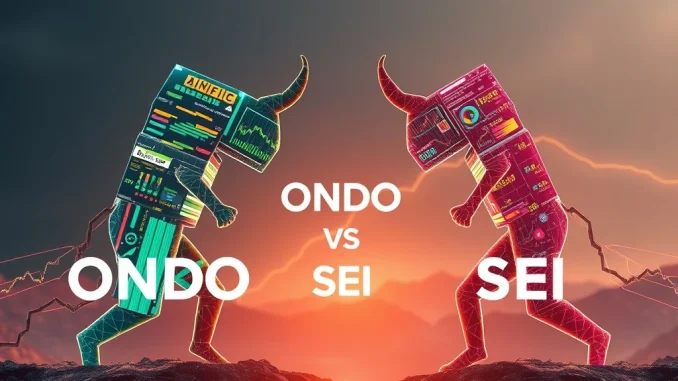
The core of the current market debate revolves around the unique value propositions of Ondo Finance and Sei Network. While both aim to revolutionize finance, they target different segments of the burgeoning crypto ecosystem. A recent comparative analysis, aptly titled ‘ONDO vs SEI Crypto – Best for Altcoin Season 2025!!’, highlights their distinct technological foundations, use cases, and ecosystem growth trajectories. Understanding these differences is crucial for anyone looking to navigate the complex landscape of the upcoming 2025 Bull Cycle.
Ondo Finance ($ONDO) is a prominent player in the DeFi space, particularly focused on bridging traditional finance with decentralized applications through asset-backed tokens and structured yield products. Built on Ethereum’s robust infrastructure, Ondo emphasizes security, compliance, and institutional-grade offerings. Its appeal lies in providing stable, compliant yield generation, attracting a more conservative, yet growing, segment of investors seeking predictable returns in a often-volatile market.
Sei Network ($SEI), on the other hand, is a Layer 1 blockchain specifically optimized for decentralized trading. It positions itself as a direct competitor to networks like Ethereum for high-frequency trading and derivatives. Sei prioritizes ultra-low latency and cost-effective transactions, aiming to solve the congestion and high gas fee issues that plague many existing decentralized exchanges. This focus has made it a magnet for active traders and developers building high-performance trading applications.
The market sentiment for both tokens reflects their specialized niches. $ONDO’s performance is intrinsically linked to broader DeFi adoption and the prevailing interest rate environments in traditional finance, given its focus on real-world assets (RWAs). Conversely, $SEI benefits directly from the surging demand for blockchain-based derivatives and the need for efficient trading infrastructure. Analysts often point to Sei’s innovative order book architecture as a significant technical advantage, poised to catalyze growth in a sector expected to expand exponentially.
Navigating the Path to Altcoin Dominance
The quest for Altcoin Dominance in the next bull cycle isn’t merely about market capitalization; it’s about establishing a sustainable ecosystem, attracting developers, and delivering tangible utility. Both Ondo and Sei are vying for this position, but their strategies diverge significantly. The competition between these two projects perfectly illustrates a broader trend within the altcoin space: the increasing diversification of use cases beyond mere speculation.
For Ondo Finance, the path to dominance involves solidifying its position as a trusted bridge between TradFi and DeFi. Its emphasis on regulatory compliance and structured products appeals to institutional capital, which is increasingly looking for secure entry points into the crypto market. By offering stablecoin issuance and yield aggregation, Ondo caters to risk-averse participants and large-scale investors who prioritize capital preservation alongside returns.
Sei Network’s strategy for dominance centers on becoming the premier blockchain for decentralized trading. By solving critical issues like front-running, high latency, and inefficient order execution, Sei aims to capture a significant share of the global derivatives market. Its focus on cross-chain liquidity and deep integration with trading infrastructure positions it as a vital backbone for the next generation of decentralized exchanges.
While Cardano ($ADA) and other mid-cap altcoins have faced their share of volatility, $ONDO’s resilience in 2025 has been notable, suggesting a growing confidence in its fundamental value proposition. However, for both ONDO and SEI, achieving true Altcoin Dominance will depend on sustained innovation, robust security, and the ability to adapt to a rapidly evolving regulatory landscape.
DeFi Protocols: Ondo’s Strategic Edge
Ondo Finance represents a crucial evolution within DeFi Protocols, moving beyond speculative lending and borrowing to offer more sophisticated, institution-friendly products. Its strategic edge lies in several key areas:
- Real-World Asset (RWA) Integration: Ondo is a leader in tokenizing real-world assets like U.S. Treasuries, making traditional financial instruments accessible on-chain. This opens up new avenues for yield generation and diversification for crypto investors.
- Compliance and Security: Operating within a framework that prioritizes regulatory compliance makes Ondo attractive to institutional players who require robust legal and security assurances before deploying significant capital.
- Yield Aggregation: Ondo simplifies access to various yield opportunities, allowing users to earn returns on stablecoins and other assets with transparent and audited strategies.
- Stablecoin Focus: By offering stablecoin-centric products, Ondo provides a haven for investors seeking stability and predictable returns, especially during periods of market volatility.
This focus positions Ondo not just as another DeFi platform, but as a critical infrastructure layer for the next wave of institutional adoption. Its ability to onboard traditional capital into the decentralized space could be a significant driver of its growth, especially as the crypto market matures and seeks broader integration with the global financial system.
The Rise of Crypto Derivatives: Sei’s Niche
The market for Crypto Derivatives is exploding, and Sei Network is strategically positioned to capture a significant portion of this growth. Derivatives, which include futures, options, and perpetual swaps, allow traders to speculate on the price movements of underlying assets without owning them directly. Sei’s optimized blockchain is designed to cater specifically to the demands of this high-volume, high-frequency trading environment:
- Order Book Architecture: Unlike many AMM-based DEXs, Sei utilizes a central limit order book (CLOB) model, familiar to traditional traders, which enables efficient price discovery and deep liquidity.
- Low Latency and High Throughput: Sei’s custom-built blockchain is engineered for speed, allowing for near-instant transaction finality, which is critical for competitive trading.
- Front-Running Prevention: Its unique Twin-Turbo consensus mechanism helps mitigate front-running, creating a fairer trading environment for all participants.
- Scalability: Designed from the ground up to handle massive trading volumes, Sei aims to provide a robust and reliable platform even during peak market activity.
Sei’s specialization in decentralized trading infrastructure makes it a compelling alternative for traders and developers frustrated by the limitations of general-purpose blockchains. As the demand for sophisticated trading instruments grows, Sei’s tailored approach could see it become the go-to platform for on-chain derivatives, attracting significant liquidity and user adoption.
Forecasting the 2025 Bull Cycle: What’s Next?
As we look ahead to the 2025 Bull Cycle, the trajectories of ONDO and SEI will largely depend on their strategic adaptability and ability to navigate external pressures. Both projects face distinct hurdles:
- Regulatory Scrutiny: For $ONDO, protocols generating yield, especially those involving real-world assets, are likely to face increasing regulatory oversight. Adapting to evolving legal frameworks without compromising decentralization will be key.
- Sustained Scalability: $SEI must demonstrate its ability to maintain low latency and cost-effectiveness under immense real-world trading volumes. Any performance bottlenecks could deter users.
- Macroeconomic Factors: Broader economic conditions, such as U.S. Federal Reserve policies, inflation, and global market stability, will continue to influence all crypto assets, just as they do traditional markets.
To unlock new adoption channels, $ONDO might need to expand beyond Ethereum, integrating with other Layer 1s or Layer 2 solutions to broaden its reach. For $SEI, deepening partnerships with institutional traders and existing DeFi platforms could solidify its position as the preferred hub for decentralized derivatives. The success of both projects will ultimately hinge on execution, user adoption, and their alignment with the evolving demands of the crypto market.
Comparative Overview: ONDO vs SEI
| Feature | Ondo Finance ($ONDO) | Sei Network ($SEI) |
|---|---|---|
| Primary Focus | DeFi, Real-World Assets (RWA), Yield Generation | Decentralized Trading, Crypto Derivatives |
| Underlying Tech | Ethereum-based protocols, Smart Contracts | Custom Layer 1 Blockchain, Optimized for Trading |
| Target Audience | Institutional investors, conservative DeFi users, RWA enthusiasts | Active traders, DeFi developers, high-frequency trading firms |
| Key Value Prop. | Compliant, stable yield, bridging TradFi to DeFi | Low latency, high throughput, fair trading environment |
| Growth Drivers | Institutional adoption of RWA, stablecoin demand, DeFi maturity | Explosion of crypto derivatives, demand for efficient DEXs |
| Main Challenges | Regulatory scrutiny, competition in RWA space | Sustained scalability under load, network effect building |
In conclusion, the ONDO vs SEI debate exemplifies the dynamic and diversifying landscape of crypto value propositions. While both projects offer compelling narratives and cater to distinct, yet crucial, segments of the market, their journey through the 2025 Bull Cycle will be a testament to their ability to innovate, adapt, and deliver on their promises. Investors should carefully consider their risk appetite and investment goals when evaluating these two powerful contenders for future Altcoin Dominance. The coming years promise to be fascinating as DeFi and derivatives continue their rivalry for market leadership.
Frequently Asked Questions (FAQs)
Q1: What is the main difference between Ondo Finance ($ONDO) and Sei Network ($SEI)?
A1: Ondo Finance ($ONDO) focuses on bringing real-world assets (RWAs) and institutional-grade yield products to decentralized finance (DeFi), primarily on Ethereum. Sei Network ($SEI), on the other hand, is a Layer 1 blockchain specifically optimized for high-performance decentralized trading and crypto derivatives, aiming for ultra-low latency and high throughput.
Q2: Why are ONDO and SEI considered key players for the 2025 Bull Cycle?
A2: Both ONDO and SEI are addressing significant growth areas in crypto. Ondo is capitalizing on the increasing demand for compliant, stable yield and RWA integration, attracting institutional capital. Sei is positioned to capture the burgeoning market for crypto derivatives by providing a highly efficient and fair trading environment. Their distinct niches make them strong contenders for significant growth.
Q3: How does Ondo Finance appeal to institutional investors?
A3: Ondo Finance appeals to institutional investors through its emphasis on security, compliance, and the tokenization of real-world assets like U.S. Treasuries. By offering structured products and stable yield opportunities within a regulated framework, it provides a more familiar and less volatile entry point for traditional finance into the DeFi space.
Q4: What technical advantages does Sei Network offer for decentralized trading?
A4: Sei Network offers several technical advantages, including a custom-built Layer 1 blockchain optimized for trading, a central limit order book (CLOB) architecture for efficient price discovery, ultra-low latency transactions, and a unique Twin-Turbo consensus mechanism designed to prevent front-running. These features aim to create a superior decentralized trading experience.
Q5: What are the main challenges facing ONDO and SEI in the coming years?
A5: ONDO faces challenges related to evolving regulatory scrutiny of yield-generating protocols and competition in the RWA space. SEI must prove its sustained scalability under high trading volumes and successfully build a strong network effect. Both are also susceptible to broader macroeconomic factors and overall crypto market sentiment.