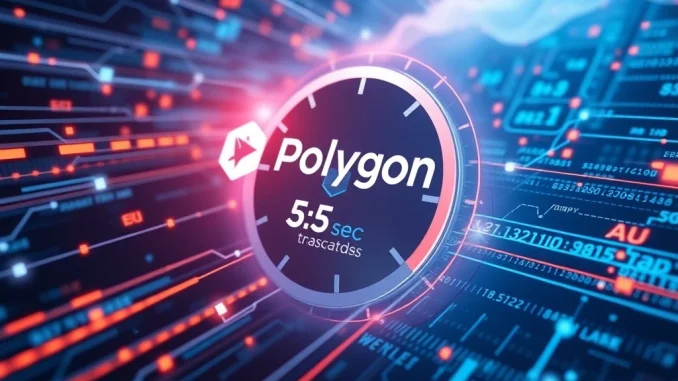
In the fast-paced world of cryptocurrency, speed and efficiency are paramount. Recently, Polygon made a significant stride, dramatically reducing its Polygon transaction finality to an astonishing 5 seconds. This pivotal move, part of the Heimdall 2.0 upgrade, promises to reshape the network’s capabilities and user experience. But how has the market reacted, and what does this mean for the POL price?
The Game-Changing Polygon Upgrade: What’s Under the Hood?
On July 10, 2025, Polygon executed its Heimdall 2.0 upgrade, a monumental architectural overhaul of its Proof-of-Stake (PoS) chain. This wasn’t just a minor tweak; it involved replacing legacy components like Tendermint consensus and Cosmos SDK version 0.37 with cutting-edge CometBFT and Cosmos SDK 0.50. The result? A jaw-dropping reduction in transaction finality from approximately 90 seconds to just 5 seconds.
This enhancement directly addresses critical pain points that have long plagued blockchain networks, such as:
- Slow Confirmation Times: Previously, users had to wait over a minute for transactions to be fully settled. Now, it’s almost instantaneous.
- Systemic Risks in Cross-Chain Operations: Faster finality enhances the security and reliability of assets moving between different blockchain networks.
- Improved dApp Performance: Decentralized applications (dApps) can now operate with much greater responsiveness, offering a smoother user experience.
The update also introduced modular governance for cross-chain validation, bolstering overall security and paving the way for future innovations in modularity and ecosystem expansion. This strategic Polygon upgrade positions the network for institutional-grade scalability, making it more appealing for large-scale enterprise adoption.
Navigating the Market: What’s Happening with the POL Price?
Despite the monumental technical achievements, the market’s immediate reaction to the upgrade has been mixed. As of July 23, the POL price traded at $0.2437, experiencing a nearly 4% dip from the previous day. This pullback follows a robust 30% rally that occurred in early July, likely in anticipation of the upgrade.
Analysts suggest this current price action represents a short-term consolidation rather than a panic sell-off. The price has managed to hold above the key support level of $0.2334. While technical indicators show expanding volatility, the drop has not breached the 20-day simple moving average (SMA) at $0.2213, indicating that the underlying bullish structure remains stable. Such corrections are common after major upgrades, as markets often ‘front-run’ anticipated gains, leading to profit-taking post-event.
Key Price Levels to Watch for POL:
Short-term observers are closely monitoring two critical price levels:
- Rebound Above $0.2334: A sustained move above this level could reignite bullish momentum.
- Breakout Above $0.256: If POL can break and hold above this resistance, it could target higher levels, potentially reaching $0.28 and even $0.32.
Mid-term optimism hinges on continued growth in dApp usage and developer engagement post-upgrade, translating the technical improvements into tangible network activity.
Broader Implications: Enhancing Blockchain Scalability and Utility
The reduction in Polygon transaction finality has profound implications for the network’s overall utility and appeal. Faster finality significantly enhances data reliability for a wide array of applications, including:
- Decentralized Applications (dApps): Real-time interactions and seamless user experiences.
- Oracles: More accurate and timely data feeds for DeFi protocols.
- High-Frequency Trading Systems: Critical for institutional players who demand low-latency infrastructure.
This improved performance could be a magnet for institutional investors seeking secure, rapid settlement capabilities. It strengthens Polygon’s position in burgeoning sectors like real-world assets (RWAs) and cross-chain yield aggregation, where swift and secure settlements are non-negotiable. Ultimately, the long-term trajectory of the POL price will depend on ecosystem adoption metrics, including developer activity and transaction throughput, rather than technical upgrades alone.
Polygon’s Position in the Layer 2 Solutions Landscape
The Heimdall 2.0 upgrade underscores Polygon’s unwavering commitment to competing at the forefront of the blockchain space. By addressing finality—a core metric for blockchain performance—Polygon aims to lower barriers for real-time applications such as DeFi and Web3 gaming. Long-term, these structural improvements could reposition Polygon as a more credible and competitive contender among Layer 2 solutions, challenging rivals like Arbitrum and Optimism.
The network’s strategy involves competing with high-speed blockchains like Solana while meticulously retaining Ethereum’s robust security model. This dual approach of speed and security is a powerful differentiator. However, the price’s response will ultimately reflect broader market sentiment and Polygon’s ability to effectively differentiate itself in an increasingly crowded Layer 2 landscape. Continued innovation and successful implementation of future roadmap items will be key to solidifying its market position and driving sustainable growth for the POL price.
Conclusion: A Bold Step Towards a Faster, More Secure Future
Polygon’s Heimdall 2.0 upgrade marks a significant milestone, dramatically enhancing the network’s speed and reliability by cutting Polygon transaction finality to a mere 5 seconds. While the immediate POL price reaction shows a period of consolidation, the fundamental improvements position Polygon for substantial long-term growth and increased adoption, particularly in institutional and high-frequency use cases. As one of the leading Layer 2 solutions, Polygon continues to innovate, aiming to provide a scalable and secure foundation for the decentralized future. The coming months will reveal how effectively these technical advancements translate into ecosystem expansion and sustained value for POL holders.
Frequently Asked Questions (FAQs)
Q1: What is Polygon’s Heimdall 2.0 upgrade?
A1: Heimdall 2.0 is a major architectural overhaul of Polygon’s PoS chain, executed on July 10, 2025. It replaced older components with CometBFT and Cosmos SDK 0.50, significantly enhancing the network’s performance and security.
Q2: How has the Polygon upgrade impacted transaction finality?
A2: The upgrade drastically reduced transaction finality from approximately 90 seconds to just 5 seconds, making transactions on the Polygon network nearly instantaneous.
Q3: Why did the POL price fall after such a significant upgrade?
A3: The POL price experienced a short-term pullback of about 4% following the upgrade. This is often due to ‘buy the rumor, sell the news’ market behavior, where investors take profits after anticipating an event. Analysts view it as consolidation rather than panic selling, as the price remains above key support levels.
Q4: What are the main benefits of 5-second transaction finality for Polygon?
A4: Faster finality improves data reliability for dApps, oracles, and high-frequency trading. It enhances Polygon’s appeal to institutional investors, boosts performance for real-time applications like DeFi and Web3 gaming, and strengthens cross-chain operations.
Q5: How does this upgrade position Polygon among other Layer 2 solutions?
A5: By dramatically improving finality, the upgrade strengthens Polygon’s competitive edge against other Layer 2 solutions like Arbitrum and Optimism. It allows Polygon to offer high-speed transactions while maintaining Ethereum’s security, attracting a broader range of developers and users.