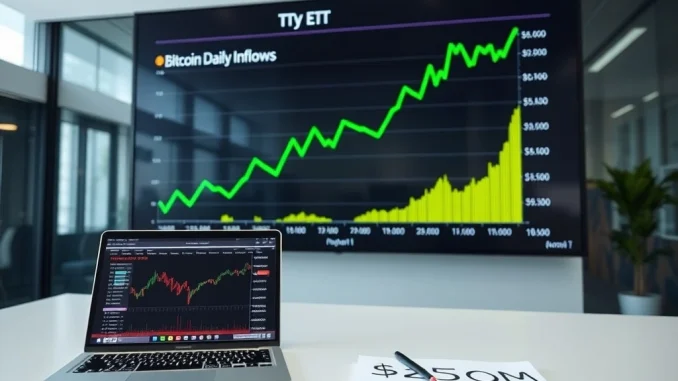
Bitcoin ETFs Shatter Expectations with $250M Inflow Surge, Biggest Since February
Global Financial Markets, April 2025: The market for spot Bitcoin exchange-traded funds (ETFs) has recorded a seismic shift in sentiment, with daily net inflows surging past $250 million. This powerful influx marks the most significant single-day capital commitment since early February, suggesting a pivotal moment of renewed institutional accumulation as Bitcoin’s price consolidates below its recent record highs. The data provides a clear, quantifiable signal of returning confidence in the flagship cryptocurrency’s long-term value proposition through regulated investment vehicles.
Bitcoin ETFs Experience a Landmark $250 Million Inflow Day
Data from fund issuers and custodians confirms that U.S.-listed spot Bitcoin ETFs collectively attracted over a quarter of a billion dollars in net new capital on a single trading day this week. This substantial figure represents the highest daily inflow recorded in over two months, breaking a period of relative stability and occasional outflows that characterized much of March. Analysts immediately scrutinized the timing, noting it coincides with a Bitcoin trading range approximately 15-20% below its mid-March all-time high. The sheer volume of the inflow indicates that a broad array of investors—from registered investment advisors to hedge funds—are interpreting the current price level as a strategic entry point within a longer-term bullish thesis.
Analyzing the Surge in Cryptocurrency ETF Investment
The resurgence of capital into Bitcoin ETFs is not an isolated event but fits within a broader narrative of institutional adoption. To understand the scale, consider the following comparative data for prominent fund flows in recent history:
| Event Period | Approximate Net Inflow | Market Context |
|---|---|---|
| Early February 2025 | $300M (Single Day Peak) | Post-approval momentum, rising price |
| Late March 2025 | Net Outflows / Neutral | Price consolidation, profit-taking |
| Current Surge (April 2025) | $250M+ (Single Day) | Price below highs, perceived accumulation zone |
This pattern suggests a maturation in investor behavior. The initial flows in January and February were driven by novelty and momentum. Current flows, however, appear more strategic, demonstrating a “buy-the-dip” mentality that is common in traditional equity markets but is now being visibly applied to digital asset exposure. The mechanics are straightforward: investors purchase shares of the ETF, the issuer uses that cash to buy the underlying Bitcoin, and the assets are held in secure, third-party custody—a process that creates direct, measurable buying pressure on the Bitcoin network.
Contextualizing the Inflow Within Broader Market Dynamics
The significance of this $250 million inflow extends beyond the headline number. First, it occurred without a concomitant dramatic price spike, indicating the buying was absorbed efficiently by the market—a sign of deepening liquidity. Second, it reverses a recent trend where flows into newer ETFs were often offset by minor outflows from the pioneering Grayscale Bitcoin Trust (GBTC). Early data suggests this latest surge saw positive contributions across multiple funds, signaling broad-based demand rather than a rotation between products. This collective action points to a foundational shift where Bitcoin ETFs are increasingly treated as a standard portfolio allocation, with flows responding to macroeconomic indicators, relative asset performance, and technical price levels, much like gold or broad-market ETFs.
The Institutional Perspective on Current Bitcoin Valuation
Market strategists point to several converging factors that likely catalyzed this substantial inflow. The dominant theme is valuation. With Bitcoin retreating from its highs, institutional models that track metrics like the Mayer Multiple (price relative to its 200-day moving average) or realized price (the average price at which all coins last moved) may have flashed a relative value signal. Furthermore, the macroeconomic backdrop of persistent inflation concerns and geopolitical uncertainty continues to fuel interest in hard, non-sovereign assets. For portfolio managers who have received approval to allocate to crypto but missed the initial ETF launch, this price pullback presented a disciplined entry opportunity, executed at scale through the familiar, regulated ETF wrapper.
The flow of capital also reflects growing comfort with the operational and regulatory framework surrounding these products. Key developments contributing to this confidence include:
- Clear Custody and Audit Trails: Monthly attestations from auditors like Coinbase provide transparent proof of reserves.
- Robust Trading Volumes: Daily trading volumes for major Bitcoin ETFs regularly exceed $1.5 billion, ensuring tight bid-ask spreads and easy entry/exit.
- Regulatory Scrutiny: Ongoing oversight by the SEC, while rigorous, has provided a framework that mitigates existential risk for large allocators.
Conclusion
The landmark $250 million daily inflow into Bitcoin ETFs serves as a powerful barometer of institutional sentiment. It demonstrates that demand for regulated Bitcoin exposure remains potent, particularly when prices trade at a discount to recent peaks. This event is less about short-term speculation and more about strategic, volume-driven accumulation, reinforcing the thesis that Bitcoin and its associated financial products are becoming integrated into the global institutional portfolio toolkit. As the market continues to evolve, these flow metrics will remain a critical, transparent indicator of how professional capital engages with the digital asset ecosystem.
FAQs
Q1: What does a $250 million inflow into Bitcoin ETFs actually mean?
A1: It means investors purchased a net $250 million worth of shares in Bitcoin ETFs on that day. The ETF issuers then use that cash to buy an equivalent amount of actual Bitcoin, which is held in custody. This creates direct buying pressure in the Bitcoin market.
Q2: Why is this the largest inflow since early February?
A2: Initial frenzy after the January ETF approvals led to huge inflows. Activity then normalized. This new surge suggests a second wave of institutional buying, potentially triggered by Bitcoin’s price trading at a level deemed attractive for accumulation.
Q3: Do these inflows guarantee the Bitcoin price will rise?
A3: Not directly or immediately. While sustained buying pressure is a positive fundamental factor, price is influenced by many variables including broader market sentiment, macroeconomic news, and selling activity from other market participants.
Q4: Who is most likely responsible for these large inflows?
A4: While precise breakdowns are delayed, such large, concentrated flows typically originate from institutional players like hedge funds, asset managers, registered investment advisors (RIAs), and possibly corporate treasuries executing planned allocation strategies.
Q5: How does this impact the average cryptocurrency investor?
A5: It validates the investment thesis for Bitcoin as an institutional-grade asset. Large, steady inflows can improve market liquidity and stability over time. It also provides a transparent, publicly trackable metric for gauging professional market sentiment alongside price action.
Related: Bitcoin Neo-Bank Breakthrough: Core's SatPay Aims to Redefine BTC Financial Infrastructure
Related: UK FCA Stablecoins: Regulator Reveals Four Firms for Critical Sandbox Testing Before 2027 Rules
Related: $SHOLA Token Launch: Shola's Strategic Collaboration with Pump.fun on Solana