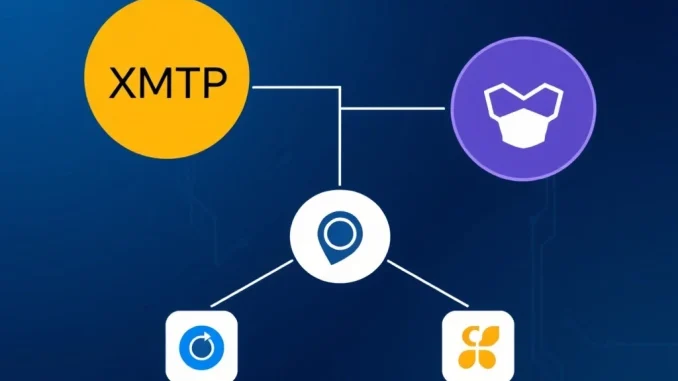
Secure Messaging Breakthrough: XMTP and Mask Network Partner to Standardize Communication Across Lens, Orb, and Firefly
Global, May 2025: A significant partnership aims to reshape how users communicate across the decentralized web. The secure messaging protocol XMTP and the Web3 social tooling provider Mask Network have announced a strategic collaboration. Their goal is to standardize and enhance private, decentralized messaging across three major social ecosystems: Lens Protocol, Orb, and Firefly. This move directly addresses one of Web3’s most persistent challenges—fragmented and insecure communication—by building a foundational layer for interoperability and user privacy.
Decoding the Partnership: XMTP and Mask Network’s Secure Messaging Mission
The collaboration between XMTP (Extensible Message Transport Protocol) and Mask Network represents a technical and philosophical alignment. XMTP provides the underlying infrastructure for secure, blockchain-based messaging. It functions as an open protocol and network, allowing wallets and applications to exchange encrypted messages without relying on centralized servers. Mask Network, historically known for bridging Web2 social media like Twitter with Web3 functionalities, brings deep integration expertise and a large user base seeking privacy-focused social tools.
This partnership is not merely an integration but an effort to establish a common standard. By working together, the teams intend to ensure that secure messaging features are not just available but are consistent, reliable, and user-friendly across different platforms. The immediate targets are three prominent players in the decentralized social landscape. Lens Protocol is a composable social graph, Orb is a decentralized social media client built on Lens, and Firefly is a lightweight social aggregator. Standardizing messaging across these distinct but related applications could dramatically reduce user friction and enhance network effects within Web3.
The Technical Foundation and Web3 Communication Challenges
Prior to this initiative, secure communication in Web3 often existed in silos. Users might have one messaging experience within a specific wallet, a different one on a social platform, and no communication at all with users on another chain or application. This fragmentation hindered adoption and forced users back to traditional Web2 platforms for coherent conversations. The XMTP protocol was designed to solve this by using decentralized identifiers (DIDs) and storing encrypted message content on a peer-to-peer network, with message delivery receipts stored on a blockchain for verifiability.
Mask Network’s role involves building the user-facing interfaces and seamless integrations that make this protocol accessible. Their experience in creating browser extensions and application plugins that overlay Web3 features onto existing platforms is crucial. The technical workflow for this partnership likely involves:
- Protocol Integration: Embedding XMTP’s SDKs directly into the Lens, Orb, and Firefly applications.
- Key Management: Leveraging existing user wallet keys (like those from MetaMask or Phantom) for message encryption and authentication, eliminating the need for separate logins.
- Interoperability Layer: Creating a shared inbox or notification system that can work across all three platforms, so a message sent from an Orb user can be read by a Firefly user.
This approach tackles the core issues of identity, access, and cross-platform functionality that have plagued decentralized communication.
The Historical Context of Messaging in Decentralized Ecosystems
The quest for decentralized messaging is not new. Early blockchain projects like Bitmessage emerged over a decade ago, but they struggled with usability and scalability. The rise of decentralized finance (DeFi) highlighted the need for secure wallet-to-wallet communication for transaction verification and coordination. Later, the growth of NFTs and decentralized autonomous organizations (DAOs) created urgent demand for group chats and announcement channels that were resistant to censorship and platform shutdowns.
Protocols like XMTP and Waku (used by Status) have evolved to meet these needs, but adoption has been piecemeal. The partnership with Mask Network signals a shift from building isolated tools to fostering a cohesive communication layer. It mirrors the historical development of SMTP for email—a standardized protocol that allowed different email clients and servers to interoperate, which was fundamental to the internet’s growth. This partnership aims to be the SMTP moment for Web3 social interaction.
Implications for Privacy, Interoperability, and User Experience
The implications of a standardized secure messaging layer are profound for the average Web3 user and developer alike. For users, the primary benefits are enhanced privacy and a unified experience. Messages are end-to-end encrypted by default, with keys controlled solely by the user’s wallet. This means no central entity can read, block, or data-mine conversations. Furthermore, a user’s social identity and conversations become portable. If a user switches from the Orb app to the Firefly app, their message history and contacts could, in principle, move with them.
For developers building on Lens, Orb, or Firefly, this partnership provides a ready-made, robust communication module. Instead of each team building its own secure messaging system—a complex and security-sensitive undertaking—they can integrate the standardized XMTP-Mask solution. This reduces development overhead, accelerates time-to-market for new features, and ensures a higher security standard. It also encourages innovation, as developers can focus on building unique social features atop a reliable communication base.
The table below outlines the core value propositions for different stakeholders:
| Stakeholder | Core Benefit | Practical Outcome |
|---|---|---|
| End User | Privacy & Portability | Ownership of conversation history; seamless chat across apps. |
| App Developer (Lens/Orb/Firefly) | Reduced Complexity & Security | Plug-and-play messaging; no need to manage encryption keys. |
| Web3 Ecosystem | Interoperability & Network Effects | Reduced fragmentation; stronger collective user base. |
Conclusion: A Foundational Step for the Social Web3 Stack
The partnership between XMTP and Mask Network to standardize secure messaging across Lens, Orb, and Firefly is a pivotal development. It moves beyond announcing a feature to architecting a foundational utility for the decentralized social web. By addressing the critical trifecta of security, interoperability, and usability, this collaboration has the potential to significantly lower the barriers to mainstream adoption of Web3 social platforms. If successful, it will demonstrate that decentralized applications can provide a user experience that rivals centralized counterparts, while fundamentally returning data ownership and privacy to the individual. The evolution of secure messaging is no longer just a technical novelty but a necessary infrastructure for the next generation of the internet.
FAQs
Q1: What is XMTP?
XMTP (Extensible Message Transport Protocol) is an open-source protocol and network for secure, private, and interoperable messaging built for Web3. It allows applications to send encrypted messages between blockchain-based identities, such as wallet addresses.
Q2: What does Mask Network do?
Mask Network is a platform that builds bridges between Web2 and Web3. It is best known for its browser extension that lets users interact with decentralized apps, send encrypted messages, and use cryptocurrencies directly on traditional social media sites like X (formerly Twitter).
Q3: How will this partnership benefit users of Lens, Orb, and Firefly?
Users will gain access to a consistent, secure, and private messaging experience across all three platforms. They will be able to message each other regardless of which specific app they are using, with conversations secured by their own wallet keys.
Q4: Is this messaging truly private and decentralized?
Yes, based on the XMTP protocol’s design. Messages are end-to-end encrypted, and the network is peer-to-peer. No central server holds the decryption keys or has full access to message content, aligning with Web3 principles of user sovereignty.
Q5: Does this mean I need a specific wallet to use this messaging?
You will likely need a compatible Web3 wallet (such as MetaMask, Rainbow, or Phantom) that holds the cryptographic keys used for your identity and message encryption. The partnership aims to make the wallet the single sign-on for both identity and communication.
Related News
- Urgent Warning: CZ Predicts AI Job Disruption, Positions Crypto as Critical Financial Hedge
- Unlocking Growth: Bullish's Monumental $629M U.S. IPO Amidst Favorable Crypto Landscape
- Bitcoin Price Plummets: BTC Falls Below $83,000 in Sudden Market Shift
Related: Decentralized by Design: Why Ripple Made the XRP Ledger Impossible to Control
Related: Bitcoin Surge Faces Critical Test as Schiff Warns of Trump Speech Fallout
Related: Crypto Market Recovery: A 2.95% Gain Clashes with Persistent Extreme Fear