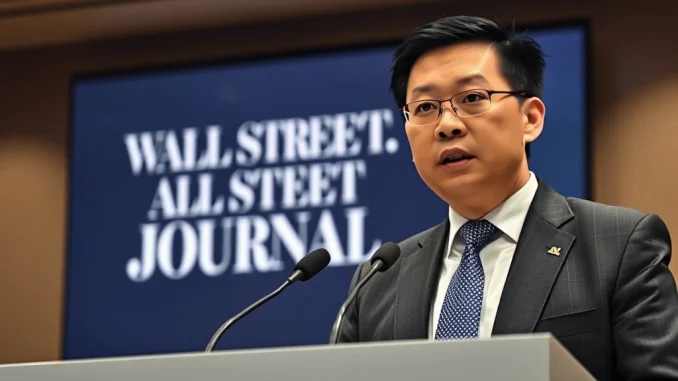
Binance CEO Richard Teng Blasts WSJ Over ‘Defamatory’ Compliance Allegations
Singapore, March 2025: In a forceful and detailed rebuttal, Binance CEO Richard Teng has publicly challenged a Wall Street Journal report alleging compliance failures at the world’s largest cryptocurrency exchange. The executive labeled the publication’s claims as “defamatory and inaccurate,” specifically denying reports that the company fired staff over sanctions-related cases. This confrontation marks a significant escalation in the ongoing narrative surrounding regulatory oversight in the digital asset industry and places Binance’s extensive compliance apparatus under a global spotlight.
Binance CEO Richard Teng Issues Point-by-Point Rebuttal to WSJ
Richard Teng, who assumed the role of Binance’s CEO in late 2023, took the unusual step of addressing the media allegations directly and publicly. In his response, he systematically contested the core assertions of the Wall Street Journal’s report. The central point of contention revolves around personnel decisions linked to sanctions enforcement. Teng stated unequivocally that Binance did not terminate employees for raising concerns about sanctions compliance. Instead, he framed any staff changes as part of normal organizational evolution and a continuous effort to strengthen the company’s global compliance framework. This direct engagement from the top leadership signals Binance’s strategy to actively manage its regulatory reputation in a post-settlement era.
Quantifying Compliance Progress: A 97% Reduction in Exposure
Beyond the denials, Teng’s rebuttal was anchored by a significant data point offered as evidence of the exchange’s improved controls. He revealed that Binance’s compliance exposure to Iranian exchanges plummeted by 97% between January 2024 and January 2026. This metric, likely referring to transaction volumes, user interactions, or risk-weighted exposure, is presented as a tangible outcome of the company’s enhanced monitoring and blocking mechanisms. To contextualize this improvement, the period follows Binance’s landmark $4.3 billion settlement with U.S. authorities in late 2023, which mandated a complete overhaul of its sanctions compliance program under the supervision of an independent monitor.
- Pre-Settlement Landscape: Prior to 2024, cryptocurrency exchanges globally faced challenges in perfectly filtering geographically restricted users due to the pseudo-anonymous nature of blockchain transactions.
- Post-Settlement Overhaul: The settlement required Binance to exit the U.S. market entirely via a spun-off entity (Binance.US) and implement world-class, real-time transaction monitoring for its global platform.
- Industry Benchmark: A 97% reduction suggests a aggressive application of geofencing technology, know-your-customer (KYC) checks, and blockchain analytics tools to identify and shut off access.
The Scale of Binance’s Compliance Machinery
A key pillar of Teng’s defense is the sheer scale of Binance’s investment in compliance personnel. He emphasized that the company maintains a team of over 1,500 employees dedicated solely to compliance and regulatory functions. This figure is critical for perspective. For comparison, traditional global financial institutions of similar user scale might employ thousands in compliance, but for a tech-native company like Binance, this represents a substantial operational cost center deliberately built to navigate complex international regulations. These teams are tasked with sanctions screening, anti-money laundering (AML) monitoring, KYC verification, and liaising with regulators across hundreds of jurisdictions.
Historical Context and the Road to Regulatory Reconciliation
The current dispute cannot be separated from Binance’s recent history. The company’s rapid growth under founder Changpeng Zhao was often accompanied by criticism regarding its regulatory approach. The 2023 settlement with the U.S. Department of Justice, Commodity Futures Trading Commission (CFTC), and Treasury’s Financial Crimes Enforcement Network (FinCEN) was a watershed moment. It included guilty pleas to charges related to anti-money laundering and sanctions violations. Part of the agreement was the appointment of Richard Teng, a former regulator from Abu Dhabi and Singapore, as CEO, signaling a clear pivot toward a compliance-first leadership model. Teng’s public clash with the WSJ is, in part, an effort to demonstrate this new chapter and assert that the company is being judged by its past rather than its present capabilities.
Implications for the Cryptocurrency Industry and Media Scrutiny
This public dispute has broader implications beyond Binance. It highlights the intense and ongoing scrutiny that major cryptocurrency entities face from both regulators and the traditional financial press. For the industry, Binance’s case serves as a high-profile example of the costly and complex journey toward mainstream regulatory acceptance. The resources required to maintain a 1,500-person compliance team and achieve a 97% reduction in specific risk exposures set a new benchmark for operational scale in the sector. For financial journalism, the incident underscores the challenges of reporting on technically complex and rapidly evolving industries, where internal compliance data is often opaque and claims are difficult for external parties to independently verify.
Conclusion
The confrontation between Binance CEO Richard Teng and the Wall Street Journal represents a critical moment in the narrative of cryptocurrency regulation. Teng’s detailed rebuttal, supported by specific metrics like the 97% exposure reduction and the scale of the compliance workforce, is a strategic move to publicly defend the exchange’s post-settlement transformation. While the veracity of the specific allegations will continue to be debated, the response unequivocally signals that Binance intends to aggressively contest narratives it views as inaccurate and to position itself as an entity committed to robust, global compliance standards. The outcome of this reputational battle will significantly influence stakeholder confidence and the regulatory dialogue surrounding the entire digital asset ecosystem.
FAQs
Q1: What exactly did the Wall Street Journal report allege about Binance?
The WSJ report, as referenced by Richard Teng, alleged compliance failures at Binance, including that the company had fired staff who raised concerns about sanctions-related cases. Teng has called these claims defamatory and inaccurate.
Q2: What is the significance of the 97% reduction figure cited by Richard Teng?
Teng stated that Binance’s compliance exposure to Iranian exchanges dropped by 97% from January 2024 to January 2026. This metric is presented as key evidence of the dramatic improvement and effectiveness of the exchange’s enhanced sanctions screening and geofencing controls implemented after its 2023 settlement with U.S. authorities.
Q3: How large is Binance’s compliance team?
According to CEO Richard Teng, Binance employs over 1,500 people focused specifically on compliance and regulatory functions. This sizable investment is central to the company’s argument that it operates a robust, global oversight program.
Q4: Why is Richard Teng’s background relevant to this story?
Richard Teng is a former financial services regulator from Singapore and Abu Dhabi. His appointment as Binance CEO in late 2023 was a direct result of the company’s settlement with U.S. agencies and was intended to signal a new era of compliance-focused leadership, making his personal defense of the company’s practices particularly noteworthy.
Q5: What was the 2023 settlement between Binance and U.S. authorities?
In November 2023, Binance agreed to a $4.3 billion settlement with the U.S. Department of Justice, CFTC, and FinCEN. The company pleaded guilty to charges related to anti-money laundering and sanctions violations. The agreement required leadership changes, the exit from the U.S. market, and the implementation of a stringent independent compliance monitorship for several years.
Related News
- CoinPulseHQ Unveils Strategic Weekly Coverage Schedule for Essential Cryptocurrency News
- Bitcoin Dollar Hedge: JPMorgan's Revealing Analysis Shows Market Skepticism
- Mt. Gox Is Far From Done With Distributing Bitcoin, Here’s How Much BTC Is Left
Related: Cardano Price Prediction: Analyzing ADA's Trajectory Amid Evolving Tech and Policy
Related: Nexo's Remarkable 52% Repeat Borrower Rate Signals Crypto Lending Surge
Related: Nigeria's 2026 Tax Laws: Bitcoin Holders Face Stiff 25% Capital Gains Levy