BlockDAG Presale Final Hours: Analyzing Market Shifts as BNB and Ethereum Prices Test Support
Global, May 2025: The cryptocurrency market enters a period of heightened scrutiny as two major assets, BNB and Ethereum, experience significant price movements, testing key technical support levels. Concurrently, the presale for BlockDAG, a project utilizing a Directed Acyclic Graph (DAG) structure, enters its final phase at a price of $0.00125 per token. This convergence of events provides a relevant case study in contemporary market dynamics, contrasting established platform tokens with emerging layer-1 architectures.
Current Cryptocurrency Market Conditions and Support Levels
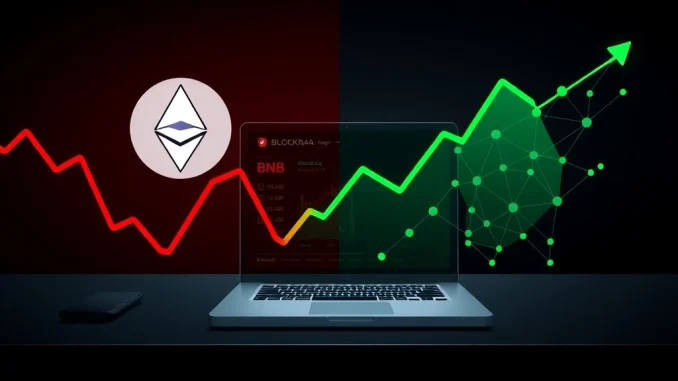
Market analysts observe a cautious tone across digital asset exchanges. The price of BNB, the native token of the BNB Chain ecosystem, has declined below a previously established support zone near the $550 mark. Similarly, Ethereum (ETH), the second-largest cryptocurrency by market capitalization, has broken below its short-term support level around $3,200. These movements often trigger technical analysis reviews and can influence short-term trader sentiment. It is critical to contextualize these shifts within broader macroeconomic factors, including interest rate expectations and institutional capital flows, which have historically impacted asset volatility.
Breaking a support level does not inherently predict long-term direction but signals a shift in the immediate supply-demand balance. For platform tokens like BNB and ETH, their value is intrinsically linked to network utility—transaction volume, decentralized application (dApp) activity, and staking yields. Recent on-chain data shows varied activity; while some sectors like decentralized finance (DeFi) see consolidation, others like real-world asset (RWA) tokenization continue gradual growth. This creates a complex fundamental picture beyond simple price charts.
The BlockDAG Presale and Project Fundamentals
Amid this market activity, the BlockDAG network is concluding its presale event. The project proposes an alternative to traditional linear blockchains by implementing a DAG-based structure. In theory, this architecture allows for multiple blocks to be added to the chain simultaneously, potentially addressing scalability limitations known as the “blockchain trilemma”—balancing decentralization, security, and scalability. The final presale price is set at $0.00125.
Presale events are common fundraising mechanisms in the cryptocurrency sector, allowing projects to secure capital for development before a public token listing. Investors participate with the expectation of future network adoption and utility. For any presale, thorough due diligence is paramount. Key factors for evaluation include:
- Technical Whitepaper: Clarity of the proposed protocol, consensus mechanism, and roadmap.
- Development Team: Public experience and track record in software engineering and cryptography.
- Problem Statement: A clear definition of the scalability or efficiency issue the project aims to solve.
- Tokenomics: The total supply, distribution schedule, and intended utility of the native token within its ecosystem.
BlockDAG enters a competitive landscape of layer-1 and layer-2 scaling solutions, including established networks and other DAG-based projects like Hedera and Fantom. Its success will depend on developer adoption, transaction finality speed, and overall network security post-launch.
Understanding Directed Acyclic Graph (DAG) Technology
To comprehend the proposed value of BlockDAG, one must understand the basic principles of DAG architecture. Unlike a traditional blockchain, which orders transactions in sequential, time-stamped blocks, a DAG structures transactions as a graph where each new transaction validates previous ones. Imagine a tree with multiple branches growing simultaneously rather than a single chain of links.
Proponents argue this allows for higher throughput (transactions per second) and lower fees. However, the model presents distinct challenges, particularly in achieving robust consensus and preventing network spam without fees. The evolution of DAG technology demonstrates the industry’s ongoing research into next-generation distributed ledgers beyond the original blockchain design pioneered by Bitcoin.
Comparative Analysis: Market Phases and Investor Considerations
The current market presents a study in contrasts: the price discovery of large-cap, utility-driven assets versus the speculative phase of a pre-launch network. These are fundamentally different risk and time-horizon profiles. Established assets like BNB and Ethereum have extensive histories, vast ecosystems, and correlated relationships with broader crypto market cycles. Their price movements are analyzed through metrics like network revenue, active addresses, and protocol treasury health.
In contrast, pre-launch projects like BlockDAG represent early-stage venture risk. Their valuation at this stage is not based on operational metrics but on the perceived potential of their technology and team’s execution capability. Market participants often diversify across asset classes and development stages to manage portfolio risk. The following table outlines key differentiating factors:
| Factor | Established Platform Tokens (e.g., BNB, ETH) | Pre-Launch Network (e.g., BlockDAG Presale) |
|---|---|---|
| Primary Value Driver | Existing network utility, fee revenue, staking yield | Technological promise and future adoption potential |
| Data Availability | Years of on-chain and price history, analyst coverage | Whitepaper, team background, roadmap milestones |
| Liquidity Profile | High, on major global exchanges | Low to none until public listing post-presale |
| Risk Category | Market & systemic risk | Technical execution & adoption risk |
Investors pivoting or allocating between such assets are not merely reacting to price but to a calculated assessment of risk tolerance, investment thesis, and the specific technological narratives they believe will shape the next market cycle.
Conclusion: A Landscape Defined by Innovation and Volatility
The cryptocurrency market remains a dynamic arena where technical price movements for major assets like BNB and Ethereum coincide with the fundraising cycles of nascent projects like BlockDAG. The break of support levels for established tokens reflects ongoing macroeconomic and sector-specific recalibrations. Simultaneously, the final phase of the BlockDAG presale highlights the continuous market appetite for innovative scalability solutions. Informed participation in this space requires separating observable on-chain data and project fundamentals from speculative narratives. As the industry matures, the interplay between incumbent platforms and emerging architectures like DAG will be a critical narrative, ultimately driving the evolution of decentralized technology and its applications.
FAQs
Q1: What does it mean when a cryptocurrency price “breaks support”?
A1: In technical analysis, a “support level” is a price point where an asset has historically found buying interest, preventing it from falling further. A break below this level suggests selling pressure has overcome buying demand at that price, which some traders interpret as a bearish signal for the short term. It is one indicator among many and does not guarantee future price direction.
Q2: What is a Directed Acyclic Graph (DAG) in blockchain technology?
A2: A Directed Acyclic Graph (DAG) is a data structure different from a linear blockchain. Instead of blocks in a single chain, transactions are linked in a graph where each new transaction references and validates multiple previous ones. This aims to allow parallel processing, potentially increasing transaction speed and scalability compared to some traditional blockchains.
Q3: What are the key risks associated with participating in a cryptocurrency presale?
A3: Presale investments carry significant risks, including the potential for total loss. Key risks include project failure (the team may not deliver the promised technology), lack of liquidity (you cannot sell the tokens until they list on an exchange, if ever), regulatory uncertainty, and the possibility of smart contract vulnerabilities or scams.
Q4: How do the value propositions of BNB and Ethereum differ from a new project like BlockDAG?
A4: BNB and Ethereum derive value from extensive, active ecosystems. BNB is used to pay fees on the BNB Chain, while ETH is used for fees and staking on Ethereum. Their value is tied to current usage. A new project like BlockDAG’s value proposition is based entirely on its future potential to solve scalability issues and attract developers and users, which is unproven at the presale stage.
Q5: Where can investors find reliable information to evaluate projects like BlockDAG?
A5: Investors should consult primary sources first: the project’s official whitepaper, GitHub repository for code activity, and audits from reputable security firms. Secondary research can include analyses from diverse, credible crypto research platforms and comparing the project’s claims against existing solutions. Always be wary of information from purely promotional channels.
Related News
- Crypto Market Cycle: Unlocking the Institutional Drive for the Next Mania
- Next Crypto to Explode: Analyzing Capital Rotation Signals After Multicoin Leadership Shift
- Dough Finance Hack: Users Devastated by $2.5M Loss and Crypto Lawsuit Against Founders
Related: Decred (DCR) Leads Top Gainers: A Deep Dive into the Resilience of Privacy and Utility Tokens
Related: Binance CEO Richard Teng Blasts WSJ Over 'Defamatory' Compliance Allegations
Related: Hedera AccountBalanceQuery Deprecation: The Critical Developer Migration Guide