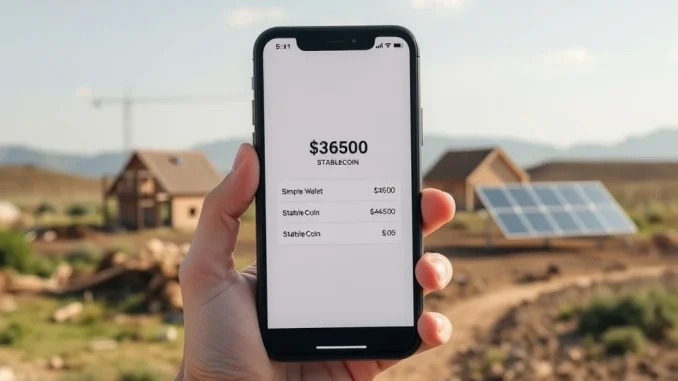
Stablecoin Plan: Board of Peace Proposes Digital Currency for Gaza’s Postwar Future
Washington D.C., March 2025: A novel proposal to utilize digital currency for humanitarian and economic stabilization is gaining serious attention. The Board of Peace, an advisory body, is actively studying the creation of a dedicated stablecoin to facilitate the rebuilding of the postwar Gaza economy. This initiative, part of a broader $17 billion pledged framework for reconstruction and digital infrastructure, represents a significant exploration of blockchain technology in complex geopolitical recovery efforts. The plan aims to provide a secure, transparent medium of exchange for citizens and aid organizations, potentially circumventing traditional banking hurdles in a devastated financial landscape.
Stablecoin Proposal for Gaza’s Economic Rebuilding
The core of the Board of Peace’s investigation centers on a bespoke stablecoin—a cryptocurrency pegged to a stable asset like the US dollar. According to initial reports, this digital tool is conceived not as a speculative asset but as a pragmatic utility. Its primary function would be to enable citizens, merchants, and aid groups to exchange goods and services without relying solely on physical cash, which can be scarce, unsafe to transport, and difficult to audit in large-scale aid operations. The proposal emerges amidst staggering humanitarian needs and a near-total collapse of Gaza’s physical and financial infrastructure following prolonged conflict. Proponents argue a digitally-native currency could leapfrog broken systems, offering immediate accountability for aid funds and a foundation for a future digital economy.
The $17 Billion Pledge and Digital Infrastructure Framework
The stablecoin concept is embedded within a larger, multi-billion dollar commitment. The $17 billion figure, cited in early deliberations, is earmarked for a dual purpose: immediate humanitarian relief and the long-term construction of a modern digital infrastructure. This infrastructure is considered a prerequisite for any digital currency system. Key components under review include establishing reliable internet connectivity, deploying secure digital identity solutions for residents, and creating the regulatory and technical scaffolding to issue and manage the stablecoin. Analysts note that without these foundational elements, a digital currency could fail or become exclusionary. The board’s study reportedly involves consultations with fintech experts, blockchain developers, and humanitarian logistics specialists to assess feasibility.
Historical Context and Precedents in Crisis Finance
The use of alternative currencies in crisis zones is not without precedent. In conflict-ridden regions, communities have historically relied on barter, foreign currencies, or mobile money solutions like M-Pesa in East Africa. However, a sovereign-aligned stablecoin for postwar reconstruction would be a pioneering experiment. It draws lessons from both the success of digital humanitarian aid delivery in Ukraine and the challenges faced by central bank digital currency (CBDC) projects worldwide. The critical differentiator for Gaza would be starting from a near-zero baseline, requiring an integrated approach that builds the network and the currency concurrently. This presents immense technical and governance challenges but also a unique opportunity to design an inclusive system from the ground up.
Potential Benefits and Inherent Challenges
The proposed stablecoin system offers several potential advantages for a rebuilding Gaza. First, it promises enhanced transparency; every transaction on a blockchain is recorded, which could reduce corruption and ensure aid reaches its intended recipients. Second, it could foster financial inclusion, providing digital wallets to unbanked populations. Third, it might streamline cross-border aid payments from international donors, making them faster and cheaper. However, the challenges are formidable. They include ensuring equitable access to smartphones and electricity, protecting against cyber attacks, managing the coin’s peg to ensure stability, and navigating complex political and regulatory approvals from multiple stakeholders. The volatility of the Palestinian currency and the absence of a central banking authority in Gaza add further layers of complexity.
Expert Analysis on Implementation and Sustainability
Financial technology experts emphasize that the technology, while promising, is only one piece of the puzzle. “The hardest parts are not the blockchain code, but the governance model, the legal framework, and the user education,” explains Dr. Amara Chen, a professor of digital economics. “Who controls the reserve backing the stablecoin? How are disputes resolved? How do you onboard a traumatized population with low digital literacy?” For the plan to move beyond a study, the Board of Peace would need to articulate clear answers to these questions. Furthermore, the long-term sustainability of such a currency depends on its adoption for everyday transactions beyond aid—paying for utilities, salaries, and local commerce—requiring deep trust from the Palestinian people.
Conclusion
The Board of Peace’s exploration of a stablecoin for Gaza’s postwar economy marks a bold, technology-forward approach to one of the world’s most daunting reconstruction challenges. While firmly in the study phase, the proposal highlights a growing recognition of digital tools’ potential in humanitarian crises. The success of this stablecoin plan hinges on overcoming significant technical, social, and political hurdles, and integrating seamlessly with the parallel $17 billion effort to build physical and digital infrastructure. Its development will be closely watched as a potential blueprint for using cryptocurrency not for speculation, but for tangible, peaceful economic stabilization and renewal.
FAQs
Q1: What is the Board of Peace?
The Board of Peace is an advisory group reportedly involved in proposing and studying solutions for postwar stabilization and reconstruction, particularly in complex geopolitical contexts like Gaza.
Q2: How would a stablecoin help Gaza’s economy?
Proponents suggest it could provide a secure, transparent way to distribute aid, facilitate everyday transactions without physical cash, and lay the groundwork for a future digital financial system, potentially increasing efficiency and reducing fraud.
Q3: What is a stablecoin?
A stablecoin is a type of cryptocurrency designed to have a stable value, typically by being pegged to a reserve asset like the US dollar or gold. This distinguishes it from volatile cryptocurrencies like Bitcoin.
Q4: Is this stablecoin plan confirmed?
No. Current reports indicate it is under active study and review by the Board of Peace. It is a proposal within a larger reconstruction framework, not an implemented policy.
Q5: What are the biggest risks of this plan?
Major risks include ensuring stable access to electricity and the internet, protecting the system from technical failures or hacks, establishing fair governance, gaining public trust, and navigating the complex political environment of the region.
Q6: Where would the $17 billion come from?
While the Board of Peace’s proposal references this figure, specific funding sources and commitments would likely involve a consortium of international donors, governments, and potentially private sector partners, details of which are still under discussion.
Related News
- Crypto Money Laundering Skyrockets: Chinese Networks Drive Projected $82B Surge by 2025
- Bitcoin Plummets Below $92,000: Analyzing the Sudden Market Shift
- Flipster Announces Collaboration with Tether
Related: Binance Proof of Reserves Reveals Crucial 639K Bitcoin Holdings as ETH and USDT Decline
Related: Crypto Presale Gems 2026: Analyzing Five Emerging Projects for Potential Growth