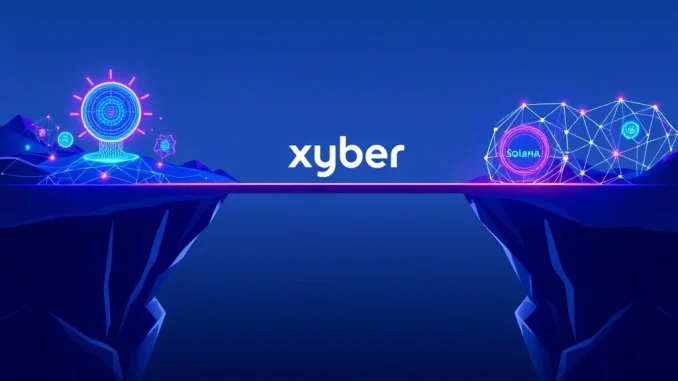
Xyber Genesis Sale on Solana: The Critical Infrastructure Launch for Autonomous AI Agents
Global, May 2025: The Xyber Genesis sale on the Solana blockchain marks a pivotal development for builders of autonomous AI agents. This launch provides the essential payment and verification infrastructure that has been a significant barrier to the practical, large-scale deployment of serious AI applications. The move addresses a core challenge in the Web3 and artificial intelligence convergence, aiming to equip developers with the tools needed for agentic systems to operate reliably and transact seamlessly in decentralized environments.
Xyber Genesis Sale Addresses a Foundational AI Gap
The announcement of the Xyber Genesis sale represents more than a typical token launch. It signals a strategic effort to solve a fundamental problem within the rapidly evolving field of autonomous AI. For years, developers and researchers have advanced the capabilities of AI models, enabling them to perform complex tasks, analyze data, and even make decisions. However, a persistent hurdle has remained: how these autonomous entities can reliably verify their actions, prove their work, and execute payments in a trustless, global digital economy.
Traditional financial and identity systems are not built for non-human actors. Xyber’s infrastructure, launching via its Genesis sale on Solana, proposes a native solution. The platform intends to function as a critical middleware layer, providing a standardized protocol for AI agents to request payment for services, verify the completion of tasks on-chain, and establish a cryptographic record of their interactions. This capability is not merely additive; for many envisioned use cases, from decentralized AI marketplaces to automated DeFi strategies, it is a prerequisite for functionality.
The Solana Blockchain as a Strategic Foundation
Xyber’s choice of the Solana network for its Genesis sale and underlying infrastructure is a calculated decision based on technical requirements. Solana is renowned for its high throughput and low transaction costs, characteristics that are non-negotiable for infrastructure supporting potentially millions of micro-transactions from AI agents. An autonomous AI managing a portfolio or providing small-scale API services may need to execute dozens of transactions per hour. On networks with slower block times or higher fees, such activity becomes economically and practically unfeasible.
The historical context of blockchain scalability is relevant here. Earlier generations of smart contract platforms, while pioneering, often struggled with network congestion and fee volatility. Projects building real-time, high-frequency applications frequently sought alternatives. Solana’s architecture, designed for speed and parallel execution, has positioned it as a preferred settlement layer for applications demanding performance. By building on Solana, Xyber aligns its infrastructure with a network whose capabilities match the operational tempo of autonomous AI.
- High Throughput: Solana’s capability to process thousands of transactions per second (TPS) supports the scale required for widespread AI agent adoption.
- Low Latency: Fast block confirmation times ensure AI agents receive timely verification for their actions, which is critical for time-sensitive operations.
- Cost Efficiency: Minimal transaction fees enable micro-payments and small-value verifications, which are essential for granular AI services.
Understanding the Core Infrastructure: Payment and Verification
To grasp the significance of Xyber’s launch, one must understand the two pillars of its proposed infrastructure: payment rails and verification systems. The payment component involves creating standardized interfaces and smart contracts that allow an AI agent to securely receive cryptocurrency. This could be payment for completing a data analysis job, generating content, or providing a prediction. The system must handle escrow, dispute resolution (potentially through decentralized arbitration or oracles), and final settlement.
The verification component is arguably more complex. It involves creating an on-chain attestation, or proof, that a specific AI agent performed a specific task or reached a certain conclusion. This could leverage zero-knowledge proofs (ZKPs) to verify computation without revealing proprietary model data, or rely on trusted execution environments (TEEs). This verifiable output becomes a tamper-proof record, enabling other smart contracts or users to trust the agent’s work. This solves the “black box” problem often associated with AI, providing a layer of accountability and auditability on the blockchain.
Implications for the Future of Autonomous AI Development
The successful deployment of infrastructure like Xyber’s could have profound implications for the trajectory of AI development. First, it lowers the barrier to entry for developers who wish to monetize their AI creations. Instead of building custom payment and logging systems, they can plug into a standardized protocol. This accelerates innovation and allows developers to focus on core AI capabilities.
Second, it enables new economic models. We could see the emergence of AI-agent-as-a-service platforms, where autonomous agents compete for tasks in an open marketplace, with payment and performance guarantees enforced by smart contracts. Decentralized Autonomous Organizations (DAOs) could employ AI agents as automated executives or analysts, with their work transparently verified on-chain for members to review. The long-term consequence is the potential creation of a vibrant, decentralized economy of interacting AI agents, a concept often discussed but hampered by a lack of foundational tools.
The timeline for this vision is multi-phased. The Genesis sale represents the initial funding and community-building phase. Following this, the core protocol development and mainnet launch will be critical milestones. Widespread adoption will depend on developer tooling, documentation, and the emergence of compelling early use cases that demonstrate clear value over centralized alternatives.
Conclusion
The Xyber Genesis sale on Solana is a noteworthy event that highlights the maturation of the blockchain and AI intersection. By targeting the critical gap of payment and verification infrastructure for autonomous AI agents, Xyber is addressing a foundational need for serious builders in this space. The success of such infrastructure could unlock a new wave of decentralized applications and economic models, moving autonomous AI from controlled experiments to functional participants in the global digital economy. The development warrants close attention from observers of both cryptocurrency and artificial intelligence, as it represents a practical step toward integrating these two transformative technologies.
FAQs
Q1: What is the Xyber Genesis sale?
The Xyber Genesis sale is the initial token distribution event for the Xyber protocol, conducted on the Solana blockchain. It aims to fund the development of a decentralized infrastructure layer designed to provide payment and verification services for autonomous AI agents.
Q2: Why is this infrastructure important for AI agents?
Autonomous AI agents lack native ways to transact value or prove their work in a trustless environment. Xyber’s proposed infrastructure provides the essential rails for these agents to receive payments and create verifiable, on-chain records of their actions, which is necessary for them to operate independently in Web3 ecosystems.
Q3: Why did Xyber choose the Solana blockchain?
Solana was likely chosen for its technical characteristics, including high transaction throughput, low latency, and minimal fees. These features are critical for supporting the high-volume, low-cost micro-transactions and rapid verifications that would be generated by a network of active AI agents.
Q4: What are some potential use cases for this technology?
Potential use cases include decentralized AI marketplaces, automated DeFi portfolio managers, verifiable AI content creation services, DAO-managed AI analysts, and any application where an autonomous software agent needs to transact or prove its output without human intervention.
Q5: How does the verification system work?
While specific technical details depend on Xyber’s final implementation, verification systems typically involve creating a cryptographic proof or on-chain attestation that a specific task was completed by an AI agent. This may involve techniques like zero-knowledge proofs to maintain privacy while ensuring the work is valid and tamper-proof.
Related News
- CLARITY Act Breakthrough: White House Official Reveals Banks' Imminent Crypto Market Entry
- Canton Network (CC) Listing: Bybit Unveils Exciting Spot Debut on November 10
- Pundi AI and Bullshot Partner to Fuel the Explosive Meme and AI Economy on BNB Chain
Related: Binance Proof of Reserves Reveals Crucial 639K Bitcoin Holdings as ETH and USDT Decline
Related: Crypto Presale Gems 2026: Analyzing Five Emerging Projects for Potential Growth