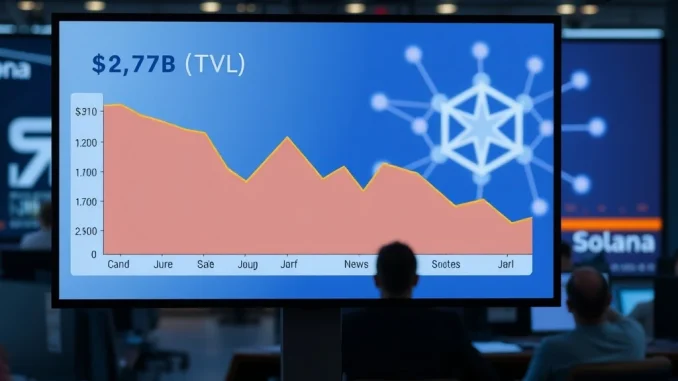
Jito TVL Plummets $2.77B – Analyzing the Solana Liquid Staking Shift
Global, May 2025: The Solana decentralized finance (DeFi) ecosystem witnessed a significant recalibration this week as Jito, a leading liquid staking protocol, experienced a substantial withdrawal of funds. Data from multiple blockchain analytics platforms confirms a reduction in Total Value Locked (TVL) approximating $2.77 billion. This movement has ignited widespread analysis among developers, validators, and market observers, prompting a deeper look into the mechanics of liquid staking, Solana’s network performance, and the fluid nature of capital in the DeFi landscape. While dramatic in scale, such volatility often reveals underlying trends in blockchain economics.
Jito TVL Drop Represents a Major DeFi Reallocation
Jito’s core function within the Solana ecosystem is to provide liquid staking services. Users deposit their SOL tokens with Jito, which then stakes them with network validators. In return, users receive JitoSOL, a liquid staking token that represents their staked position and accrues rewards. This JitoSOL can then be used across other DeFi applications on Solana for lending, borrowing, or providing liquidity, thereby unlocking the value of staked assets. The protocol’s TVL, which had been a benchmark of Solana’s DeFi growth, saw a rapid decline over a 48-hour period. On-chain transaction records show this was not a single event but a series of large-scale withdrawals and redemptions of JitoSOL tokens back into native SOL.
Analysts point to several concurrent factors that likely contributed to this capital movement. Firstly, shifts in staking reward rates across different protocols can trigger arbitrage opportunities. Secondly, broader market conditions often lead investors to rebalance portfolios between liquid and illiquid assets. Finally, the launch of new financial primitives or competitive offerings on Solana can redirect user attention and capital. It is critical to note that a decrease in TVL for one protocol does not inherently indicate a loss for Solana overall; it frequently signifies capital rotation within the same ecosystem.
Solana Network Health and Liquid Staking Dynamics
The event provides a real-time case study in Solana’s resilience and the maturity of its DeFi infrastructure. Despite the sizable TVL movement, the Solana network maintained operational stability. Transaction fees remained low, and block times were consistent, demonstrating the network’s capacity to handle significant economic activity without congestion. This stability is a key metric for developers and institutions evaluating blockchain platforms.
The liquid staking sector on Solana is characterized by robust competition. Protocols differentiate themselves based on several technical and economic factors:
- Validator Selection and Decentralization: How protocols choose validators impacts network security and user rewards.
- Fee Structures: The commission taken by the protocol on staking rewards.
- Liquid Staking Token Utility: The breadth and depth of integrations across DeFi applications.
- Governance and Security: The smart contract audit history and community governance models.
Capital is highly responsive to changes in these variables. A strategic update, a competitor’s incentive program, or a nuanced shift in perceived risk can result in rapid TVL migration. This competitive environment ultimately benefits end-users through innovation and improved service offerings.
Contextualizing the Broader Crypto Market Environment
To understand capital flows, one must consider the wider digital asset market. Periods of heightened volatility or macroeconomic uncertainty often see capital move from more speculative DeFi yield strategies back to core staking or even off-chain positions. Furthermore, the lifecycle of major liquidity mining or incentive programs can create natural expiration dates for capital deposits. When a lucrative farming program concludes, a portion of that capital will seek the next highest risk-adjusted return, sometimes exiting a protocol entirely.
This behavior underscores a fundamental principle of decentralized finance: sovereignty and mobility. Unlike traditional finance, users can move millions, or billions, of dollars in value across global protocols in minutes, without intermediaries. This event with Jito is a powerful demonstration of that capability. It highlights both the agility of the system and the constant need for protocols to deliver sustained value to retain users.
Implications for Validators and Solana’s Security
A natural concern following large-scale unstaking is the potential impact on the Solana network’s security. Blockchain security relies on a decentralized set of validators staking tokens to participate in consensus. If a large amount of SOL is suddenly unstaked and becomes liquid, could it reduce the staked percentage and make the network less secure?
Analysis of Solana’s staking metrics before, during, and after the Jito TVL drop shows a nuanced picture. A significant portion of the withdrawn JitoSOL was likely restaked through other mechanisms or directly with validators. The overall percentage of SOL staked across the network experienced only a minor, temporary fluctuation, remaining well within the range considered healthy for network security. This suggests a mature ecosystem where capital reallocates without critically undermining foundational security parameters. Validators, therefore, monitor these flows but were not presented with a systemic threat from this isolated event.
Conclusion
The $2.77 billion shift in Jito’s TVL on Solana is a significant event that merits close examination, but it is not an anomaly. Instead, it is a manifestation of the dynamic, efficient, and user-empowered nature of modern decentralized finance. It reflects capital responding to evolving incentives, competitive landscapes, and market conditions. For the Solana ecosystem, the smooth handling of this volume demonstrates technical resilience. For participants, it reinforces the importance of understanding protocol mechanics and market cycles. The Jito TVL drop is less a story of failure and more a chapter in the ongoing story of capital allocation and innovation within the blockchain economy.
FAQs
Q1: Does Jito losing $2.77B TVL mean users lost money?
No. TVL (Total Value Locked) measures the amount of assets deposited in a protocol. A drop in TVL means users withdrew their assets. It does not mean the protocol was hacked or that user funds were lost, unless specified by a security incident, which was not the case here.
Q2: Is the Solana network less secure because of this?
Available data indicates Solana’s overall staked SOL ratio saw only a minor, temporary impact. The network’s security, which depends on the total amount of SOL staked, remained robust throughout the event. Capital largely moved within the ecosystem.
Q3: What is liquid staking, and how does Jito work?
Liquid staking allows users to stake their crypto assets (like SOL) to secure a network and earn rewards, while receiving a liquid token (like JitoSOL) in return. This token can be used elsewhere in DeFi. Jito facilitates this process on Solana, managing validator selection and distributing rewards.
Q4: Why would users suddenly withdraw from Jito?
Common reasons include seeking better rewards from a competing protocol, concluding a participation in a time-limited incentive program, rebalancing a personal portfolio in response to market conditions, or utilizing capital for an opportunity in another sector of crypto.
Q5: Is this kind of TVL volatility normal in DeFi?
Yes, significant TVL movements are a standard characteristic of the DeFi landscape. Capital is highly mobile and flows to where users perceive the best opportunities or safest returns. Large fluctuations can occur due to new protocol launches, changes in rewards, or broader market sentiment.
Related News
- Bitcoin Price Achieves Historic Weekly Close Record
- Who's Dumping Their Coins, How Much And Why?
- Urgent Binance Delisting: Crucial Update for BAKE, HIFI, SLF Holders
Related: JitoSOL ETPs: Hanwha's Strategic $4.44B Bet on Solana Liquid Staking for Retirement Portfolios
Related: Chainlink Dominates RWA Projects with Unprecedented Social Activity Surge