Immersive AR and VR Tech Trends Are Revolutionizing Sweepstakes Sites
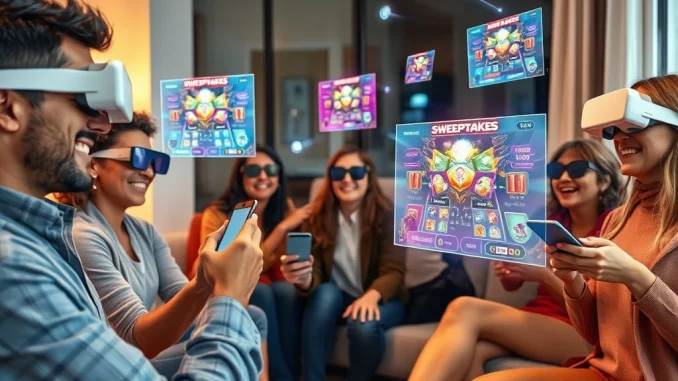
Global, May 2025: The landscape of online sweepstakes and promotional gaming is undergoing a fundamental transformation. Driven by advancements in consumer hardware and software, technologies like Augmented Reality (AR), Virtual Reality (VR), and sophisticated mobile interfaces are moving beyond niche applications and heading directly toward mainstream sweepstakes platforms. This shift is creating a new paradigm where participation evolves from simple clicks to deeply immersive, multi-sensory experiences that engage users through smart visuals, spatial audio, and intuitive touch-driven interactions.
Immersive AR and VR Tech Trends Are Reshaping User Engagement
The integration of immersive technology into sweepstakes represents a logical progression in digital engagement. Historically, online contests relied on static forms or basic point-and-click mechanics. The rise of mobile gaming in the 2010s introduced more interactive elements. Today, the proliferation of affordable AR-capable smartphones and standalone VR headsets has created the infrastructure for a more profound shift. Major platforms are now experimenting with these tools not as gimmicks, but as core components of user experience design. The goal is to increase dwell time, enhance brand recall, and foster a deeper emotional connection with participants by making the act of entering a sweepstakes an event in itself, rather than a transactional afterthought.
The Technical Foundations of Modern Sweepstakes Immersion
This evolution is built upon several converging technological pillars. First, AR technology overlays digital information onto the real world through a device’s camera. For sweepstakes, this can manifest as a user pointing their phone at a product in a store to reveal a floating, interactive game portal or a 3D model of a prize they can examine from all angles. Second, VR creates a fully enclosed digital environment. While more resource-intensive, it offers the ultimate escape, allowing brands to host virtual prize draw events or create exploratory games where finding tokens leads to entries. Third, haptic feedback and advanced touch interfaces on mobile devices add a tangible layer. A user might feel a subtle vibration when they virtually “scratch” a digital card or experience variable resistance in a swipe-based mini-game, mimicking physical actions.
- Augmented Reality (AR): Enhances real-world environments with digital overlays, ideal for location-based or product-tied promotions.
- Virtual Reality (VR): Constructs complete digital worlds for fully immersive brand experiences and social prize events.
- Haptic Feedback: Provides tactile sensations through device vibrations, simulating physical interactions with digital objects.
- Spatial Audio: Uses directional sound cues that change based on user movement, deepening environmental immersion.
From Novelty to Necessity: The Industry’s Strategic Pivot
Industry analysts note that what began as experimental marketing campaigns around 2020-2022 has matured into a strategic investment. Data from early adopters suggests that sweepstakes featuring AR/VR elements see significantly higher engagement rates and shareability compared to traditional formats. The logic is clear: an immersive experience is more memorable and more likely to be shared on social media, effectively turning each participant into a brand ambassador. Furthermore, these technologies provide marketers with rich, anonymized data on user interaction patterns—how long they engage with a virtual object, what paths they take in a VR environment—offering insights far beyond a simple email submission.
Balancing Innovation with Accessibility and Regulation
The drive toward high-tech sweepstakes is not without its challenges. A primary concern is ensuring accessibility; not every user owns a VR headset or the latest smartphone. Consequently, successful implementations often use a tiered approach. A core experience might be accessible via any modern mobile browser using basic AR, while premium layers are unlocked for users with more advanced hardware. Another critical consideration is the regulatory landscape. Sweepstakes and contests are heavily regulated in jurisdictions like the United States and the European Union to ensure fairness and prevent gambling. Platform developers and brands must meticulously design these immersive experiences to comply with existing laws regarding chance, consideration, and prize awarding, ensuring the technology enhances rather than complicates legal adherence.
| Technology | Primary Use Case | User Hardware Required | Key Benefit |
|---|---|---|---|
| Mobile AR (Web/App) | Product visualization, real-world game triggers | Modern Smartphone | High accessibility, low barrier to entry |
| Standalone VR | Virtual events, exploratory game environments | VR Headset (e.g., Meta Quest) | Full immersion, high engagement potential |
| Advanced Haptics | Simulating physical actions (scratching, pulling) | Phones with advanced vibration motors | Enhanced tactile feedback, increased realism |
| Spatial Audio | Directional sound in VR/AR environments | Headphones or capable speakers | Deepened sense of presence and location |
The Role of Mobile Technology as the Gateway
While VR captures headlines, industry experts emphasize that mobile technology remains the most significant vector for this trend. Smartphones are ubiquitous, powerful, and constantly evolving. Features like LiDAR scanners on higher-end models enable more precise AR object placement. Improved GPUs render complex graphics smoothly. 5G and widespread Wi-Fi reduce latency, allowing for more responsive, cloud-streamed experiences. This makes the smartphone the primary gateway for immersive sweepstakes, ensuring that while cutting-edge VR experiences attract enthusiasts, the core technological shift is democratized and reaches a mass audience through the device already in their pocket.
Conclusion
The trajectory for sweepstakes sites is firmly set toward richer, more engaging experiences powered by AR, VR, and sophisticated mobile tech. This movement is less about replacing traditional draws and more about expanding the definition of participation. By leveraging smart visuals, immersive sound, and touch-driven interactions, platforms are building deeper connections with users. The successful implementation of these immersive AR and VR tech trends will depend on balancing innovation with accessibility, ensuring fun and fairness remain paramount. As the underlying technology continues to become more affordable and widespread, the line between playing a game and entering a sweepstakes will blur further, heralding a new era of interactive digital marketing and user engagement.
FAQs
Q1: Do I need special equipment to participate in AR/VR sweepstakes?
Not necessarily. Many augmented reality experiences are designed to work on standard modern smartphones through a web browser or app. Full virtual reality experiences typically require a VR headset, but brands often provide multiple ways to enter to ensure broad accessibility.
Q2: Are these high-tech sweepstakes considered a form of gambling?
Reputable sweepstakes are designed to be games of skill or chance with free entry, distinguishing them from gambling, which involves payment for a chance to win. The use of AR/VR does not change this fundamental legal structure; it merely changes the presentation and interaction mode.
Q3: How does immersive tech improve the sweepstakes experience for users?
It transforms a passive entry process into an active, engaging activity. Instead of just submitting a form, users might solve a puzzle in a virtual space, interact with a 3D product model, or play a mini-game, making the experience more memorable and entertaining.
Q4: What are the main challenges for brands adopting this technology?
Key challenges include development cost, ensuring cross-platform compatibility across different devices, maintaining user data privacy within immersive environments, and strictly adhering to the complex legal regulations governing sweepstakes in different countries.
Q5: Is this trend expected to continue growing?
Yes. As AR glasses and VR hardware become more mainstream and affordable, and as users grow accustomed to richer digital interactions, the expectation for engaging, immersive experiences will only increase. Sweepstakes and promotional games will likely follow this broader consumer technology trend.
Related News
- World Swap Remittance Platform: World Liberty Financial's Revolutionary Crypto Payment Strategy
- Binance Assets Surge: How a Withdrawal Campaign Became an Unlikely Stress Test
- Chainlink's Strategic Atlas Acquisition: A Game-Changing Move for MEV Protection in DeFi
Related: Gemini Staff Cuts: Crypto Exchange Slashes Up to 25% of Workforce in Pivotal Restructuring
Related: Funton.ai Partners with LF Wallet to Revolutionize Multi-Chain Web3 Gaming Security
Related: Tether Gold's Stunning 94-Tonne On-Chain Transfer Proves Blockchain Efficiency for Physical Assets