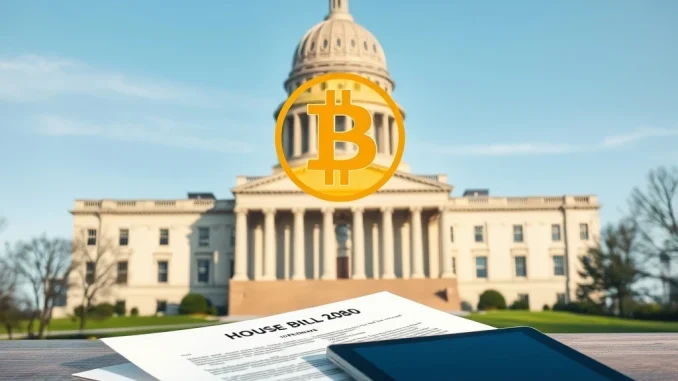
Missouri Bitcoin Reserve Bill: A Groundbreaking Push for State Crypto Adoption
Jefferson City, Missouri – April 2025: In a move that could redefine how U.S. states manage public assets, Missouri lawmakers have advanced House Bill 2080, landmark legislation proposing the creation of an official state Bitcoin reserve. This initiative places Missouri at the forefront of a growing national conversation about the role of digital assets in public finance and treasury management.
Missouri Bitcoin Reserve: The Details of House Bill 2080
The proposed legislation, formally known as House Bill 2080, outlines a comprehensive framework for the Missouri State Treasury. The core provision authorizes the establishment of a dedicated Bitcoin reserve fund. This fund would operate under the direct oversight and custody of the State Treasurer’s office. The bill grants the treasury explicit authority to acquire, secure, and manage Bitcoin holdings. It also establishes clear legal pathways for the treasury to accept Bitcoin donations, a provision that could open new avenues for public funding. Furthermore, the legislation includes foundational language that could eventually enable the state to accept cryptocurrency for certain payments or obligations, though that functionality would require subsequent enabling regulations.
The National Context of State Crypto Legislation
Missouri’s proposal does not exist in a vacuum. It represents a renewed wave of political interest in digital assets at the state level, following several years of legislative experimentation and, in some cases, failure. This bill marks a significant evolution from earlier, more symbolic efforts. It moves beyond simple resolutions recognizing Bitcoin’s utility to creating a practical, operational framework for state-level engagement.
Missouri now joins a small but influential group of states exploring similar concepts. The table below illustrates how Missouri’s approach compares to other notable state-level crypto initiatives.
| State | Initiative | Status / Key Feature |
|---|---|---|
| Missouri | House Bill 2080 (Bitcoin Reserve Fund) | Proposed; focuses on treasury custody and management. |
| Wyoming | DAO and Crypto Banking Laws | Enacted; creates a comprehensive legal framework for blockchain businesses. |
| Texas | Blockchain Working Group / Mining Support | Ongoing; focused on industry growth and energy integration. |
| Colorado | Cryptocurrency for Tax Payments | Pilot ended; allowed limited crypto tax payments via a third-party processor. |
The distinction of Missouri’s bill lies in its primary focus on asset reserve management rather than just payment processing or commercial regulation. This positions the potential Bitcoin holdings as a strategic state asset, analogous to portions of a traditional sovereign wealth fund or gold reserve.
Overcoming Past Legislative Hurdles
The advancement of HB 2080 is particularly notable given the mixed history of cryptocurrency bills in various statehouses. Previous legislative efforts often stalled due to:
- Technical Complexity: Lawmakers’ unfamiliarity with blockchain technology and custody solutions.
- Volatility Concerns: Apprehension about managing public funds in a famously volatile asset class.
- Security Risks: Well-publicized exchange hacks and custody failures creating risk aversion.
- Regulatory Uncertainty: The evolving federal stance creating a “wait-and-see” attitude at the state level.
The current bill appears designed to address these concerns directly. By placing custody and management squarely within the existing, audited State Treasury—rather than a new or external entity—it leverages established financial governance. The bill also mandates the development of strict security protocols and risk management policies before any acquisition occurs.
Operational and Financial Implications
If enacted, the practical implementation of a state Bitcoin reserve would involve several critical steps. The State Treasurer would need to select and contract with qualified institutional-grade custodians. These are specialized financial firms that provide secure, insured storage for digital assets, often using a combination of cold (offline) storage and multi-signature cryptographic controls. The treasury would also need to develop a transparent valuation and accounting methodology, deciding whether to mark holdings to market daily or use another model for official state books.
The funding mechanism for the initial acquisition of Bitcoin is a key detail still subject to legislative debate. Options could include:
- Allocating a small percentage of existing treasury cash balances.
- Using proceeds from specific state asset sales or budget surpluses.
- Relying solely on the donation mechanism outlined in the bill to seed the fund.
Proponents argue that even a small, diversifying allocation could offer potential long-term upside as a non-correlated asset, while critics caution against exposing public funds to speculative risk. The bill’s requirement for oversight reports to the legislature aims to ensure ongoing transparency and accountability.
The Donation Pathway and Public Engagement
A unique aspect of HB 2080 is its formalization of a process to accept Bitcoin donations. This creates a novel channel for public contribution to the state. Individuals, corporations, or trusts could donate Bitcoin directly to the state reserve fund. The treasury would then custody the asset, and its value would accrue to the state. This mechanism could appeal to cryptocurrency advocates wishing to see their holdings used for public benefit, potentially creating a new form of philanthropic giving tied to the appreciation of a digital asset.
Expert Analysis on Treasury Management Evolution
Financial governance experts note that state treasuries have historically been conservative managers, focusing on liquidity, safety, and modest returns through instruments like government bonds and money market funds. The consideration of Bitcoin represents a paradigm shift. It reflects a growing, albeit cautious, acknowledgment of digital assets as a legitimate, if niche, asset class.
The move is also interpreted as a strategic response to monetary policy and inflation. Some state legislators have publicly expressed interest in Bitcoin as a potential hedge against currency debasement, drawing parallels to states that hold physical gold. However, the bill itself is framed in neutral, operational language, focusing on the “how” rather than the “why,” which strengthens its procedural credibility.
The success of the bill will depend heavily on the detailed policies crafted by the Treasury. Key questions they must answer include: What is the maximum allowable allocation? What are the explicit rules for buying, selling, or rebalancing? How will security be audited? The legislation provides the authority, but the prudent exercise of that authority will determine its long-term viability.
Conclusion
The advancement of House Bill 2080 to create a Missouri Bitcoin reserve is a significant development in the intersection of public finance and digital innovation. It represents a mature, second-wave approach to state cryptocurrency legislation, focusing on secure custody and treasury management rather than mere symbolism. While the bill’s final passage and implementation remain uncertain, its progress signals a growing willingness among state governments to develop formal frameworks for engaging with the digital asset ecosystem. The outcome in Missouri will provide a critical case study for other states considering whether and how to integrate cryptocurrencies into their own financial infrastructure.
FAQs
Q1: What exactly would the Missouri Bitcoin reserve fund do?
The fund, as proposed in House Bill 2080, would allow the Missouri State Treasury to legally acquire, hold, and manage Bitcoin as a state asset. It establishes a framework for secure custody, allows the state to accept Bitcoin donations, and sets the stage for potential future crypto payment systems.
Q2: Has any other U.S. state created a similar Bitcoin reserve?
As of April 2025, no U.S. state has yet established an official Bitcoin reserve fund managed by its treasury. Missouri’s bill is among the first to propose such a structure explicitly. Other states like Wyoming and Texas have passed supportive blockchain laws but not focused on state-held reserves.
Q3: Where would the state’s Bitcoin be stored for security?
The bill requires the State Treasurer to implement high-security custody solutions. This would almost certainly involve contracting with regulated, institutional-grade digital asset custodians that use military-grade encryption, offline “cold” storage, and multi-signature technology to protect the assets.
Q4: Could this make Missouri money if Bitcoin’s price rises?
Potentially, yes. Like any investment, if the value of the Bitcoin held in the reserve increases, the value of the state’s asset would appreciate. Conversely, the state would bear the loss if the price falls. The bill emphasizes risk management and prudent allocation to mitigate volatility.
Q5: What happens next for House Bill 2080?
The bill has been advanced by committee. It must now pass a full vote in the Missouri House of Representatives, then move to the State Senate for consideration and potential amendments. If it passes both chambers, it would go to the Governor’s desk to be signed into law or vetoed.
Related News
- Essential: Upbit Announces Temporary SEI Deposit and Withdrawal Suspension for Network Upgrade
- CoinPulseHQ Unveils Strategic Weekly Coverage Schedule for Essential Cryptocurrency News
- Linebet: the first to introduce AI in the betting industry
Related: Crypto Whale Doubles Down: A Revealing Look at High-Leverage Solana and Ethereum Trading Strategies
Related: Kai Cenat Net Worth 2026: The Staggering $35M+ Fortune of a Streaming Titan
Related: DeepSnitch AI Outperforms Ripple and Bitcoin as Investors Pivot to AI-Driven Crypto Tools