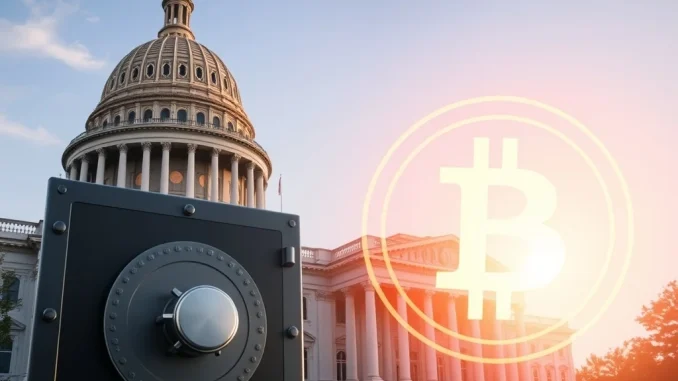
Missouri Bitcoin Strategic Reserve: Lawmakers Advance Groundbreaking State Treasury Bill
Jefferson City, Missouri – April 2025: In a move that could redefine state treasury management, Missouri lawmakers are advancing House Bill No. 2080, legislation designed to establish a first-of-its-kind Bitcoin Strategic Reserve. The bill proposes creating a dedicated, tax-free state fund with a mandatory five-year cold storage protocol for any acquired bitcoin, positioning Missouri at the forefront of a growing national conversation about sovereign digital asset adoption.
Missouri Bitcoin Strategic Reserve: The Details of House Bill 2080
The core mechanism of House Bill 2080 is the creation of a “Bitcoin Strategic Reserve” fund within the Missouri state treasury. This fund would operate separately from the state’s general revenue and other investment pools. Crucially, the legislation mandates that any bitcoin purchased for this reserve must be held in a secure, offline cold storage solution for a minimum period of five years. This long-term custody requirement is a defining feature, explicitly designed to shield the state’s potential investment from short-term market volatility and operational security risks associated with online “hot” wallets. The bill’s sponsors frame the initiative not as a speculative trading vehicle, but as a strategic, long-term store of value for the state.
Legislative Context and National Precedents
Missouri’s proposal enters a legislative landscape where several states have already taken steps to engage with digital assets, though approaches vary significantly. For instance, in 2022, the state of Arizona proposed a bill to make bitcoin legal tender, though it did not pass. More directly relevant is the action by the state of Ohio, which briefly allowed businesses to pay taxes in bitcoin before halting the program. However, the concept of a state establishing a dedicated treasury reserve specifically for bitcoin, with a legislated custody mandate, appears to be unprecedented at this scale. This move by Missouri lawmakers reflects a broader, post-2024 trend where state legislatures are increasingly exploring frameworks to hold digital assets on their balance sheets, often citing concerns about dollar devaluation and the desire for portfolio diversification.
The Rationale Behind a State Crypto Reserve
Proponents of the bill, including its lead sponsors, argue for the reserve on several grounds. First, they cite bitcoin’s historical performance as a non-correlated asset, suggesting it could act as a hedge against inflation and provide diversification for state holdings traditionally concentrated in bonds, equities, and cash. Second, they point to the growing institutional adoption of bitcoin by publicly traded companies and sovereign wealth funds as validation of its role as a legitimate reserve asset. Third, the five-year cold storage rule is presented as a prudent risk management measure, enforcing a disciplined, long-term perspective that avoids the pitfalls of reactive trading. Detractors, including some fiscal policy analysts, raise concerns about price volatility, custody complexities, and the opportunity cost of capital that could be deployed elsewhere.
Operational and Security Implications of the Cold Storage Mandate
The mandated five-year cold storage period introduces unique operational challenges and security protocols for the state treasury. Implementing this would require:
- Multi-Signature Wallets: Utilizing cryptographic wallets that require multiple authorized signatures (likely from different state officials or departments) to authorize a transaction, preventing unilateral access.
- Physical Security: Storing the private keys or hardware wallets in highly secure, geographically dispersed locations, such as state vaults or dedicated custodial facilities, with strict access logs.
- Third-Party Custody Audits: Engaging specialized, regulated cryptocurrency custodians or auditors to verify holdings and security practices without compromising key security.
- Legislative Override Provisions: The bill would need clear stipulations on what constitutes an emergency or legislative consensus sufficient to override the five-year holding period, ensuring democratic oversight of the asset.
This approach mirrors best practices in institutional digital asset management but would represent a significant new competency for a state treasury department.
Potential Economic and Political Consequences
The passage of House Bill 2080 could have ripple effects beyond Missouri’s balance sheet. Economically, a sizable state purchase of bitcoin could signal broader legitimacy to financial markets and potentially attract cryptocurrency businesses and talent to the state, framing Missouri as a “pro-innovation” jurisdiction. Politically, it sets a bold precedent that other state legislatures with similar political compositions may seek to emulate or modify, potentially creating a patchwork of state-level digital asset policies. Furthermore, it invites scrutiny from federal regulators, particularly the Securities and Exchange Commission and the Treasury Department, regarding how such a reserve is classified, audited, and reported. The bill’s progress is being closely monitored by both the cryptocurrency industry and traditional public finance observers as a potential bellwether.
Historical Parallels in State Treasury Innovation
While novel in its asset choice, the concept of a state establishing a strategic reserve is not without historical analogue. States have long created sovereign wealth funds, rainy day funds, or dedicated trusts for revenue from natural resources like oil and gas. For example, the Texas Permanent School Fund and the Alaska Permanent Fund were established to manage and preserve wealth from state-owned resources for future generations. Proponents of the Missouri bill draw a parallel, arguing that allocating a portion of treasury surplus to bitcoin is a modern adaptation of this principle—treating the digital asset as a new form of “mined” resource (through proof-of-work) to be secured for long-term public benefit.
Conclusion
The advancement of House Bill 2080 to create a Missouri Bitcoin Strategic Reserve represents a significant and carefully structured experiment in state-level financial policy. By combining the establishment of a dedicated fund with a stringent five-year cold storage mandate, Missouri lawmakers are proposing a model that emphasizes long-term strategic holding over active trading. The bill’s fate will provide critical data points on the political appetite for digital asset adoption by sovereign entities, the practical challenges of state-level cryptocurrency custody, and the evolving narrative around bitcoin as a potential component of public treasury management. Its progression through the legislature will be a key story to watch in the intersection of policy, finance, and technology.
FAQs
Q1: What exactly is the Missouri Bitcoin Strategic Reserve?
The Missouri Bitcoin Strategic Reserve, as proposed in House Bill 2080, is a dedicated fund within the state treasury that would be used to purchase and hold bitcoin as a long-term state asset. It is designed to be separate from other state funds and requires bitcoin to be stored in offline cold storage for a minimum of five years.
Q2: Why is a five-year cold storage period required?
The five-year cold storage mandate is a key risk management feature of the bill. It is intended to enforce a long-term investment horizon, discouraging the state from reacting to short-term price volatility. It also enhances security by keeping the assets offline and inaccessible to online hacking attempts for a substantial period.
Q3: Has any other U.S. state done this before?
No state has yet established a legislated, treasury-held Bitcoin Strategic Reserve with a mandated long-term custody rule like the one proposed in Missouri. Other states have explored accepting bitcoin for tax payments or proposed making it legal tender, but Missouri’s bill is unique in creating a formal state investment reserve.
Q4: Where would the money to buy bitcoin come from?
The bill proposes funding the reserve through appropriations from the state’s general revenue surplus, specific budget allocations, or potentially from other non-tax revenue sources. The exact funding mechanism would be determined during the legislative appropriations process if the bill becomes law.
Q5: What are the main arguments against the bill?
Critics argue that bitcoin’s price volatility makes it an unsuitable asset for conservative state treasury management, that the security and custody responsibilities are complex and untested for a state entity, and that the capital could be better used for immediate public services or invested in more traditional, income-generating assets.
Related News
- Uniswap Proposal Unveils Ambitious Plan to Activate Protocol Fees on All V3 Pools
- Crucial Partnership: Bazaars Integrates Trezor to Fortify Web3 Wallet Security and $BZR Token Protection
- Kernel Secures Binance Labs Funding to Redefine Restaking on BNB Chain
Related: Bitcoin Realized Loss Hits Historic Peak: A Crucial Signal the Bottom May Be Near
Related: SegWit Debate Reignites: The Critical Question Over Bitcoin's 'No Hard Fork' Norm
Related: Ethereum RWA Market Skyrockets Past $15B as Tokenized Treasuries Fuel Explosive Growth