Dogecoin’s Critical Test: DOGE Holds Trendline Support as Momentum and Volume Weaken
Global, May 2025: Dogecoin (DOGE) is undergoing a critical technical test, holding a key trendline support level even as its upward momentum and trading volume show signs of weakening. This divergence between price action and underlying market strength presents a complex puzzle for traders and analysts, raising fundamental questions about the sustainability of the meme coin’s recent breakout from a prolonged downtrend. The current consolidation phase offers a crucial window into the balance of power between buyers and sellers in the volatile cryptocurrency market.
Dogecoin’s Technical Crossroads: Support Holds Amid Fading Conviction
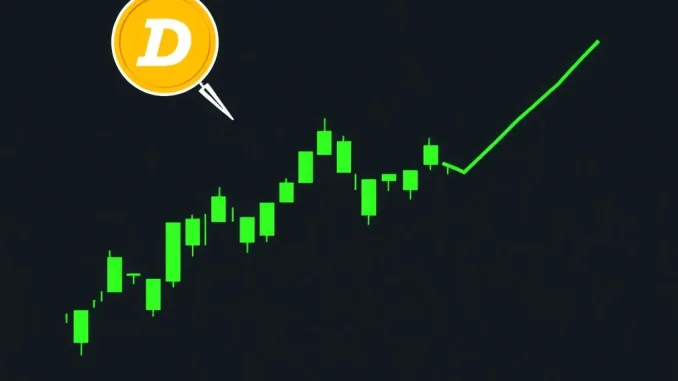
According to data from major cryptocurrency exchanges, Dogecoin’s price action over recent weeks has followed a classic technical pattern. After decisively breaking above a significant descending trendline that had constrained its price for several months—a move highlighted by analyst Trader Tardigrade—DOGE has now pulled back to retest that former resistance level as new support. This retest is a normal and expected phase in technical analysis, serving to confirm the validity of the initial breakout. The fact that the price has, so far, held above this level is technically constructive. However, the concerning signals emerge from the ancillary data. On-chain metrics and exchange volume trackers indicate a notable decline in trading activity and leverage market interest during this retest phase. This suggests that while selling pressure may not be overwhelming, the buying conviction required to propel another leg higher is currently absent. Market participants appear to be in a state of watchful waiting, lacking the aggressive momentum that typically fuels sustained crypto rallies.
Analyzing the Weakening Market Dynamics Behind DOGE
The muted volume and weak leverage metrics are not occurring in a vacuum. They reflect broader market conditions and specific challenges for Dogecoin. Several factors contribute to this dynamic:
- Macro Sentiment: The broader cryptocurrency market has entered a phase of consolidation after a strong first quarter. Bitcoin and Ethereum, the market leaders, have seen reduced volatility, which often trickles down to altcoins like Dogecoin, dampening speculative fervor.
- Shifts in Meme Coin Attention: The retail-driven meme coin sector is notoriously fickle. Capital and social media attention can rapidly rotate between different assets based on trends and influencer mentions. Current chatter suggests some momentum may be shifting toward newer or other established meme tokens.
- Liquidity and Depth: Analysis of order book depth on major exchanges shows thinner liquidity around current price levels compared to earlier in the year. This can lead to sharper price moves on relatively small volume, increasing risk for traders.
- Historical Precedent: Dogecoin has experienced similar phases in the past, where breakouts were followed by low-volume retests. The subsequent price direction was often determined by whether volume returned to confirm the move or evaporated entirely, leading to a false breakout.
The Role of Network Fundamentals and Ecosystem Development
Beyond pure price charts, Dogecoin’s fundamental ecosystem provides important context. Unlike many cryptocurrencies that tout complex roadmaps for smart contracts or decentralized finance, Dogecoin’s value proposition remains closely tied to its brand, community, and utility as a digital currency for payments and tipping. Recent years have seen incremental but meaningful progress in this area. Several payment processors have maintained or added DOGE support, and its community continues to fund charitable initiatives and advocate for its use. However, the pace of major, headline-grabbing technological upgrades or institutional adoption announcements has slowed. For a momentum-driven asset, the absence of fresh, positive fundamental catalysts can contribute to a cooling of speculative interest, allowing technical factors like volume and leverage to take center stage in the short term. This creates a scenario where price is being supported more by technical structure and holder sentiment than by aggressive new buying.
Comparative Analysis: How DOGE’s Behavior Stacks Up
To understand if Dogecoin’s current behavior is unique or part of a sector-wide trend, it is useful to compare its metrics against peers. The following table outlines key indicators for DOGE against two other major meme-inspired cryptocurrencies as of late May 2025.
| Metric | Dogecoin (DOGE) | Shiba Inu (SHIB) | Pepe (PEPE) |
|---|---|---|---|
| 30-Day Volume Change | -25% | -15% | +5% |
| Social Dominance (7d Avg) | 1.8% | 2.1% | 3.4% |
| Price vs. 200-Day MA | +12% | +8% | +45% |
| Leverage Ratio (Aggregate) | Low | Medium | High |
This comparison reveals that while the entire meme coin sector is not uniformly booming, Dogecoin is notably lagging in terms of recent volume trends and social media buzz. Its price remains above key long-term averages, suggesting the overall trend is not bearish, but the lack of leverage and volume indicates a more cautious, wait-and-see approach from the market compared to more speculative assets like PEPE.
Expert Perspectives on Sustainability and Risk
Financial technicians emphasize that volume is the fuel for any trend. A breakout on low volume is often viewed with skepticism, as it may lack broad participation. The current scenario for Dogecoin—holding support but on weak volume—places it in a neutral, transitional zone. Analysts note that the most likely outcomes from this setup are either a period of extended sideways consolidation to rebuild energy or a sharp directional move triggered by an external catalyst. The key risk is a volume-supported breakdown below the trendline support, which would technically invalidate the recent breakout and likely target lower support levels. Conversely, a surge in buying volume from this support zone would confirm strength and could open the path toward testing higher resistance. Seasoned traders often advise against taking large directional bets during such low-conviction phases, instead recommending tighter risk management and waiting for the market to show its hand with a clear volume spike.
Conclusion
Dogecoin finds itself at a technical inflection point, holding trendline support in a display of resilience while simultaneously grappling with weakening momentum and muted trading volume. This dichotomy encapsulates the current state of the cryptocurrency: it has successfully arrested a prior downtrend but now must prove it can attract fresh capital to sustain forward progress. The coming days will be critical in determining whether this support level becomes a launchpad for the next leg up or a failed breakout point. For market observers, the behavior of volume will be the most telling indicator, serving as a real-time gauge of trader conviction and the underlying health of Dogecoin’s price movement beyond the simple line on a chart.
FAQs
Q1: What does it mean that DOGE is “holding trendline support”?
In technical analysis, a trendline is a diagonal line drawn on a price chart connecting significant lows (in an uptrend) or highs (in a downtrend). When the price breaks above a descending trendline and then falls back to touch it without breaking below, it is “holding” that line as support. This action suggests the prior breakdown of the trend has shifted market psychology, with the old resistance now acting as a floor for prices.
Q2: Why is low trading volume considered a problem for a breakout?
Volume confirms the strength of a price move. A high-volume breakout indicates broad market participation and strong conviction from buyers. A low-volume breakout suggests limited interest and participation, making the move more vulnerable to failure because fewer traders are committed to supporting the new price level. It can indicate a lack of follow-through buying.
Q3: What are “leverage metrics” in cryptocurrency trading?
Leverage metrics refer to data showing how much borrowed money (margin) traders are using to amplify their bets. This includes aggregate leverage ratios across exchanges and funding rates for perpetual swap contracts. Weak leverage metrics suggest traders are not aggressively using debt to bet on price moves, indicating caution or a lack of strong directional bias in the market.
Q4: Has Dogecoin been in similar situations before?
Yes, Dogecoin’s history is marked by periods of explosive, high-volume rallies followed by extended consolidation phases with lower volume. Its price is often influenced heavily by social sentiment and broader crypto market cycles. Past consolidations have sometimes preceded major moves, but the specific outcome depends on the prevailing market conditions and catalysts at the time.
Q5: What should a trader watch for next in DOGE’s price action?
Traders should monitor two key developments: 1) A significant increase in trading volume, either pushing the price decisively above the recent consolidation range or breaking below the trendline support. Volume will validate the next move. 2) A catalyst, such as a major announcement, shift in Bitcoin’s price, or a surge in social media activity that could reignite interest and provide a fundamental reason for the price to move.
Related News
- CLARITY Act Drama: Armstrong Reveals Constructive White House Dialogue Amid Regulatory Tensions
- Altcoin Mining Made Easy: HASHJ Launches Instant SHIB, Ethereum, and Litecoin Mining
- Crypto Tax Reporting Gets a Major Boost as Taxbit Joins Backpack in Essential Partnership
Related: Daily Crypto Gainers: $PIPPIN Surges 18% as $DCR Leads Altcoin Momentum
Related: Cardano ETF Countdown Begins: CME Futures Launch Triggers 75-Day Regulatory Clock
Related: Stablecoin Reserves Plunge: A $10.5 Billion Exodus from Crypto Exchanges in 90 Days