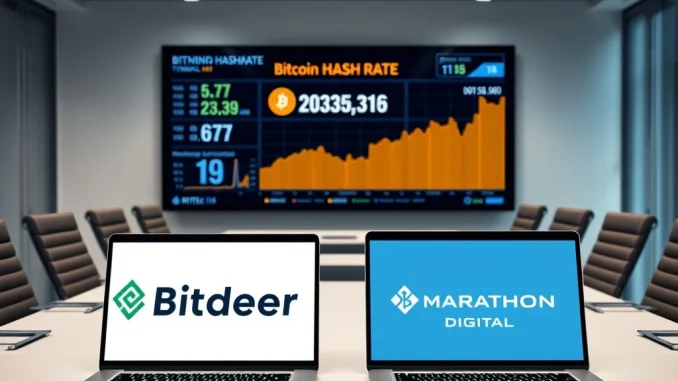
Bitdeer Stuns Market: Sells All Bitcoin Holdings While Overtaking Marathon as Top Miner
SINGAPORE, April 2025: In a move that has sent ripples through the cryptocurrency sector, Bitdeer Technologies Group has executed a dual-pronged strategic shift of remarkable scale. The company has completely liquidated its corporate Bitcoin treasury, selling its final holdings, while simultaneously achieving a new operational milestone by surpassing Marathon Digital Holdings to become the world’s largest publicly traded Bitcoin miner by self-managed hashrate. This decisive action underscores a significant pivot in corporate strategy for one of the industry’s leading players, balancing financial maneuvering with raw computational power expansion.
Bitdeer Sells All Corporate Bitcoin in Major Treasury Liquidation
The company’s recent financial disclosures confirm the complete divestment of its Bitcoin reserves. Bitdeer sold 189.8 BTC from its corporate holdings and liquidated an additional 943.1 BTC that had been held in reserve. This brings the total corporate Bitcoin balance to zero, a stark contrast to the treasury strategies employed by many of its peers. The decision to exit a Bitcoin position entirely is rare among major mining firms, which typically hold a portion of their mined coins as a long-term strategic asset on their balance sheets.
This liquidation follows a period of substantial capital raising. Bitdeer successfully secured $300 million through a private placement of convertible notes and an additional $43.7 million in equity financing. The company’s latest reports indicate a strong cash position of $149.4 million. Analysts interpret these moves as a concerted effort to strengthen the balance sheet with liquid fiat currency, potentially to fund aggressive infrastructure expansion, weather market volatility, or pursue strategic acquisitions without the price risk associated with holding a volatile digital asset.
Overtaking Marathon Digital in the Hashrate Race
Concurrent with its treasury shift, Bitdeer announced it has overtaken Marathon Digital in self-managed hashrate. Hashrate, measured in exahashes per second (EH/s), represents the total computational power dedicated to securing the Bitcoin network and mining new blocks. Surpassing Marathon marks a pivotal moment in the competitive landscape of public Bitcoin mining.
Marathon Digital had long been considered the industry leader in this metric among publicly listed companies. Bitdeer’s ascent to the top spot signals not just growth, but superior execution in deploying and managing high-performance mining infrastructure. The company’s operational model, which includes proprietary chip design, advanced cooling solutions, and strategic site selection, has evidently allowed for rapid and efficient scaling of its computational footprint.
- Self-Managed Hashrate: This refers to computational power directly owned and operated by the company, as opposed to hashpower acquired through hosting services for third-party clients. It represents core operational strength.
- Industry Significance: Leading in hashrate provides greater economies of scale, more consistent Bitcoin production, and increased influence within the mining ecosystem.
- Competitive Dynamic: The leaderboard for public miner hashrate is intensely competitive, with companies like Riot Platforms and CleanSpark also aggressively expanding capacity.
The Strategic Calculus: Liquidity vs. Bitcoin Exposure
Bitdeer’s twin announcements present a fascinating case study in corporate cryptocurrency strategy. On one hand, the company is doubling down on its core business—the physical act of mining—by investing in the hardware and energy infrastructure needed to become the industry’s computational leader. On the other hand, it is distancing its corporate treasury from direct exposure to Bitcoin’s price fluctuations.
This approach diverges from the “HODL” strategy famously adopted by companies like MicroStrategy and, to a lesser extent, other miners. It suggests a focus on mining as a specialized industrial and technology service business, where profitability is driven by operational efficiency and low energy costs, rather than as a leveraged bet on Bitcoin’s price appreciation. The raised capital provides a war chest to navigate the post-halving environment, where mining rewards are reduced, and operational excellence becomes even more critical for survival and profitability.
Implications for the Bitcoin Mining Industry
Bitdeer’s moves are likely to influence strategic thinking across the sector. First, it highlights the intense capital requirements of remaining competitive in the hashrate arms race. The $343.7 million in recent financing was likely a prerequisite for the infrastructure build-out that enabled it to overtake Marathon.
Second, the Bitcoin sale prompts a reevaluation of treasury management. While some may see holding Bitcoin as a non-negotiable alignment with the asset, Bitdeer demonstrates a model focused on financial flexibility. In a high-interest-rate environment or during periods of capital expenditure, holding cash can be a prudent risk-management decision. The industry may see a wider spectrum of treasury strategies emerge, from full HODL to more active management and hedging.
The competitive landscape is now clearer. Bitdeer has set a new benchmark for operational scale among public miners. Its rivals will need to respond with their own capacity announcements and technological innovations to keep pace. This competition ultimately benefits the Bitcoin network by continually increasing its security and decentralization through globally distributed hashrate.
Conclusion
Bitdeer has orchestrated a profound strategic shift, selling all its corporate Bitcoin while simultaneously claiming the title of the world’s largest public Bitcoin miner by hashrate. This dual action reflects a sophisticated, two-track strategy: fortifying its balance sheet with liquid capital to ensure financial resilience and aggressively expanding its core mining operations to achieve industry-leading scale and efficiency. The move redefines what it means to be a leader in the Bitcoin mining sector, emphasizing operational prowess and financial agility alongside simple coin accumulation. As the industry continues to mature and consolidate, Bitdeer’s calculated pivot will be studied as a potential blueprint for navigating the complex interplay of technology, finance, and cryptocurrency markets.
FAQs
Q1: Why did Bitdeer sell all its Bitcoin?
Bitdeer sold its corporate Bitcoin holdings to strengthen its liquid cash position. The capital provides financial flexibility for expansion, covers operational costs, and mitigates risk from Bitcoin’s price volatility, especially following a significant capital raise of over $340 million.
Q2: What does “largest by self-managed hashrate” mean?
It means Bitdeer now operates more computational power (hashrate) dedicated to mining Bitcoin than any other publicly traded company. “Self-managed” indicates it owns and controls this mining equipment directly, rather than just hosting machines for other clients.
Q3: Who did Bitdeer overtake to become the top miner?
Bitdeer surpassed Marathon Digital Holdings, which was previously considered the largest publicly traded Bitcoin miner by this key metric of operational capacity.
Q4: Is it common for Bitcoin miners to sell all their Bitcoin?
No, it is relatively uncommon. Most large public miners practice a “HODL” strategy, retaining a portion of the Bitcoin they mine as a long-term treasury asset. Bitdeer’s complete liquidation represents a distinct strategic choice focused on fiat liquidity.
Q5: How does having the highest hashrate benefit Bitdeer?
A higher hashrate increases the statistical probability of successfully mining Bitcoin blocks, leading to more consistent reward generation. It also provides greater economies of scale, potentially lower operational costs per unit of hashpower, and enhanced influence within the mining network.
Related News
- Alchemy Pay: Unlock Seamless USD1 Stablecoin On-Ramps with WLFI Partnership
- 10 BIGGEST CRYPTO HACKS IN HISTORY
- Gen Z Revolution: How a New Generation is Redefining Success and Financial Independence
Related: Elon Musk XRP Ledger Speculation Ignites Market Volatility and Scrutiny
Related: Vitalik Buterin's ETH Movement: Analyzing the 3,500 Aave Withdrawal and On-Chain Context