Grayscale GSUI ETF: The Revolutionary Zero-Fee Gateway to Sui Staking
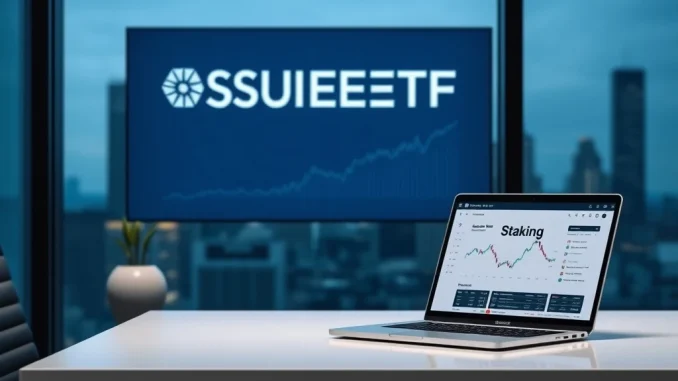
New York, April 2025: Grayscale Investments, a dominant force in digital asset management, has launched a groundbreaking financial product that could reshape institutional crypto access. The Grayscale Sui Staking ETF, trading under the ticker GSUI, offers investors 100% exposure to staking rewards from the Sui blockchain’s native SUI token while charging zero management fees. This move represents a significant evolution in regulated cryptocurrency investment vehicles, merging the yield-generating potential of proof-of-stake networks with the familiar, secure structure of an exchange-traded fund.
Grayscale GSUI ETF: Structure and Core Mechanics
Grayscale’s GSUI ETF is not a traditional equity or commodity fund. Instead, it is structured as a grantor trust that directly holds SUI tokens. The fund’s entire asset base is committed to the Sui network’s staking mechanism. Consequently, the ETF generates yield through two primary channels: the standard staking rewards distributed by the Sui protocol for validating transactions and securing the network, and any potential appreciation in the value of the underlying SUI tokens. Crucially, Grayscale has waived all management fees for this product, a stark contrast to the expense ratios common in both traditional and crypto-focused ETFs. This zero-fee model means that, barring minimal operational and custodial costs, the staking rewards accrued by the fund flow directly to shareholders, distributed periodically.
The operational process is streamlined for the investor. Individuals purchase shares of GSUI on a traditional securities exchange, just like they would shares of Apple or an S&P 500 ETF. Grayscale handles the technical complexities of acquiring the SUI tokens, selecting and managing validators on the Sui network, claiming staking rewards, and navigating the tax reporting requirements for those distributions. This structure provides a critical bridge, offering exposure to a decentralized blockchain’s economic activity through a centralized, regulated, and familiar investment wrapper.
Understanding the Sui Blockchain and Its Staking Model
To comprehend the GSUI ETF’s value proposition, one must understand the Sui blockchain itself. Developed by Mysten Labs and launched in 2023, Sui is a Layer-1 blockchain designed for high-throughput and low-latency applications. It utilizes a delegated proof-of-stake (DPoS) consensus mechanism. In this system, SUI token holders can “stake” their tokens by delegating them to a validator node. These validators are responsible for processing transactions and maintaining the network’s integrity. In return for staking, which enhances network security, participants earn rewards paid out in newly minted SUI tokens.
The Sui staking model involves specific parameters that influence the GSUI ETF’s performance:
- Reward Rate: This variable annual percentage yield (APY) is determined by network protocol and fluctuates based on total staked supply and network activity.
- Unstaking Period: SUI tokens committed to staking enter a lock-up period before they can be withdrawn and traded, introducing an illiquidity factor.
- Validator Selection: Grayscale, as the fund manager, assumes the responsibility of choosing reliable, high-performance validators to maximize rewards and minimize “slashing” risks (penalties for validator misbehavior).
This underlying mechanics transform the ETF from a passive holding vehicle into an active income-generating asset, a feature historically absent from most spot crypto ETFs.
Comparative Analysis: GSUI vs. Other Crypto Investment Products
The launch of GSUI creates a new category within crypto ETPs. Its most direct comparison is with Grayscale’s own flagship product, the Grayscale Bitcoin Trust (GBTC). While GBTC offers pure price exposure to Bitcoin, it does not generate yield and has historically traded at significant discounts or premiums to its net asset value (NAV). GSUI, by generating staking yield, aims to provide a total return component. Furthermore, its zero-fee structure directly addresses a major investor criticism of GBTC’s historically high fee.
Compared to a spot SUI ETF that merely holds the token, GSUI’s staking feature provides an additional return stream, potentially making it more attractive in sideways or moderately bullish markets. However, it also carries the unique risks associated with staking, such as lock-up periods and protocol-specific failures. The table below illustrates key differences:
| Feature | Grayscale GSUI ETF | Spot Crypto ETF (e.g., hypothetical SUI Spot ETF) | Direct SUI Staking |
|---|---|---|---|
| Primary Return | Staking Yield + Token Appreciation | Token Appreciation Only | Staking Yield + Token Appreciation |
| Management Fee | 0% | Typically 0.2% – 0.8% | 0% (but validator may take commission) |
| Custody & Security | Handled by Grayscale/Custodian | Handled by ETF Sponsor/Custodian | Investor’s Responsibility (Hot/Cold Wallets) |
| Regulatory Wrapper | SEC-regulated ETF (Form S-1) | SEC-regulated ETF | Direct Blockchain Interaction |
| Liquidity Access | Instant via Stock Exchange | Instant via Stock Exchange | Subject to Unstaking Period (e.g., 1-30 days) |
| Tax Documentation | Form 1099 Provided | Form 1099 Provided | Investor Must Track & Report |
Market Implications and Strategic Rationale for Grayscale
Grayscale’s launch of GSUI is a strategic maneuver with multiple layers. First, it represents product diversification beyond Bitcoin and Ethereum. By selecting Sui, Grayscale signals confidence in a newer, high-performance blockchain, potentially attracting investors seeking growth beyond the largest crypto assets. Second, the zero-fee model is a powerful competitive weapon. It pressures rival asset managers to justify their fee structures and positions Grayscale as a leader in cost-efficient crypto access.
For the broader market, GSUI could catalyze several trends. It may increase institutional demand for SUI tokens, as the ETF must purchase and stake the underlying asset. This could positively impact Sui’s network security (through higher staked value) and potentially its token economics. Furthermore, it sets a precedent. If GSUI proves successful, expect a wave of similar staking-focused ETPs for other proof-of-stake assets like Solana (SOL), Cardano (ADA), and Polkadot (DOT), fundamentally changing how yield is packaged for mainstream investors.
However, the product also introduces new variables for regulators. The SEC has approved spot Bitcoin ETFs, but a product whose returns are explicitly tied to the operation of a specific blockchain’s consensus mechanism ventures into new territory. Grayscale’s ability to launch GSUI suggests careful navigation of these regulatory waters, potentially paving a path for more complex crypto-native financial products.
Risk Assessment for Potential Investors
While innovative, the GSUI ETF carries a distinct risk profile that investors must thoroughly evaluate. The primary risk remains the volatility of the underlying SUI token. A severe decline in SUI’s market price could wipe out gains from staking yield. Additionally, staking-specific risks are now embedded within an ETF structure:
- Protocol Risk: A critical bug or failure in the Sui network could impact staking operations and token value.
- Validator Risk: Despite Grayscale’s due diligence, if its chosen validators are slashed for downtime or malicious action, the fund’s staked tokens could be penalized.
- Liquidity Mismatch Risk: The underlying SUI tokens are locked in a staking contract with an unstaking period. However, GSUI shares trade freely on an exchange. In a market panic, this could theoretically create a scenario where share redemptions cannot be met instantly with liquid tokens.
- Regulatory Evolution: Future changes in how the IRS treats staking rewards for taxation could affect the product’s after-tax returns.
Investors should view GSUI not as a substitute for a money market fund but as a satellite holding within a diversified portfolio, acknowledging its higher risk-return potential tied to a specific blockchain’s success.
Conclusion
The launch of the Grayscale GSUI ETF marks a pivotal moment in the maturation of cryptocurrency markets. It successfully bridges the decentralized finance (DeFi) concept of staking yield with the traditional, regulated framework of an exchange-traded fund. By offering 100% Sui staking exposure with zero management fees, Grayscale has created a compelling product for investors seeking regulated access to crypto-native yields. The success of this Grayscale GSUI ETF will be closely watched, as it will test investor appetite for structured yield products and likely influence the next generation of crypto ETPs. Its performance will hinge not only on the Sui blockchain’s adoption and technical execution but also on broader market sentiment towards innovative, yield-bearing digital assets.
FAQs
Q1: How does the Grayscale GSUI ETF actually generate yield?
The fund purchases and holds SUI tokens, then “stakes” them on the Sui blockchain network. By participating in network security through staking, the fund earns newly minted SUI tokens as rewards, which are then reflected in the fund’s net asset value and can be distributed to shareholders.
Q2: What does “zero fees” mean for the GSUI ETF?
Grayscale has waived its management fee for this ETF. Investors will not pay an annual expense ratio to Grayscale for managing the fund. However, there will still be minimal costs for custody, administration, and exchange listing, which are typically borne by the fund and thus indirectly affect its NAV.
Q3: Can I lose my staked tokens with this ETF?
The primary risk of loss comes from a decline in the market value of SUI tokens. Regarding staking, while the fund’s validators could be penalized (slashed) for misbehavior, Grayscale assumes this risk through its operational structure and validator selection process. A catastrophic slashing event would impact the fund’s assets, but this is a managed risk.
Q4: How is the GSUI ETF different from just buying and staking SUI myself?
The ETF handles all technical complexity, security, custody, validator selection, and tax reporting (Form 1099). It also provides immediate liquidity through stock exchange trading, bypassing the unstaking lock-up period. In return, you give up direct control over the tokens and pay for the convenience and regulatory safety of the wrapper.
Q5: Is the GSUI ETF approved by the SEC?
Grayscale would have filed a registration statement (like an S-1) with the SEC to launch this ETF. Its launch indicates it has met regulatory requirements for a publicly offered securities product, operating within the established framework for exchange-traded products holding digital assets.
Related News
- Unlocking Potential: Binance Announces UB Perpetual Futures Listing
- MrBeast Crypto Gateway: How a YouTuber Could Redefine Youth Finance
- Crypto Regulation: Trump Treasury Announces Pivotal Policy Shift Toward Digital Assets
Related: DAO Governance Crisis: Vitalik Buterin's Critical Warning on Human Attention Scarcity
Related: Jambo Jarvis: The Revolutionary Solana-Powered Agentic Mobile Device Unveiled
Related: Crypto Market Sentiment Plummets to Extreme Fear as Sector Struggles Amid Volatility