Aave V3 Protocol Secures Future as Crucial V4 Mainnet Launch Nears
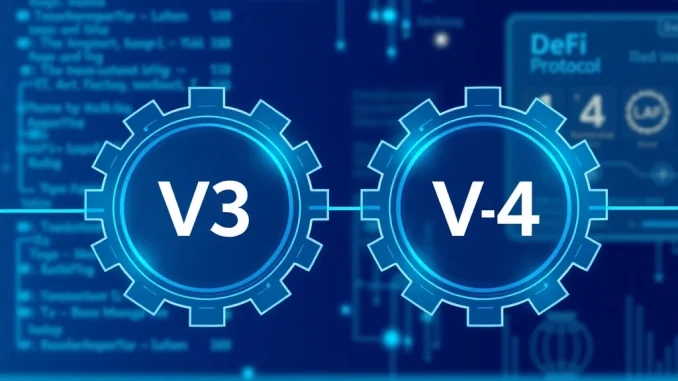
Global, May 2025: The decentralized finance (DeFi) community received crucial clarity this week as the Aave protocol officially confirmed its current Aave V3 iteration will not be deprecated or abandoned following the highly anticipated mainnet launch of Aave V4. This announcement directly addresses speculation and uncertainty, outlining a deliberate, phased transition strategy focused on stability, security, and continued support for existing integrations and users. The move underscores a mature, user-first approach to protocol evolution within the competitive DeFi lending landscape.
Aave V3 Maintains Operational Role Post-V4 Launch
Aave’s governance community and core development teams have finalized a multi-faceted plan for the coexistence of V3 and V4. Contrary to assumptions of a swift replacement, V3 will remain a fully operational and supported protocol on all its deployed networks. This decision stems from several critical operational and strategic considerations. First, numerous third-party applications, wallets, and institutional infrastructures have built deep integrations with V3’s smart contract architecture. A sudden sunset would disrupt these ecosystems and undermine trust. Second, billions of dollars in user deposits and borrowed assets currently reside within V3 markets; a forced migration could introduce unnecessary risk and complexity. The protocol’s leadership emphasizes that the transition will be user-driven, not mandated.
The technical and governance roadmap specifies that V4 will launch with a deliberately slow, capped rollout. Initial total value locked (TVL) caps will be enforced on the new version to manage risk and allow for real-world stress testing in a controlled environment. This cautious deployment mirrors best practices from traditional software development and major blockchain upgrades, prioritizing the security of user funds above all else. During this period, V3 will continue to operate at full capacity, serving as the primary workhorse for the protocol’s liquidity. The development teams have committed to maintaining both codebases, ensuring security audits and necessary updates are applied to V3 for the foreseeable future.
Strategic Implications for DeFi Protocol Development
This dual-protocol strategy represents a significant evolution in how major DeFi projects manage upgrades. Historically, many protocols have executed “hard” migrations, requiring users to manually move assets to new contracts, a process often fraught with friction and security concerns. Aave’s model of parallel operation with incentivized, gradual migration offers a new template. It provides several key advantages:
- Reduced User Friction: Users can migrate at their convenience, avoiding gas fee spikes and UI congestion that often accompany mandatory migration events.
- Enhanced Security: Limiting initial TVL on V4 contains the “blast radius” of any potential undiscovered vulnerability.
- Ecosystem Stability: Partners and integrators have a clear, extended runway to update their systems without service interruption.
The approach also reflects lessons learned from Aave’s own history, including the transition from V2 to V3, which was itself a gradual, multi-chain process. It demonstrates an institutional-grade understanding of managing complex financial systems where continuity is paramount. Other DeFi protocols observing this model may adopt similar phased strategies for their own major version releases, moving the industry away from abrupt, disruptive upgrades.
Coordinating with Partners and the Broader Ecosystem
A critical component of the announced plan is close coordination with partners. The Aave team has established dedicated communication channels with major integrators, including wallet providers like MetaMask and Rabby, front-end interfaces like DeBank, and institutional custody platforms. This coordination ensures that from day one, V4 will be accessible and functional across the tools that users rely on. Furthermore, liquidity incentives and governance rewards for V4 will be carefully calibrated to avoid cannibalizing V3 liquidity too quickly, ensuring both versions remain healthy and functional during the overlap period.
The timeline for V4’s feature parity and eventual potential dominance is intentionally non-prescriptive. Governance proposals will guide the process, potentially adjusting TVL caps and incentive structures based on real-time data regarding adoption rates, security performance, and community sentiment. This flexible, data-driven method places governance token holders (AAVE and stkAAVE) at the center of the transition’s pace, aligning with the protocol’s decentralized ethos.
Conclusion
The clarification that Aave V3 will continue operating with full support after the Aave V4 mainnet launch marks a pivotal moment in DeFi’s maturation. It moves beyond a simplistic narrative of replacement, embracing a nuanced strategy of managed evolution, risk mitigation, and ecosystem stewardship. For users, developers, and liquidity providers, this means stability, optionality, and a clear, low-pressure path forward. As the decentralized finance sector seeks broader adoption, such deliberate and user-centric upgrade protocols will be essential for building the lasting trust and reliability required for mainstream financial use cases. Aave’s planned transition sets a new standard for responsible innovation in the space.
FAQs
Q1: Do I need to immediately move my funds from Aave V3 to V4 when it launches?
No. Aave V3 will remain fully operational and supported. You can choose to migrate your positions to V4 at any time that is convenient for you, based on the features and incentives you find compelling.
Q2: Will Aave V3 still receive security updates and bug fixes?
Yes. The Aave development and security teams have committed to maintaining and updating the V3 codebase for the foreseeable future, ensuring the safety of funds that remain there.
Q3: What is the main reason for launching V4 if V3 is not being shut down?
V4 introduces a new, more modular and efficient architecture designed for long-term scalability, cross-chain interoperability, and enhanced risk management features. It represents the next technological step forward, but V3 remains a robust and proven system.
Q4: How will liquidity be divided between V3 and V4?
Initially, V4 will launch with TVL (Total Value Locked) caps to manage risk. Liquidity incentives (like reward emissions) will be used to gently encourage migration to V4 over time, but V3 will continue to function with its existing liquidity pools.
Q5: Can developers still build new projects that integrate with Aave V3?
Absolutely. The Aave team encourages ongoing integration with V3 and will support developers doing so. The stable, well-audited nature of V3 makes it an excellent choice for many applications, even as V4 becomes available.
Related News
- Playnance Web3 Infrastructure Opens Publicly, Powering Seamless On-Chain Applications
- Bithumb Halts IP Token Transactions: Crucial Network Upgrade Underway
- Robinhood SEI: Unlocking New Opportunities for Crypto Traders
Related: Jambo Jarvis: The Revolutionary Solana-Powered Agentic Mobile Device Unveiled
Related: Crypto Market Sentiment Plummets to Extreme Fear as Sector Struggles Amid Volatility
Related: RaveDAO ($RAVE) Surges 80% as Whale Withdrawal from Bitget Defies Crypto Market Downturn