BNB Undervaluation: The Critical Technical Signals Every Investor Must See
Global, April 2025: Binance Coin (BNB), the native token of the world’s largest cryptocurrency exchange by volume, has entered a statistically significant undervaluation territory, triggering intense scrutiny from market analysts. Current data reveals BNB is trading approximately 37% below its short-term holder realized price, a level that has historically preceded notable price recoveries for the asset. This development occurs amidst a complex macroeconomic backdrop and shifting regulatory landscapes, placing the token at a potential inflection point that warrants a detailed, fact-based examination.
Understanding BNB’s Current Undervaluation Metrics
The concept of “realized price” provides a crucial lens for evaluating market sentiment. Unlike the simple spot price, the realized price calculates the average price at which all coins in circulation were last moved on-chain, weighted by their value. The “short-term holder” subset specifically refers to addresses that have acquired their coins within the last 155 days. When the market price falls significantly below this cohort’s average cost basis, it indicates widespread unrealized losses among recent buyers, often creating a condition of capitulation or extreme pessimism. Historical on-chain data for BNB shows that deviations of this magnitude have, in the past, coincided with local market bottoms, though past performance is never a guarantee of future results. This metric must be considered alongside broader exchange flows, network activity, and fundamental developments within the Binance ecosystem.
Technical Analysis and Key Indicator Convergence
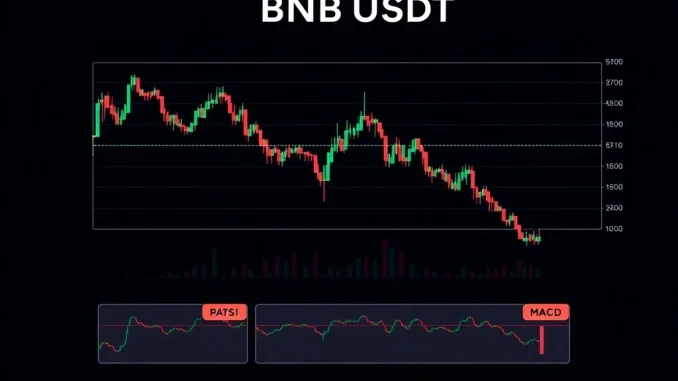
Beyond on-chain metrics, traditional technical indicators are flashing signals that align with the undervaluation thesis. The Relative Strength Index (RSI), a momentum oscillator, currently sits at 35.62. While the classic oversold threshold is 30, readings in the mid-30s often suggest selling pressure is becoming exhausted. More telling is the behavior of the Moving Average Convergence Divergence (MACD) histogram, which measures the distance between the MACD line and its signal line. Analysts observe that the histogram is shrinking, indicating that the momentum of the recent downtrend is decelerating. This convergence of a depressed price below key on-chain cost bases and waning bearish momentum on oscillators forms the core of the current analytical perspective.
- Realized Price Discount: A 37% gap suggests significant stress among recent investors.
- RSI Reading: At 35.62, momentum is weak but not yet at historical oversold extremes.
- MACD Histogram: A shrinking histogram precedes potential trend reversals by signaling slowing momentum.
- Volume Analysis: Declining volume on downward moves can indicate a lack of conviction among sellers.
The $587 Weekly Support: A Line in the Sand
Market technicians have identified the $587 level as a critical weekly support zone for BNB. In market analysis, support represents a price level where buying interest is historically strong enough to prevent the asset from falling further. A weekly timeframe analysis provides a broader, less noisy perspective than daily charts. A sustained breach below this level on a weekly closing basis could invalidate the current bullish divergence setup and signal a continuation of the downtrend, potentially targeting lower support zones. Conversely, a strong rejection of prices at or near this level, accompanied by rising volume, would provide technical confirmation that buyers are actively defending this area, potentially setting the stage for a corrective rally. It is essential to note that support levels are dynamic and can fail, especially during periods of market-wide stress or negative catalyst events.
Contextualizing BNB’s Position in the Broader Crypto Market
The valuation of BNB cannot be analyzed in a vacuum. Its performance is intrinsically linked to several factors. First, the overall health of the cryptocurrency market, often reflected in Bitcoin’s dominance and price action, exerts a major influence. Second, the operational and regulatory standing of the Binance exchange itself is paramount. News regarding licensing, legal settlements, or new product launches directly impacts investor perception of the token’s utility and future demand. Third, the activity on the BNB Smart Chain (BSC) ecosystem—measured by metrics like daily active addresses, transaction counts, and total value locked (TVL) in decentralized finance (DeFi)—provides fundamental demand-side data for the token, which is used to pay transaction fees. A divergence where the token price falls sharply but network activity remains robust can further highlight a valuation disconnect.
Historical Precedents and Cautious Interpretation
Reviewing BNB’s price history reveals several instances where the token became deeply oversold relative to its realized price before experiencing a significant rally. For example, during the market-wide downturn in mid-2022 and again in late 2023, similar technical setups emerged. However, analysts consistently warn against drawing direct parallels. Each market cycle possesses unique macroeconomic drivers, such as interest rate environments, inflation data, and geopolitical events. Furthermore, the regulatory landscape for cryptocurrencies has evolved substantially, adding a new layer of complexity to asset valuations. Therefore, while historical patterns offer a useful framework, they serve as a guide for potential scenarios rather than a predictive blueprint. Responsible analysis always incorporates multiple outcomes and emphasizes risk management.
Conclusion
BNB currently presents a compelling technical picture, characterized by a deep discount to its short-term holder cost basis and converging momentum indicators suggesting bearish exhaustion. The $587 weekly support level stands as the immediate technical focal point for traders and analysts. While these conditions have historically been associated with recovery phases, investors must balance this technical perspective with ongoing fundamental developments within the Binance ecosystem and the broader digital asset market. The current BNB undervaluation zone represents a high-conviction area for market participants, but as with all financial markets, certainty remains elusive, and prudent position-sizing and a focus on long-term fundamentals are advised.
FAQs
Q1: What does it mean that BNB is trading below its “short-term holder realized price”?
This means the current market price is lower than the average price paid by investors who bought BNB within the last five months. It indicates these recent buyers are, on average, sitting on unrealized losses, which can signal market pessimism or capitulation.
Q2: Is an RSI of 35.62 a guaranteed buy signal?
No. While an RSI below 30 is traditionally considered “oversold,” a reading in the mid-30s suggests weakening downward momentum. It is a signal to watch for potential reversal confirmation (like a price breaking above a trendline), not a standalone trigger to buy.
Q3: Why is the $587 price level specifically important?
Technical analysis of BNB’s weekly price chart identifies $587 as a level where buying interest has previously emerged to halt declines. It is a key support zone; a decisive break below it could lead to further selling, while a hold could foster a rebound.
Q4: How does Binance’s performance affect BNB’s price?
BNB’s utility and demand are closely tied to the Binance exchange. Positive developments like increased trading volume, new regulatory approvals, or successful product launches can boost demand for BNB. Conversely, negative news can pressure the price.
Q5: Should historical patterns of recovery be relied upon for investment decisions?
Historical patterns provide context and identify potential scenarios, but they are not guarantees. Market conditions, regulations, and macroeconomic factors change with each cycle. Investment decisions should be based on a comprehensive analysis of current technicals, fundamentals, and personal risk tolerance.
Related News
- Crypto Fund Outflows: The Stunning $1.7bn Weekly Exodus Led by Bitcoin
- Cloud Mining 2025 – Industry Insights: The Safest and Most Transparent Platforms (Daily Payouts, No Hidden Fees)
- Solana Policy Institute Demands Crucial Legal Protections for Blockchain Developers Amid Regulatory Storm
Related: RaveDAO ($RAVE) Surges 80% as Whale Withdrawal from Bitget Defies Crypto Market Downturn
Related: SEC Stablecoin Rules: A Pivotal Shift as Regulators Allow Capital Inclusion with 2% Haircut
Related: HyperGPT and LF Wallet Forge Strategic Alliance to Revolutionize Web3 Access