Strategic Accumulation: Bitmine Acquires $217M in ETH During Market Panic Selling
Global, May 2025: While cryptocurrency markets experienced significant downward pressure throughout much of the month, on-chain data reveals a notable counter-trend. Bitmine, a significant entity in the digital asset space, executed a substantial accumulation of Ethereum (ETH), acquiring over $217 million worth during a two-week period of broad market weakness. This strategic move, which saw the addition of 63,481 ETH to tracked wallets, occurred as many retail and institutional traders engaged in panic selling, highlighting a stark divergence in market behavior and long-term conviction.
Bitmine ETH accumulation details and on-chain verification
Blockchain analytics firms and on-chain data aggregators first flagged the unusual wallet activity in early May. The transactions, which were visible on the public Ethereum ledger, showed a consistent pattern of large ETH purchases flowing into wallets associated with Bitmine. The total accumulation amounted to 63,481 ETH, which at the time of the purchases represented a fiat value exceeding $217 million. This activity was not a single transaction but a series of buys executed across the fortnight, suggesting a deliberate dollar-cost averaging strategy rather than a one-time market order. Analysts cross-referenced these wallet addresses with known Bitmine holdings and prior transaction patterns to confirm the entity’s involvement. The transparency of blockchain technology allows for this level of verification, providing a clear, albeit pseudonymous, record of major market movements.
Context of the broader cryptocurrency market drawdown
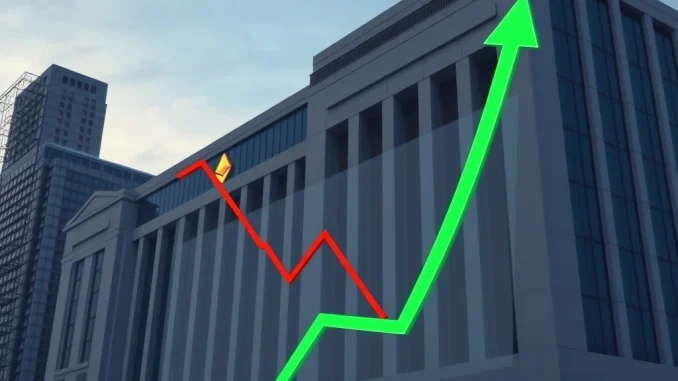
The accumulation period coincided with a pronounced correction across digital asset markets. Several factors contributed to the selling pressure and negative sentiment. Macroeconomic concerns, including persistent inflation data and shifting interest rate expectations from major central banks, weighed on risk assets globally. Within the crypto ecosystem, specific events, such as regulatory announcements from key jurisdictions and the underperformance of certain altcoin sectors, exacerbated the decline. The total cryptocurrency market capitalization fell by approximately 15% during this window, with Ethereum’s price declining from over $3,600 to briefly touch below $3,200. This environment triggered classic panic selling behavior, where traders, fearing further losses, liquidated positions, often at a loss. Trading volume data from major exchanges showed a spike in sell-side activity, while social media sentiment metrics reached bearish extremes.
The historical pattern of contrarian institutional moves
Bitmine’s recent activity fits a historical pattern observed in both traditional finance and cryptocurrency markets. Large, sophisticated entities often build positions during periods of fear and price dislocation, a strategy famously articulated by investor Warren Buffett to “be fearful when others are greedy and greedy when others are fearful.” In the crypto space, similar behavior was observed during previous cycles, such as the accumulation by known entities during the market lows of late 2018 and the March 2020 liquidity crisis. These moves are typically based on a long-term fundamental thesis rather than short-term price action. For Ethereum, the thesis often revolves around its established role as the primary platform for decentralized finance (DeFi) and non-fungible tokens (NFTs), its ongoing technical upgrades to improve scalability and efficiency (like the transition to proof-of-stake), and its growing recognition as a digital commodity. Accumulating during downturns allows these entities to secure assets at a lower average cost basis, positioning themselves for potential future appreciation.
Analyzing the implications for Ethereum’s market structure
Large-scale accumulation by a single entity has several potential implications for Ethereum’s market structure. Firstly, it reduces the immediate liquid supply of ETH on the market. When coins move from exchange wallets or liquid trading pools into long-term custody solutions (often called “cold storage”), they are effectively removed from the daily trading float. This can reduce selling pressure and increase scarcity, a fundamental economic principle. Secondly, it signals confidence to the broader market. While retail sentiment was negative, the visible action of a major player buying can alter market psychology and provide a floor for prices. However, analysts also caution about over-concentration. The distribution of ETH ownership is a metric watched closely by the community. Significant holdings by a few entities, while not uncommon in early-stage asset classes, can raise questions about network decentralization and potential market manipulation risks, though Ethereum’s robust and distributed validator set mitigates some of these concerns.
The table below summarizes key data points from the accumulation event:
| Metric | Detail |
|---|---|
| Entity | Bitmine |
| Asset Accumulated | Ethereum (ETH) |
| Total Quantity | 63,481 ETH |
| Approximate USD Value | $217 Million |
| Accumulation Period | Two weeks in May 2025 |
| Market Context | Broad crypto market drawdown, panic selling |
| Data Source | On-chain wallet analysis |
Expert perspective on long-term holding strategies
Financial strategists observing the cryptocurrency sector note that moves like Bitmine’s are indicative of a maturing market. “We are moving from a phase dominated by speculative, short-term trading to one where established institutions are executing multi-year strategic plans,” explains a portfolio manager at a digital asset fund. “Accumulation during volatility is a textbook institutional maneuver. It requires significant capital reserves, deep conviction in the underlying asset’s fundamentals, and the operational infrastructure to securely custody the assets.” This behavior contrasts sharply with the leverage-fueled trading that often amplifies retail-driven market swings. For Ethereum specifically, experts point to the network’s consistent development roadmap and high levels of developer activity as key fundamentals that long-term holders evaluate, often looking beyond quarterly price charts. The act of moving assets off exchanges also aligns with security best practices, further suggesting a long-term custody mindset rather than a ready-to-sell position.
Technical and fundamental backdrop for Ethereum
Beyond market sentiment, Ethereum’s technical and fundamental position provides context for the accumulation. The network successfully completed its transition to a proof-of-stake consensus mechanism, drastically reducing its energy consumption. Subsequent upgrades have continued to focus on scalability through layer-2 rollups and data sharding. On the adoption front, Ethereum remains the dominant settlement layer for billions of dollars in DeFi total value locked (TVL) and continues to see enterprise adoption for tokenization projects. Furthermore, the Ethereum ecosystem benefits from strong network effects; a vast majority of developers, applications, and users are built on or interact with it. For a entity like Bitmine, these factors represent a moat—a sustainable competitive advantage that is difficult for newer blockchain networks to replicate quickly. Accumulating ETH can be viewed as a bet on the continued growth and utility of this entire ecosystem, not just the native token’s price.
Conclusion
The recent Bitmine ETH accumulation of $217 million during a market downturn serves as a powerful case study in divergent market behavior. While panic selling dominated the short-term narrative, sophisticated actors were executing a long-term strategy based on fundamental analysis and conviction. This event underscores the importance of on-chain data in providing a transparent, real-time view of major market movements that often contradict surface-level sentiment. It also reflects the ongoing maturation of the cryptocurrency market, where institutional capital allocation strategies are becoming more visible and influential. The movement of such a significant quantity of Ethereum into likely long-term storage may have lasting effects on market supply dynamics and investor psychology, reminding market participants that volatility presents opportunity for those with prepared capital and a clear thesis.
FAQs
Q1: Who or what is Bitmine?
Based on available information, Bitmine appears to be a significant entity involved in the cryptocurrency sector, potentially an investment firm, mining operation, or digital asset treasury. Its exact corporate structure is not always publicly detailed, but its market activity is tracked via its on-chain wallet addresses.
Q2: How can we verify that Bitmine bought $217M in ETH?
The verification comes from on-chain data analysis. Blockchain explorers like Etherscan show the transaction history of public wallet addresses. Analysts identify addresses linked to Bitmine through patterns, known interactions, or disclosures. The inflow of 63,481 ETH into these addresses over two weeks is publicly visible and verifiable by anyone.
Q3: What does “panic selling” mean in cryptocurrency markets?
Panic selling refers to a situation where a large number of traders sell their assets rapidly, often driven by fear of further price declines rather than a change in long-term fundamentals. This behavior can create a self-reinforcing cycle of selling pressure, leading to sharp, sometimes exaggerated, price drops.
Q4: Why would an entity buy during a market downturn?
This is a common contrarian investment strategy. The goal is to acquire assets at prices perceived to be below their intrinsic or long-term value. By buying when sentiment is negative and prices are depressed, investors aim to lower their average cost per unit and position for greater potential returns when the market eventually recovers.
Q5: Does large accumulation by one entity risk centralizing Ethereum?
While large holdings raise questions about concentration, Ethereum’s security and governance do not solely depend on token ownership. Its proof-of-stake consensus is secured by a globally distributed set of validators. Ownership concentration is more a concern for market liquidity and price stability than for the network’s technical operation, though the community generally values a wide distribution of tokens.
Related News
- BlockDAG Investors Flock to Remittix Presale for Exclusive 300% PayFi Bonus
- Binance Perpetual Futures: Exciting New LAB and RIVER Listings Unveiled
- Bitcoin Hashrate Plummets: How a Devastating US Winter Storm Crippled Mining Operations
Related: Bitcoin Liquidations Reveal Stunning 'Burj Khalifa' Towers on Market Liquidity Map
Related: Claude Code Security Triggers Devastating $15B Cybersecurity Stock Plunge
Related: DOGEBALL Presale 2026: Analyzing the $100K+ Stage 1 Fundraise and Market Context