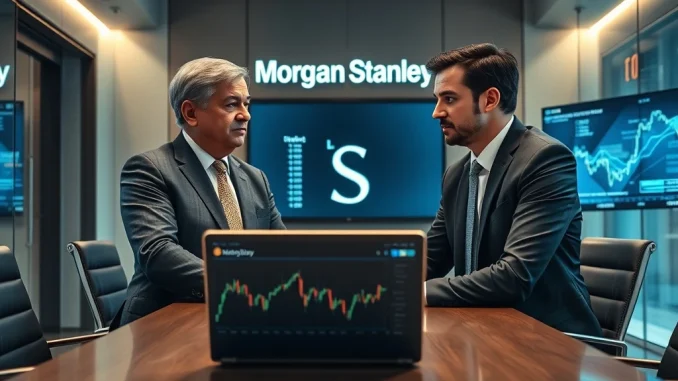
Morgan Stanley Bitcoin Strategy: Phong Le to Reveal Pivotal Long-Term Banking Plans
New York, April 2025: In a significant move highlighting the deepening integration of digital assets into mainstream finance, global investment bank Morgan Stanley and corporate Bitcoin strategy expert Phong Le will host a joint discussion next week. This session promises to dissect the evolving long-term Bitcoin strategy for major financial institutions and corporations, focusing on treasury planning, institutional demand drivers, and the critical regulatory outlook shaping global adoption.
Morgan Stanley Bitcoin Strategy Enters a New Phase
The upcoming dialogue between a titan of traditional finance and a leading voice in corporate digital asset adoption marks a notable inflection point. Morgan Stanley, with over $1.4 trillion in client assets, has been a cautious yet strategic participant in the cryptocurrency space. The bank began offering Bitcoin fund access to its wealth management clients in 2021, a decision that signaled a shift in institutional perception. This forthcoming discussion with Phong Le, known for advising corporations on Bitcoin treasury reserve strategies, suggests a maturation of that initial foray into a more comprehensive, long-term framework.
Analysts view this collaboration as a logical next step. Financial institutions are no longer merely exploring cryptocurrency as a speculative asset class for clients. They are now actively building the infrastructure and formulating the policies required to manage digital assets on their own balance sheets and for sophisticated corporate clients. The conversation will likely address the operational challenges of custody, accounting standards under frameworks like FASB’s new crypto accounting rules, and risk management protocols that satisfy both corporate boards and financial regulators.
Institutional Demand and Corporate Treasury Planning
A core topic for the session will be the sustained institutional demand for Bitcoin and its role in corporate treasury management. Since MicroStrategy’s pioneering move to hold Bitcoin as a primary treasury reserve asset in 2020, a growing number of public and private companies have followed suit. Phong Le’s insights are expected to provide a ground-level view of the decision-making process for CFOs and treasurers.
- Hedging Macroeconomic Uncertainty: Corporations are increasingly viewing Bitcoin as a potential hedge against currency debasement and inflation, diversifying away from traditional cash and cash-equivalent holdings.
- Long-Term Capital Allocation: The discussion will explore how firms integrate Bitcoin into multi-year capital allocation strategies, moving beyond short-term trading to a hold-and-accumulate model.
- Operational Integration: Key practical considerations include secure custody solutions, treasury management system (TMS) compatibility, and liquidity management for potential corporate use cases.
For a bank like Morgan Stanley, understanding this corporate demand is essential. It informs the development of tailored financial products, including structured notes, lending services against digital collateral, and advisory services for mergers and acquisitions involving crypto-native firms.
The Regulatory Landscape: A Defining Factor for Adoption
No long-term strategy can be formulated in a regulatory vacuum. The regulatory outlook, both in the United States and globally, will form a critical pillar of the discussion. The past year has seen increased regulatory clarity in several jurisdictions, alongside ongoing debates about classification and oversight.
Morgan Stanley’s approach must navigate a complex web of rules from the Securities and Exchange Commission (SEC), the Commodity Futures Trading Commission (CFTC), and banking regulators like the OCC. The panel will likely examine the implications of potential spot Bitcoin ETF approvals, the treatment of digital assets under the Bank Secrecy Act, and evolving anti-money laundering (AML) requirements. Phong Le’s perspective will add the corporate angle, highlighting how regulatory uncertainty impacts board-level decisions and the reporting requirements for public companies holding digital assets on their balance sheets.
Historical Context and the Path Forward
The journey of Bitcoin into the institutional fold has been incremental. Following the initial wave of retail interest, the entry of firms like Grayscale with its Bitcoin Trust (GBTC) created the first major institutional investment vehicle. The launch of Bitcoin futures on the CME in 2017 provided a regulated hedging tool. Morgan Stanley’s own entry in 2021 represented the opening of the wealth management channel.
This upcoming discussion represents the next logical chapter: the formalization of strategy for long-term holding and integration at the highest levels of corporate and investment banking. It reflects a transition from “if” to “how.” The implications are far-reaching, potentially influencing how pension funds, endowments, and other large, conservative asset allocators perceive and eventually engage with the asset class.
Conclusion
The joint session between Morgan Stanley and Phong Le is more than a simple panel discussion; it is a bellwether for the maturation of Bitcoin within the global financial architecture. By breaking down long-term Bitcoin strategy, treasury planning, and regulatory navigation, the dialogue will provide critical insights into how traditional finance is building a durable framework for the digital asset era. The outcomes of this strategic planning will influence corporate balance sheets, investment bank product offerings, and the broader trajectory of cryptocurrency adoption for years to come.
FAQs
Q1: What is the significance of Morgan Stanley discussing Bitcoin strategy?
Morgan Stanley is a globally systemically important bank. Its public, in-depth focus on long-term Bitcoin strategy signals a shift from exploratory interest to serious operational planning, lending credibility and providing a roadmap for other major financial institutions.
Q2: Who is Phong Le and why is his perspective important?
Phong Le is recognized as an expert in corporate Bitcoin treasury strategy. He advises companies on the practical and strategic aspects of holding Bitcoin as a reserve asset, making his insights crucial for understanding how non-financial corporations are integrating digital assets.
Q3: What is “Bitcoin treasury planning”?
Bitcoin treasury planning refers to the process by which a corporation decides to allocate a portion of its cash reserves to Bitcoin. It involves considerations of accounting (FASB rules), secure custody, risk management, and the strategic rationale for holding the asset long-term.
Q4: How does regulation affect institutional Bitcoin adoption?
Clear regulation reduces legal and operational uncertainty. Institutions like Morgan Stanley require defined rules on custody, capital requirements, and trading to deploy significant capital. Evolving regulation directly impacts the speed and scale at which they can develop and offer related products and services.
Q5: What does this mean for the average investor?
While focused on institutions, this maturation of infrastructure and strategy can lead to more regulated, accessible, and secure investment products for individual investors, such as new ETFs or integrated services within existing brokerage and banking platforms.
Related News
- Altcoins Face Grim Reality: 99% May Never Recover Previous All-Time Highs, Analysis Shows
- XRPL Permissioned Domains: The Revolutionary Upgrade That Just Went Live
- Bitcoin ETF Outflows Reveal Shifting Investor Sentiment as Major Funds See Fourth Day of Withdrawals
Related: Sonic Labs Spawn: The Revolutionary AI That Builds Web3 Apps Instantly
Related: Stunning: Garrett Jin Moves $760M in Bitcoin to Binance Amid Tariff-Induced Market Turbulence