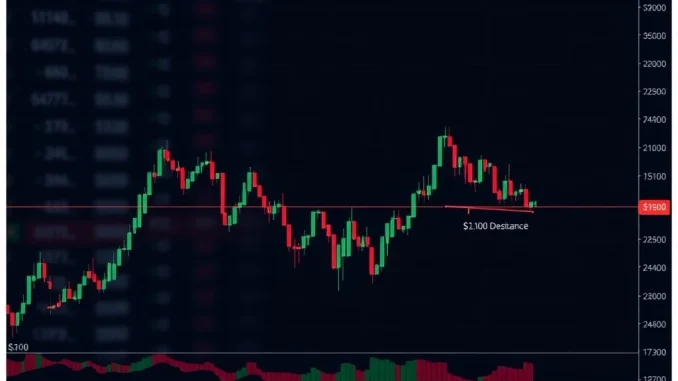
Ethereum Bearish Pennant: The Critical $2,100 Breakout or $1,850 Breakdown Dilemma
Global, April 2025: Ethereum (ETH), the world’s second-largest cryptocurrency by market capitalization, has entered a critical technical phase. After a significant pullback from its recent highs, ETH price action is compressing into a well-defined bearish pennant pattern near the psychologically important $2,000 level. This tightening consolidation signals that a decisive move is likely imminent, with traders and analysts closely monitoring the $2,100 resistance and $1,850 support as the boundaries that will define Ethereum’s next major trend. The resolution of this pattern carries substantial implications for the broader altcoin market.
Decoding the Ethereum Bearish Pennant Pattern
A bearish pennant is a continuation pattern frequently observed in technical analysis. It typically forms after a strong, sharp downward move, which acts as the pattern’s “flagpole.” The price then enters a period of consolidation with converging trendlines, creating a small symmetrical triangle that slopes slightly against the prior trend—this is the “pennant.” The pattern suggests a brief pause before the prior downtrend resumes. For Ethereum, the flagpole was the swift decline from its recent peak, and the current consolidation between $1,850 and $2,100 constitutes the pennant. A breakdown below the lower trendline and the $1,850 support would validate the pattern and often projects a move equal to the length of the initial flagpole. Conversely, a powerful breakout above the upper trendline and the $2,100 resistance would invalidate the bearish setup and could signal a reversal.
Technical Analysis of the $2,100 and $1,850 Price Levels
The two price levels framing this consolidation are not arbitrary. They represent key technical and psychological thresholds that have played significant roles in Ethereum’s recent history. The $2,100 level has acted as both support and resistance multiple times over the past year, creating a dense zone of market memory. A sustained break above it would require significant buying volume to overcome sell-side pressure from previous holders looking to exit at break-even. On the downside, $1,850 has emerged as a formidable support floor during several market corrections. A decisive weekly close below this level would likely trigger stop-loss orders and algorithmic selling, potentially accelerating a decline. Traders are analyzing volume profiles, order book depth, and momentum indicators like the Relative Strength Index (RSI) to gauge the probability of each outcome.
- On-Chain Data Context: Beyond price charts, on-chain metrics provide crucial context. Analysts examine Ethereum’s network activity, including daily transaction counts and gas fees, to assess fundamental demand. The net position change of large holders, often called “whales,” is also monitored, as accumulation near support can signal strength, while distribution near resistance suggests weakness.
- Derivatives Market Sentiment: The futures and options markets offer a window into professional trader sentiment. Key metrics include the funding rate for perpetual swaps (indicating whether longs or shorts are paying fees) and the put/call ratio for options. A high funding rate alongside a tightening pennant can sometimes precede a “long squeeze” if price breaks down.
- Broader Market Correlation: Ethereum’s price action rarely exists in a vacuum. Its correlation with Bitcoin (BTC) remains high. Therefore, a major move in Bitcoin, driven by macro factors or its own technical patterns, could be the catalyst that forces a resolution in ETH’s pennant, regardless of its internal structure.
Historical Precedents and Pattern Reliability
Bearish pennants and similar consolidation patterns have featured prominently in Ethereum’s price history. For instance, in the lead-up to major market cycles in both 2018 and 2022, ETH formed comparable tightening patterns after initial declines, which ultimately resolved with breakdowns. However, there are also examples where such patterns failed, leading to powerful reversal rallies. The key differentiator often lies in market context and catalyst. During periods of strong fundamental development—such as a major network upgrade or a surge in decentralized finance (DeFi) activity—Ethereum has demonstrated an ability to defy bearish technical setups. The current context, including the state of Ethereum’s protocol development (like further advancements in its rollup-centric roadmap) and institutional adoption, will influence how the market interprets the pattern’s resolution.
Potential Market Implications of a Breakout or Breakdown
The direction of the eventual breakout from this pennant will have cascading effects. A successful breakout above $2,100 would likely shift market sentiment from cautious to cautiously optimistic. It could open a path toward testing the next significant resistance zones near $2,300 and $2,500. Such a move would also provide relief for the broader altcoin sector, which often takes its cue from ETH’s performance relative to Bitcoin. A strong ETH could renew interest in layer-2 solutions and DeFi tokens built on its ecosystem.
Conversely, a confirmed breakdown below $1,850 would be a bearish signal with wider repercussions. The initial target projected by the pattern’s measure rule would point toward the $1,600 region, an area that provided strong support in previous market phases. A break below $1,850 could also negatively impact sentiment across the cryptocurrency market, potentially leading to increased selling pressure on other major altcoins. It would reinforce a narrative of continued corrective action or consolidation within the larger market cycle.
| Level | Role | Bullish Scenario | Bearish Scenario |
|---|---|---|---|
| $2,100 | Primary Resistance | Sustained break with high volume targets $2,300+. | Rejection confirms pennant, pressure on $1,850 support. |
| $2,000 | Psychological Midpoint | Holds as support after breakout. | Becomes resistance after breakdown. |
| $1,850 | Primary Support | Holds, forms a higher low, pattern fails. | Break triggers sell-off, targets $1,600 zone. |
Risk Management Considerations for Traders
In such a high-compression, low-volatility environment, professional traders emphasize strict risk management. The period immediately before a pattern’s resolution is often marked by deceptive price movements or “fakeouts.” A common strategy is to wait for a confirmed break—typically a daily or weekly close beyond a level with accompanying volume—before taking a position. Position sizing is also critical; the inherent uncertainty of a coin-toss setup like a symmetrical pennant warrants smaller initial positions that can be added to if the trend confirms. Setting stop-loss orders on the opposite side of the breakout level helps define risk clearly, protecting capital if the market moves abruptly in the unexpected direction.
Conclusion
Ethereum’s formation of a bearish pennant near $2,000 represents a critical inflection point for the asset and a focal point for the cryptocurrency market. The converging price action between the $2,100 breakout and $1,850 breakdown levels indicates that volatility compression is reaching its peak, and a decisive move is statistically likely in the near term. While the pattern itself leans bearish as a continuation signal, its ultimate resolution will be determined by a combination of technical confirmation, trading volume, derivatives market positioning, and broader crypto market dynamics. Market participants are advised to monitor these key levels closely, prioritize risk management, and base decisions on confirmed price action rather than anticipatory speculation. The outcome will provide valuable insight into Ethereum’s medium-term trajectory and market structure strength.
FAQs
Q1: What is a bearish pennant pattern in technical analysis?
A bearish pennant is a continuation chart pattern that appears after a strong downward move. It consists of a sharp decline (the flagpole) followed by a brief, consolidating price channel with converging trendlines (the pennant). It typically suggests the prior downtrend will resume after the consolidation ends.
Q2: Why are the $2,100 and $1,850 levels so important for Ethereum right now?
These levels have established themselves as strong technical and psychological barriers through repeated historical interaction. $2,100 is a key resistance zone where previous selling has occurred, and $1,850 is a major support floor that has halted declines. They now form the boundaries of the current consolidation pattern.
Q3: What would confirm a valid breakout or breakdown from this pattern?
Analysts generally look for a daily or weekly closing price decisively beyond the level ($2,100 or $1,850), preferably accompanied by a significant increase in trading volume. This helps distinguish a genuine breakout from a temporary “fakeout” or false move.
Q4: How does Bitcoin’s price action affect Ethereum’s pennant pattern?
Ethereum maintains a high positive correlation with Bitcoin. A strong directional move in Bitcoin, driven by its own technicals or macroeconomic news, will very likely influence and potentially catalyze the resolution of ETH’s pennant, overriding its internal pattern dynamics in the short term.
Q5: What are the key metrics to watch alongside the price chart?
Important supporting metrics include trading volume on the breakout/breakdown, on-chain data like exchange flows and whale holdings, and derivatives data such as futures funding rates and the options put/call ratio. These help gauge the strength and conviction behind a price move.
Related News
- On-Chain Mechanisms Revolution: Vitalik Buterin's Crucial Blueprint for a Dual-Layer Future
- Binance SAPIEN Listing: Crucial Details for Hodlers Unveiled
- Essential Partnership: Cache Wallet and Bluepill Forge New Frontier in Multichain Asset Protection
Related: Ledn Bitcoin Bond Makes Stunning History with First-Ever S&P Investment-Grade Rating
Related: Morgan Stanley Bitcoin Strategy: Phong Le to Reveal Pivotal Long-Term Banking Plans