Aave’s Pivotal $1B Surge in Tokenized Assets as DeFi Capital Shifts
Global, April 2025: The decentralized finance landscape is undergoing a fundamental transformation. Aave, a leading lending protocol, has officially crossed a pivotal $1 billion threshold in tokenized real-world asset (RWA) deposits. This milestone arrives as aggregate capital locked in traditional DeFi applications contracts, while investment flows decisively toward blockchain-based representations of tangible value like government treasuries and physical commodities.
Aave’s $1B Surge in Tokenized Real-World Assets
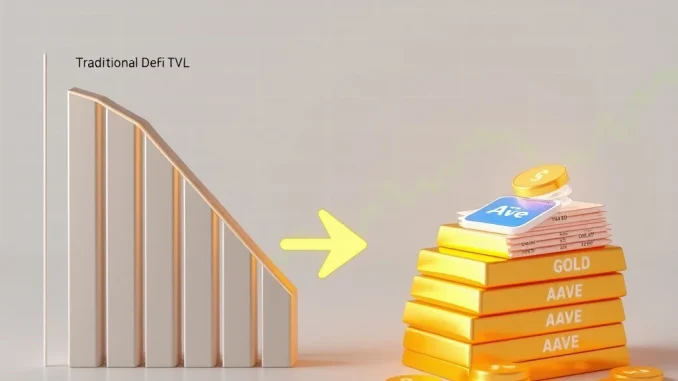
The $1 billion figure represents more than a simple metric; it marks a maturation point for decentralized finance. Aave’s protocol, originally designed for crypto-native lending and borrowing, has successfully expanded its infrastructure to accommodate tokenized versions of off-chain assets. This development indicates that sophisticated capital allocators are increasingly comfortable using DeFi rails for exposure to traditional, yield-generating instruments. The growth is not isolated. Data from industry aggregators shows the total market for tokenized assets has risen 8.68% to approximately $25 billion, even as the broader DeFi Total Value Locked (TVL) has declined by 25% to around $95 billion from recent highs. This divergence highlights a clear capital rotation within the blockchain ecosystem.
The Broader Shift from Pure DeFi to Tokenized Assets
The simultaneous drop in general DeFi TVL and rise in tokenized asset value signals a strategic pivot. Investors appear to be reallocating capital from higher-risk, speculative crypto farming strategies toward assets with established real-world cash flows and collateral backing. The leading segments within the tokenized asset sector provide clear evidence of this flight to perceived stability and tangible value.
- Tokenized Treasuries: U.S. Treasury bills and notes, tokenized by entities like Ondo Finance and Matrixdock, dominate the RWA landscape. They offer a familiar yield product in a more efficient, 24/7 accessible format.
- Tokenized Commodities: Gold, represented by tokens like PAXG, and other commodities are growing as a digital hedge against inflation and currency volatility within crypto portfolios.
- Private Credit & Real Estate: While more complex, platforms are beginning to tokenize portions of private loans and real estate equity, seeking to unlock liquidity in traditionally illiquid markets.
This shift suggests the market is prioritizing asset-backed yield over the algorithmic or incentive-driven yields that characterized the previous DeFi cycle.
Understanding the Mechanics and Drivers
The process of tokenizing a real-world asset involves creating a digital certificate of ownership on a blockchain that is legally tied to the underlying asset. Specialized institutions act as custodians and ensure regulatory compliance. For Aave, integrating these assets means users can now deposit tokenized U.S. Treasuries as collateral to borrow stablecoins or other cryptocurrencies, effectively leveraging their traditional finance holdings within DeFi. Several key drivers fuel this trend:
- Yield Seeking in a High-Rate Environment: With elevated interest rates, tokenized Treasuries offer a compelling, low-risk yield directly on-chain.
- Portfolio Diversification: Crypto natives seek exposure to uncorrelated traditional assets without leaving the blockchain environment.
- Institutional Entry: Traditional finance firms find regulated, asset-backed tokens a more palatable entry point into decentralized finance.
- Technological and Regulatory Maturation: Improved legal frameworks and more robust oracle networks for price feeds have reduced operational risk.
Implications for DeFi, TradFi, and the Future of Finance
Aave’s milestone is a leading indicator for a broader convergence. The movement of real-world assets onto blockchains, or “on-chainization,” could redefine liquidity, settlement times, and accessibility in global finance. For traditional finance (TradFi), it presents both a competitive challenge and a massive efficiency opportunity. For DeFi, it provides a bridge to trillions of dollars in existing capital, moving beyond a closed-loop crypto economy. However, this convergence brings heightened focus on critical areas:
| Area | Consideration | Current Status |
|---|---|---|
| Regulatory Compliance | How securities laws apply to on-chain RWAs | Evolving, with jurisdiction-specific approaches |
| Counterparty Risk | Reliance on off-chain custodians and issuers | Centralized point of failure remains |
| Oracle Reliability | Accuracy of price feeds for non-crypto assets | Improving with multi-source data providers |
| Market Liquidity | Depth of secondary markets for tokenized assets | Growing but still nascent for many assets |
The path forward will likely involve hybrid models that blend DeFi’s transparency and efficiency with TradFi’s regulatory frameworks and asset origination capabilities.
Conclusion
Aave’s achievement of a $1 billion threshold in tokenized real-world assets is a definitive signal of a new phase for decentralized finance. It underscores a strategic capital rotation from purely crypto-native applications toward blockchain-based representations of established financial instruments. This pivot toward tokenized assets like treasuries and commodities reflects a market demand for stability, yield, and tangible collateral. While challenges around regulation and infrastructure persist, the trend points toward an increasingly blended financial future where the line between traditional and decentralized finance continues to blur. The growth of this sector will be a key narrative to watch, as it tests the scalability, security, and regulatory acceptance of blockchain technology for mainstream finance.
FAQs
Q1: What are tokenized real-world assets (RWAs)?
Tokenized RWAs are digital tokens on a blockchain that represent ownership of a physical or traditional financial asset, such as U.S. Treasury bonds, gold, real estate, or private credit. They combine the benefits of blockchain—like 24/7 trading and transparency—with the value of established off-chain assets.
Q2: Why is Aave’s $1B in RWA deposits significant?
It demonstrates that a major DeFi lending protocol can successfully attract large-scale capital for traditional assets. This validates the use case and technological infrastructure, signaling to the broader market that tokenized assets are moving beyond experimentation into a viable, large-scale financial product.
Q3: Why is general DeFi TVL dropping while tokenized assets grow?
The decline in overall DeFi TVL suggests capital is moving away from higher-risk, incentive-driven yield farming protocols. The concurrent growth in tokenized assets indicates that capital is rotating into perceived safer, yield-generating instruments with real-world collateral, reflecting a broader risk-off sentiment or a search for sustainable yield.
Q4: What are the main risks associated with tokenized RWAs?
Key risks include regulatory uncertainty, reliance on the off-chain custodian holding the underlying asset (counterparty risk), potential inaccuracies in oracle price feeds, and currently limited liquidity in secondary markets for some tokenized assets compared to their traditional counterparts.
Q5: How does this trend affect traditional investors?
It provides a new, potentially more efficient channel for traditional investors to gain exposure to blockchain technology through familiar asset classes. Conversely, it introduces new competition and innovation pressure on traditional financial intermediaries, potentially leading to better services and lower costs across the board.
Related News
- Binance Alpha Unlocks Exciting SHARDS Listing
- MetaMask Ondo Partnership: A Revolutionary Step for Tokenized ETFs and Stocks
- Next Crypto to Explode: DeepSnitch AI Presale Draws Focus as Step Finance Hack Exposes $27M Vulnerability
Related: Trump Meme Tokens Crash: Devastating $4.3B Wipeout Leaves Retail Investors Reeling
Related: Global Stablecoin Access: Alchemy Pay Integrates USA₮ for Compliant Payments in 173 Countries