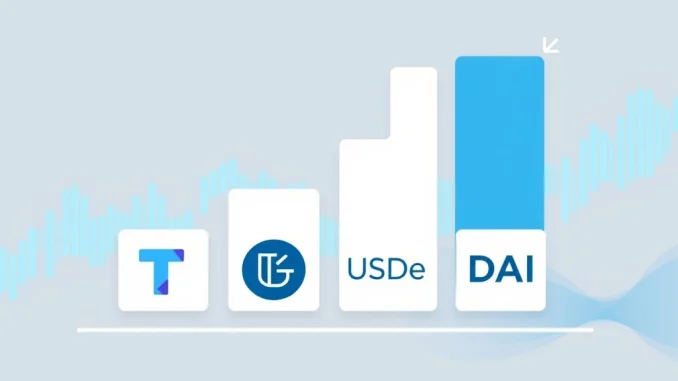
Stablecoins by Market Cap: The Unstoppable Dominance of Tether (USDT) and Its Challengers
Global, May 2025: The stablecoin market, a critical pillar of the modern cryptocurrency ecosystem, continues to demonstrate a clear hierarchy. Recent data confirms Tether’s $USDT maintains a commanding lead with a 59.65% market share, while USD Coin ($USDC), USDe, and DAI form a competitive chasing pack. This distribution of market capitalization reveals much about user trust, regulatory landscapes, and the evolving utility of these digital dollar proxies.
The Undisputed Leader: Tether’s Market Dominance
Tether’s $USDT remains the most widely used stablecoin globally. Its 59.65% market share represents a multi-year consolidation of its position as the primary medium of exchange and liquidity vehicle across centralized and decentralized crypto markets. Analysts attribute this dominance to several key factors. First-mover advantage provided $USDT with deep liquidity pools that became self-reinforcing. Exchanges and traders adopted it early, creating a network effect that is difficult to disrupt. Furthermore, its presence on multiple blockchain networks, including Ethereum, Tron, and Solana, ensures accessibility and reduces transaction friction for a broad user base.
The company behind Tether consistently publishes attestations regarding the reserves backing its tokens, a practice that has evolved in response to past scrutiny. While debates about reserve composition persist, the market has largely voted with its capital, trusting $USDT’s utility and liquidity over perfect transparency. Its primary use case remains clear: facilitating swift trades, providing a safe haven during market volatility, and serving as the default quote currency on countless trading pairs.
The Formidable Challenger: USD Coin’s Strategic Position
Circle’s USD Coin ($USDC) occupies the second-largest position by market capitalization. Unlike $USDT’s broad, exchange-focused growth, $USDC has carved a distinct path by emphasizing regulatory compliance and institutional adoption. Its reserves consist of cash and short-dated U.S. Treasury bills, held with regulated U.S. financial institutions, a structure that appeals to traditional finance entities and developers building compliant financial applications.
$USDC’s integration into legacy payment systems, such as through partnerships with Visa, and its role as the default stablecoin on major decentralized finance (DeFi) protocols like Compound and Aave, showcase its dual-track strategy. It targets both the permissioned world of traditional finance and the permissionless innovation of DeFi. This positioning makes $USDC not just a competitor in market cap but a strategic alternative with a different value proposition centered on trust through regulation and auditability.
The Rise of Algorithmic and Synthetic Challengers
The stablecoin landscape is no longer a simple duel. Newer entrants like $USDe and $DAI represent innovative models challenging the fiat-collateralized paradigm. $USDe, or ‘synthetic dollar,’ utilizes a novel mechanism involving staked Ethereum to generate yield while maintaining its peg, appealing to users seeking returns on their stable assets. DAI, the flagship decentralized stablecoin from MakerDAO, maintains its peg through over-collateralization with crypto assets and, increasingly, real-world assets (RWAs).
These projects demonstrate that market capitalization is not solely about size but also about technological diversity and resilience. They answer different user needs: $DAI offers censorship resistance and decentralized governance, while $USDe explores yield-bearing stability. Their presence in the top ranks signals a maturing market where utility extends beyond simple trading to encompass earning strategies and decentralized financial sovereignty.
Implications for the Broader Crypto Economy
The concentration of stablecoin value has significant ramifications. First, it highlights the immense power and systemic importance of the leading issuers. A technical issue or regulatory action against a major player like Tether could create widespread market instability. Second, the distribution influences DeFi. Protocols must decide which stablecoins to integrate for lending, borrowing, and liquidity, often prioritizing those with the deepest liquidity ($USDT) or strongest compliance credentials ($USDC).
Furthermore, this market structure directly interacts with global monetary policy. Hundreds of billions of dollars in digital dollar equivalents exist outside the traditional banking system, yet remain pegged to its unit of account. Central banks worldwide are studying this phenomenon as they develop their own digital currencies (CBDCs). The success of private stablecoins provides both a blueprint and a competitive benchmark for public digital money initiatives.
- Liquidity Anchor: $USDT acts as the primary liquidity layer for the entire crypto market.
- Regulatory Bellwether: $USDC’s growth is closely tied to evolving U.S. digital asset regulations.
- Innovation Indicator: The presence of $DAI and $USDe in the top ranks shows demand for non-traditional stablecoin models.
- Systemic Risk Factor: High market concentration creates potential single points of failure.
Conclusion: A Market Defined by Stability and Competition
The ranking of stablecoins by market capitalization tells a story of entrenched dominance, strategic differentiation, and relentless innovation. Tether’s $USDT continues to lead due to unparalleled network effects, while $USDC provides a regulated alternative for institutions. Meanwhile, projects like $USDe and $DAI prove there is room for algorithmic and decentralized models to capture significant value. Understanding this hierarchy is essential for anyone navigating the cryptocurrency space, as these digital dollars form the bedrock upon which trading, lending, and the future of programmable finance are built. The stablecoin market cap is more than a leaderboard; it is a real-time map of trust, utility, and financial evolution in the digital age.
FAQs
Q1: What is a stablecoin?
A stablecoin is a type of cryptocurrency designed to maintain a stable value relative to a specific asset, most often the U.S. dollar. They achieve this stability through various mechanisms like holding cash reserves, using algorithms, or locking up other cryptocurrencies as collateral.
Q2: Why does Tether (USDT) have such a large market share?
Tether benefits from a powerful first-mover advantage, having been launched in 2014. It established deep liquidity on virtually every major cryptocurrency exchange first, creating a network effect where its utility as a trading pair and liquidity tool became self-reinforcing, making it the default choice for many traders.
Q3: How is USD Coin (USDC) different from Tether?
While both are fiat-collateralized stablecoins pegged to the U.S. dollar, USD Coin places a stronger emphasis on regulatory compliance and transparency. Its reserves are held with U.S. regulated financial institutions and consist of cash and short-term U.S. Treasuries, with regular attestations from major accounting firms. It is also more integrated into traditional finance systems.
Q4: What makes DAI a ‘decentralized’ stablecoin?
DAI is not issued by a single company. It is created by the Maker Protocol, a decentralized autonomous organization (DAO). Users generate DAI by locking up collateral (like Ethereum) in smart contracts. Its stability is maintained through decentralized governance and over-collateralization, meaning the value of the locked assets always exceeds the value of the DAI created.
Q5: Are stablecoins safe?
Safety depends on the type of stablecoin and the entity behind it. Risks include the issuer failing to hold sufficient reserves (for collateralized types), the failure of complex algorithms (for algorithmic types), smart contract bugs, and regulatory intervention. It’s crucial to research the model, transparency, and governance of any stablecoin before use.
Related News
- USDC Transfer Mystery: Stunning $708 Million Binance Exodus Sparks Market Speculation
- Binance Wallet TGE: Exclusive OKZOO Token Generation Event Set for April 25
- Crucial Binance Delisting: BSW Perpetual Futures Contract Faces Impact
Related: Supreme Court Overturns Trump Tariffs: Analyzing the Immediate Bitcoin and Crypto Market Reaction
Related: Dubai Real Estate Tokenization Pilot Enters Crucial Phase Two with Secondary Trading Launch