Solana’s Monumental Surge: Nears $1B in Tokenized Real-World Assets Fueled by BlackRock and Ondo
Global, April 2025: The Solana blockchain is on the cusp of a historic financial milestone, with the total value of tokenized real-world assets (RWAs) on its network nearing $1 billion. This explosive growth, largely catalyzed by recent expansions from financial titan BlackRock and digital asset firm Ondo Finance, signals a profound shift in how institutional capital engages with blockchain technology. The convergence of traditional finance and decentralized networks is no longer theoretical; it is being quantified on-chain, with Solana emerging as a primary infrastructure layer.
Solana’s Path to a Billion-Dollar RWA Milestone
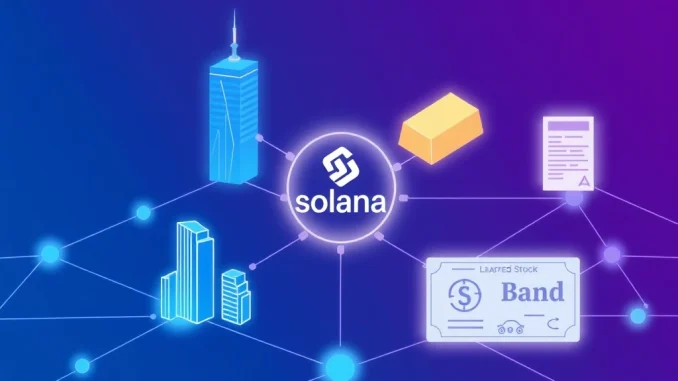
Tokenization, the process of converting rights to a physical or financial asset into a digital token on a blockchain, represents one of the most tangible use cases for distributed ledger technology. For years, proponents have argued its potential to unlock liquidity, reduce settlement times, and democratize access to investment classes like treasury bills, real estate, and private credit. Solana, with its high throughput and low transaction costs, has become a favored settlement layer for this innovation. On-chain analytics platforms now track a rapid ascent in the total value locked (TVL) within RWA protocols on Solana, a figure swiftly approaching the symbolic $1 billion threshold. This growth trajectory is not organic or retail-driven alone; it bears the distinct fingerprints of institutional strategy and validation.
The BlackRock BUIDL Effect and Ondo’s USDY Catalyst
The acceleration in Solana’s RWA ecosystem can be directly linked to two pivotal developments in early 2024. First, BlackRock, the world’s largest asset manager, launched its BlackRock USD Institutional Digital Liquidity Fund (BUIDL). This fund tokenizes shares as digital assets, allowing qualified investors to earn U.S. dollar yields by holding a token representing a share in a fund holding cash, U.S. Treasury bills, and repurchase agreements. While BUIDL initially launched on Ethereum, its underlying infrastructure and the movement of its tokens have significantly involved the Solana blockchain for secondary market activity and interoperability, bringing substantial institutional credibility and capital flow to the network.
Concurrently, Ondo Finance, a leader in the RWA space, expanded the reach of its flagship product, USDY. USDY is a tokenized note backed by short-term U.S. Treasuries and bank demand deposits, offering a yield-bearing alternative to traditional stablecoins. Ondo’s decision to make USDY natively available on Solana provided a high-quality, yield-generating asset that could be seamlessly integrated into the blockchain’s vibrant DeFi ecosystem. The combination created a powerful flywheel: BlackRock’s entry validated the asset class, and Ondo provided a compliant, scalable product that could be utilized across Solana’s lending, borrowing, and trading protocols.
Decoding the Institutional On-Chain Strategy
The movement of firms like BlackRock and Ondo onto chains like Solana is not a speculative bet but a strategic operational decision. Institutions are primarily motivated by efficiency gains, programmability, and access to a 24/7 global market. Tokenizing assets on a high-performance blockchain allows for near-instant settlement, reduced counterparty risk through smart contracts, and the creation of new financial products through composability. For example, a tokenized treasury bill can be used as collateral in a decentralized lending protocol within minutes, something impossible in traditional finance. Solana’s architecture, which can handle thousands of transactions per second at minimal cost, makes these use cases economically viable at scale, attracting developers and financial engineers to build the necessary infrastructure.
Implications for the Broader Blockchain and Financial Landscape
Solana nearing $1 billion in RWAs is a microcosm of a larger trend reshaping finance. It demonstrates that blockchain utility is expanding beyond cryptocurrency trading into the core machinery of global capital markets. This has several concrete implications:
- Infrastructure Competition: The race is on among blockchain networks to provide the most secure, scalable, and compliant environment for tokenized assets. Solana’s current progress positions it as a strong contender alongside Ethereum.
- Regulatory Scrutiny: As tokenized securities grow, regulatory clarity becomes paramount. The structure of products like BUIDL and USDY is designed to operate within existing U.S. securities frameworks, setting a precedent for future offerings.
- New Investor Archetypes: This bridges two worlds: traditional finance investors seeking blockchain efficiency and crypto-native investors seeking exposure to real-world yield, fundamentally altering capital flows.
Conclusion: A New Chapter for Solana and Finance
The approach of a $1 billion valuation for tokenized real-world assets on Solana marks a definitive inflection point. It is a metric that transcends crypto-native narratives and speaks the language of global finance. The boost from BlackRock’s institutional heft and Ondo’s innovative product suite has provided more than just capital; it has provided a blueprint. This milestone validates Solana’s technical proposition for high-value financial applications and underscores the irreversible momentum of asset tokenization. As this sector matures, the focus will shift from reaching billion-dollar milestones to integrating these digital assets into the everyday fabric of lending, trading, and investment on a global scale, with Solana positioned as a critical piece of market infrastructure.
FAQs
Q1: What are tokenized real-world assets (RWAs)?
Tokenized RWAs are digital tokens on a blockchain that represent ownership or a claim on a physical or traditional financial asset, such as real estate, government bonds, commodities, or private equity funds. They aim to make these assets more liquid, accessible, and easier to trade.
Q2: Why is BlackRock’s BUIDL fund significant for Solana?
While BUIDL is primarily an Ethereum-based fund, its operations and the movement of its tokens heavily involve Solana. BlackRock’s participation brings unprecedented institutional credibility, regulatory scrutiny, and large-scale capital to the blockchain, encouraging other traditional finance entities to explore Solana for similar tokenization projects.
Q3: How does Ondo Finance’s USDY work on Solana?
USDY is a tokenized note backed by safe, short-term assets like U.S. Treasuries. When issued natively on Solana, it becomes a yield-bearing digital asset that users can hold, trade, or use as collateral within Solana’s decentralized finance (DeFi) ecosystem, combining traditional yield with blockchain utility.
Q4: What advantages does Solana offer for tokenizing assets?
Solana offers high transaction throughput (thousands per second), very low fees (fractions of a cent), and fast block times. This makes it cost-effective and efficient for issuing, trading, and managing tokenized assets, especially for high-frequency or micro-transactions within complex financial applications.
Q5: Does this mean cryptocurrencies are becoming more tied to traditional finance?
Yes, but in a specific way. This trend, often called “TradFi meets DeFi,” shows that blockchain technology is being adopted to improve traditional financial processes. It doesn’t replace cryptocurrencies like Bitcoin but creates a new hybrid financial system where digital assets represent both novel crypto assets and digitized versions of traditional ones.
Related News
- Top 5 Crypto Trading Platforms for 2025: What’s New, What’s Next
- Crypto Market Structure Bill Stalls in Senate After Critical Coinbase Objections Spark Legislative Gridlock
- Bitcoin's 21 Million Supply: The Unshakeable Edge Amid Market Volatility
Related: Dubai Real Estate Tokenization Pilot Enters Crucial Phase Two with Secondary Trading Launch
Related: Crucial: Vital Block Launches Comprehensive Security Audit for MyShell AI on Binance Network
Related: Bitcoin Breakout Hinges on Nasdaq Surge, Expert Warns Amid Market Stalemate