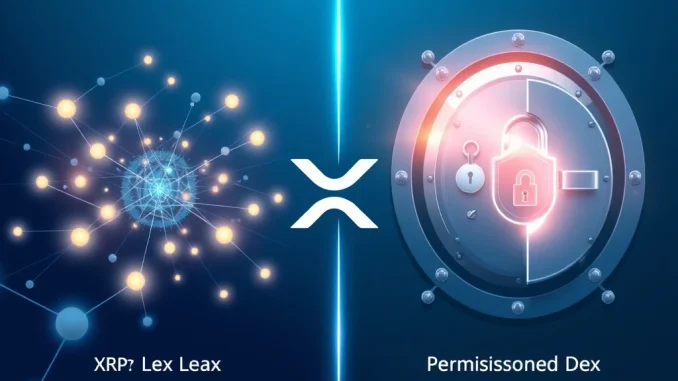
XRP Ledger Permissioned DEX Launches: The Crucial XLS-81 Upgrade for Regulated Institutions
Global, May 2025: The XRP Ledger (XRPL), one of the oldest and most established blockchain networks, has activated a pivotal upgrade that fundamentally alters its capacity to serve regulated financial entities. The Permissioned Decentralized Exchange (DEX), formally implemented through the XLS-81 amendment, is now operational. This development creates a parallel, gated trading environment designed specifically for institutions requiring strict Know Your Customer (KYC) and Anti-Money Laundering (AML) compliance, while the network’s original, permissionless DEX remains fully intact and unchanged. The move signals a strategic evolution for XRPL, positioning it as a dual-purpose ledger capable of serving both open decentralized finance and the nuanced demands of traditional finance.
XRP Ledger Permissioned DEX: Decoding the XLS-81 Upgrade
The activation of XLS-81 represents the culmination of a multi-year development and governance process native to the XRP Ledger. Unlike a hard fork or a separate blockchain, this is a feature amendment activated through the ledger’s unique consensus process, where validator operators vote on proposed changes. The Permissioned DEX is not a replacement but an additive layer. It functions by allowing issuers of assets—such as banks, payment providers, or licensed financial institutions—to create “gated” trading venues. Within these venues, only pre-vetted and approved counterparties can engage in trustline-based trading of those specific assets. This mechanism enforces compliance at the protocol level, a significant technical achievement. The core XRP asset and all other trading pairs on the open DEX continue to operate without any restrictions, preserving the ledger’s foundational decentralized nature.
Technical Architecture and Institutional Implications
The technical implementation of the Permissioned DEX is elegantly integrated into the existing XRPL infrastructure. It leverages the ledger’s native decentralized exchange functionality but adds a critical permissioning layer. An issuer can now set specific flags on their issued currency, designating it for use only within a controlled environment. The process involves three key parties: the asset issuer, the gatekeeper (who manages the allowlist), and the approved users. This structure directly addresses several longstanding barriers to institutional blockchain adoption.
- Regulatory Compliance: It provides a clear, auditable on-chain trail for KYC/AML purposes, satisfying regulatory requirements for licensed entities.
- Risk Mitigation: Institutions can limit counterparty risk by trading only with other verified participants, reducing exposure to unknown or unregulated entities.
- Market Integrity: It enables the creation of private markets for securities tokenization, real-world asset (RWA) trading, and closed institutional liquidity pools without exposing them to the public DEX’s volatility or accessibility.
This bifurcated model—an open public market and closed private markets—mirrors structures seen in traditional finance, such as public stock exchanges versus private over-the-counter (OTC) trading desks.
A Historical Context: XRPL’s Evolution Towards Dual Utility
The XRP Ledger, launched in 2012, has always featured a built-in decentralized exchange. For years, this DEX saw limited mainstream adoption compared to the explosive growth of automated market maker (AMM) models on networks like Ethereum. However, XRPL’s design priorities—speed, low cost, and settlement finality—have consistently appealed to financial institutions. The development of the Permissioned DEX can be seen as a direct response to feedback from that sector. It is a logical extension of Ripple’s work with central banks on Central Bank Digital Currency (CBDC) platforms and with commercial banks on cross-border payment solutions. The upgrade allows the same ledger that settles payments in seconds to also host compliant capital markets activity, creating a unified value layer for both payments and asset trading.
Comparative Analysis: Permissioned vs. Open DEX on XRPL
Understanding the distinction between the two DEX environments is crucial. The following table outlines their core operational differences:
| Feature | Open (Permissionless) DEX | Permissioned DEX (XLS-81) |
|---|---|---|
| Access | Open to any XRPL account | Restricted to allowlisted accounts per issuer |
| Compliance | No built-in KYC/AML | KYC/AML enforced by gatekeeper |
| Asset Control | Issuer has standard controls | Issuer can restrict trading to specific venues |
| Primary Use Case | Public, decentralized trading of XRP and community tokens | Institutional trading of tokenized assets, private liquidity pools |
| Settlement | On-ledger, in 3-5 seconds | On-ledger, in 3-5 seconds |
This dual-model approach is unique. It avoids the common compromise where networks either cater solely to decentralized ideals or rebuild entirely as permissioned, private ledgers. XRPL now supports both paradigms simultaneously on a single, public, and auditable state machine.
Potential Impact and Future Trajectory for the XRP Ledger Ecosystem
The immediate consequence of XLS-81’s activation is the unlocking of new utility. Financial institutions exploring asset tokenization—be it equity, debt, or funds—now have a regulated, blockchain-native venue for issuance and secondary trading. This could accelerate the tokenization of real-world assets (RWA) on XRPL. Furthermore, it provides a compliant pathway for the trading of stablecoins and other regulated digital currencies. The long-term implication is a potential influx of institutional liquidity and development focus onto the XRP Ledger. Developers may begin building specialized front-end interfaces and custody solutions tailored for these gated markets. However, success is not automatic. Adoption will depend on institutions choosing to issue assets on XRPL over competing regulated platforms or private blockchains. The network’s proven reliability, low cost, and now, its compliance-ready architecture, form a compelling proposition.
Conclusion
The live activation of the XRP Ledger Permissioned DEX via the XLS-81 amendment marks a significant inflection point for the network. It transcends a mere technical upgrade, representing a strategic broadening of the ledger’s addressable market. By seamlessly integrating a compliance layer into its decentralized foundation, XRPL has crafted a hybrid model that respects the principles of open finance while pragmatically embracing the necessities of global institutional finance. This development positions the XRP Ledger not just as a payments network, but as a comprehensive platform for the next generation of digital asset markets, serving both the decentralized community and the regulated world from a single, efficient ledger.
FAQs
Q1: Does the Permissioned DEX replace the existing XRP Ledger DEX?
A1: No, it does not replace it. The open, permissionless DEX remains fully operational and unchanged. The Permissioned DEX is an additional, parallel feature that creates gated trading venues for specific, compliance-heavy use cases.
Q2: Can I still trade XRP freely on the XRP Ledger?
A2: Yes, absolutely. The XRP asset itself is not subject to the permissioning rules of XLS-81. Trading of XRP against other currencies continues exactly as before on the open DEX, with no restrictions or KYC required at the protocol level.
Q3: Who controls the allowlist for a Permissioned DEX venue?
A3: Control is designated by the asset issuer. The issuer can appoint a “gatekeeper” (which could be themselves or a trusted third-party service) to manage the list of approved addresses allowed to hold and trade that specific issued asset.
Q4: What is a real-world example of how this could be used?
A4: A bank tokenizing a commercial paper offering could issue the digital securities on the XRP Ledger. Using the Permissioned DEX, it could restrict trading to a list of pre-approved institutional investors (like asset managers and other banks) who have passed KYC checks, creating a private, compliant secondary market for those securities.
Q5: How does this affect the decentralization of the XRP Ledger?
A5: The core consensus mechanism and ledger validation remain decentralized. The permissioning only applies to specific issued assets within their designated venues. The network’s ability to process transactions, including those for the open DEX and XRP payments, continues to be governed by the distributed validator network. It is a feature of application logic, not a change to network governance.
Related News
- Bitcoin's Alarming Weakness Against Gold Challenges Digital Gold Narrative
- Trading212 Crypto ETNs: The Critical FCA License Oversight Every UK Investor Must Understand
- Yellow Network: Solving Scalability & Liquidity Challenges in Crypto Trading with State Channels
Related: RWA TVL Milestone: How Securitize, Ondo, and Syrup Achieved the Crucial $1B Breakthrough
Related: Seized Bitcoin Recovery: Authorities Reclaim $21M After Critical Custody Breach
Related: Alchemy Pay Expands Global Access with Fiat On-Ramp Support for Ultima's $ULTIMA Token