BlockDAG Presale Enters Final Phase Before March 4 Trading as Uniswap Consolidates and Tron Tests $0.28
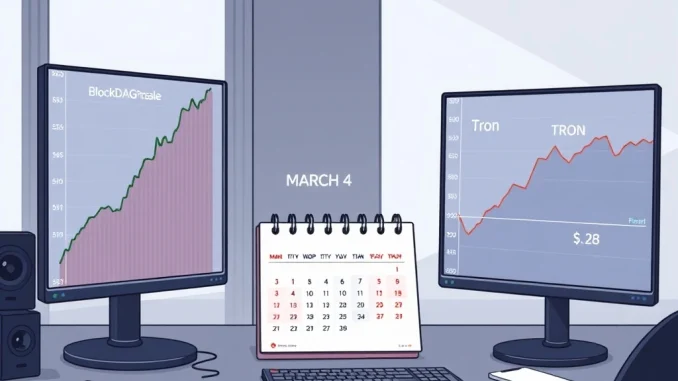
Global, February 2025: The cryptocurrency market presents a mixed landscape as a new project, BlockDAG, approaches its global trading debut on March 4. The project concludes its final presale access phase at $0.000125 per token, with analysts referencing a potential 400× growth model based on its underlying structure. This development occurs alongside observable price consolidation for the decentralized exchange token Uniswap (UNI) and a stalling price action for Tron (TRX) as it tests the $0.28 resistance level. These concurrent events highlight the diverse phases and strategies present within the digital asset ecosystem.
Analyzing the BlockDAG Presale and March 4 Trading Debut
BlockDAG represents a newer entrant in the blockchain space, utilizing a Directed Acyclic Graph (DAG) structure combined with traditional blockchain security elements. This hybrid approach aims to address scalability challenges that have historically plagued earlier blockchain networks. The presale mechanism allows early participants to acquire tokens before they become available on public exchanges, a common practice for funding development and building initial community distribution.
The cited 400× potential figure originates from comparative analysis with early valuation models of other scalable blockchain projects and their post-listing performance histories. It is crucial to understand that such projections are inherently speculative and based on theoretical growth models, not guarantees. The final presale price of $0.000125 establishes an initial benchmark against which future market pricing will be compared after March 4, when trading is scheduled to commence on various global cryptocurrency exchanges. Market observers typically monitor such debuts for insights into investor appetite for novel blockchain architectures.
Uniswap Price Consolidation Within a Broader Market Context
Simultaneously, Uniswap, a leading decentralized exchange (DEX) protocol, shows signs of price consolidation. UNI, its governance token, has experienced a period of reduced volatility and sideways trading. Consolidation phases are standard technical market phenomena where an asset’s price moves within a relatively constrained range following a period of significant upward or downward movement. For Uniswap, this period allows the market to absorb previous price actions and establish new support and resistance levels.
Several fundamental factors can contribute to this consolidation. These include:
- Protocol Development Cycles: Periods between major protocol upgrades or fee switch implementations can lead to reduced speculative trading.
- Overall DeFi Activity: UNI’s value is partially correlated with the total value locked (TVL) and trading volume across the broader decentralized finance sector.
- Regulatory Landscape: Ongoing regulatory clarity concerning DEXs and governance tokens can influence investor sentiment and trading patterns.
Analysts view consolidation as a neutral, healthy process that can precede the next significant price trend, determined by subsequent market catalysts and fundamental developments.
The Technical and Fundamental Picture for Tron at $0.28
The Tron network, designed for high-throughput decentralized applications and content sharing, faces a key technical test at the $0.28 price level. This price point has acted as both support and resistance at various times in TRX’s trading history, making it a psychologically significant level for traders. A stall at this level indicates a balance between buying and selling pressure, where neither bulls nor bears have established clear dominance.
Fundamentally, Tron’s price action interacts with network metrics such as:
- Daily active addresses and transaction counts.
- Growth of its stablecoin ecosystem, particularly USDT issued on the TRON network.
- Energy and bandwidth consumption by dApps, indicating developer and user activity.
A sustained move above $0.28 on significant volume could signal renewed bullish momentum, while repeated rejection could indicate a need for further accumulation or a test of lower support levels. This stalling action is a microcosm of the broader market’s search for direction amid mixed macroeconomic signals.
Comparative Market Dynamics and Investor Considerations
The juxtaposition of a project in its final presale phase (BlockDAG), an established protocol in consolidation (Uniswap), and a network testing a key price level (Tron) illustrates the multi-speed nature of the cryptocurrency market. Each scenario represents a different risk-return profile and time horizon for participants.
Presale investments in projects like BlockDAG carry high risk due to their unproven track record, lack of liquid trading history, and dependence on successful technical execution and post-listing market reception. In contrast, established assets like UNI and TRX offer extensive historical data, known liquidity profiles, and clearer correlation with sector-wide trends, though they are not immune to volatility.
Informed market participation requires distinguishing between:
- Speculative Potential: Based on technological promise and early-stage growth models.
- Technical Analysis: Reading price charts and volume data for established assets.
- Fundamental Analysis: Evaluating network usage, developer activity, and revenue models.
The week leading to March 4 will likely see increased scrutiny on BlockDAG’s final community metrics and exchange listings, while traders will watch for breakout or breakdown signals from Uniswap and Tron’s respective patterns.
Conclusion
The current cryptocurrency landscape is defined by distinct narratives unfolding in parallel. BlockDAG’s approach to its March 4 trading debut after a final presale phase brings a new scalable blockchain model to a liquid market, where its theoretical potential will face real-world testing. Meanwhile, Uniswap’s price consolidation reflects a mature asset digesting previous moves and awaiting its next fundamental catalyst, and Tron’s stalling action at $0.28 underscores ongoing battles at key technical levels. Together, these movements underscore the importance of context, timing, and rigorous analysis for understanding the complex and evolving digital asset market. The outcomes post-March 4 will provide valuable data points on market reception for new architectures and the strength of existing networks.
FAQs
Q1: What is the significance of March 4 for BlockDAG?
March 4, 2025, is the scheduled date for BlockDAG tokens to begin trading on public cryptocurrency exchanges globally, marking the transition from a closed presale to an open, liquid market.
Q2: What does a 400× potential mean in cryptocurrency?
It is a speculative growth projection, often based on comparative analysis with historical projects. It suggests a theoretical scenario where an asset’s value could multiply by 400 times from its starting point, but this is a high-risk model, not a prediction or guarantee of future performance.
Q3: Why is Uniswap’s price consolidating?
Price consolidation is a normal market phase where trading activity stabilizes within a range. For Uniswap, it may follow prior volatility, allowing the market to evaluate recent protocol developments, overall DeFi sector health, and regulatory news before establishing a new trend.
Q4: Why is the $0.28 level important for Tron?
In technical analysis, price levels that have historically acted as strong support or resistance become psychologically significant. $0.28 has been such a level for TRX, making its ability to hold above or break through it a key indicator of short-term trader sentiment.
Q5: What is the main difference between a presale and public trading?
A presale is a limited, early-stage offering of tokens to selected participants, often at a fixed price, to fund development. Public trading on exchanges involves continuous, open-market buying and selling by anyone, with prices determined by real-time supply and demand.
Related News
- Travala’s New Bitcoin Incentives Aim to Boost Crypto Adoption & Real-world Utility
- Revolutionary USD1 Points Program Unveiled by World Liberty Financial on Gate.io
- Kraken Acquisition: Strategic Move Bolsters Crypto Trading Platform Capabilities
Related: Injective (INJ) Price Analysis: Decoding the Critical $3 Support Test
Related: RWA TVL Milestone: How Securitize, Ondo, and Syrup Achieved the Crucial $1B Breakthrough
Related: Seized Bitcoin Recovery: Authorities Reclaim $21M After Critical Custody Breach