Ether.fi Crypto Cards Make Pivotal Shift to Optimism for Blazing-Fast Payments
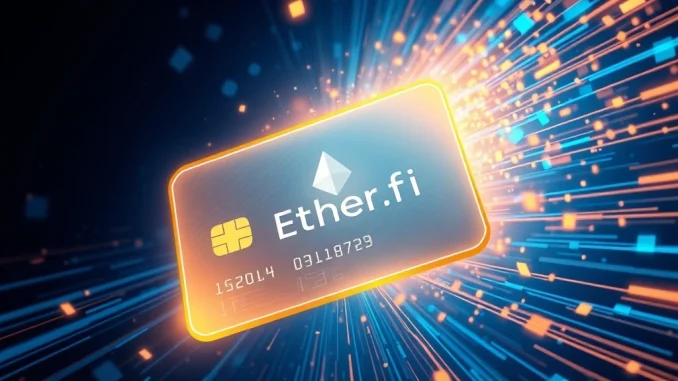
Global, March 2025: In a significant move for the decentralized finance (DeFi) payments landscape, non-custodial liquid staking protocol Ether.fi has announced the migration of its Cash product—comprising 70,000 active crypto cards and over $160 million in Total Value Locked (TVL)—from the Scroll zkEVM network to Optimism’s OP Mainnet. This strategic network shift aims to leverage Optimism’s established infrastructure for faster, cheaper transactions, directly enhancing the user experience for tens of thousands seeking to spend their digital assets seamlessly.
Ether.fi Crypto Cards Migrate to Optimism for Enhanced Performance
The core of Ether.fi’s announcement centers on transitioning its entire Cash product ecosystem. This product allows users to convert staked ETH (eETH) into a stable, spendable balance for everyday purchases via a virtual or physical card. The decision to move from Scroll, a relatively newer zk-rollup, to the more mature Optimism Superchain is driven by technical and strategic considerations. Optimism’s OP Mainnet offers lower transaction fees, faster finality times, and deeper integration within a broader ecosystem of decentralized applications (dApps). For end-users, this translates to near-instant payment confirmations and reduced costs when topping up cards or claiming rewards, addressing two persistent friction points in crypto payment adoption.
Industry analysts view this migration as a vote of confidence in Optimism’s “Superchain” vision, which aims to create a network of interoperable Layer 2 chains. By bringing a high-volume payment product with substantial TVL, Ether.fi injects significant economic activity and user traffic into the Optimism ecosystem. The move also reflects the competitive dynamics among Layer 2 scaling solutions, where factors like developer tooling, network effects, and proven reliability become critical for projects scaling to mainstream adoption.
Analyzing the Impact on Users and the DeFi Payments Landscape
For the 70,000 cardholders, the migration is designed to be seamless. Ether.fi has stated that users will not need to take any manual action regarding their cards or funds. The backend shift will automatically grant them access to Optimism’s network benefits. The promised user advantages are multifaceted:
- Faster Payment Processing: Transactions on Optimism typically finalize in under two seconds, compared to longer times on some newer networks, making point-of-sale interactions more reliable.
- Reduced Transaction Costs: Lower gas fees on OP Mainnet mean more value is preserved when moving funds to the card, making micro-transactions more feasible.
- Expanded Reward Structures: Users continue to earn cashback rewards in major assets like USDC, ETH, and BTC, but the migration may enable integration with a wider array of DeFi protocols on Optimism for enhanced yield opportunities.
- Improved Network Stability: Moving to a network with a longer operational history and a larger total value locked can reduce the risk of congestion or downtime.
This migration has broader implications. It potentially redirects a major stream of real-world payment volume from the Scroll ecosystem to Optimism, influencing where developers and liquidity providers focus their efforts. It underscores a maturation phase in Layer 2 competition, where established networks with robust ecosystems attract large-scale applications seeking stability and growth.
The Technical and Strategic Rationale Behind the Network Shift
The decision to migrate a live product with significant assets is not taken lightly. From a technical perspective, Optimism’s EVM-equivalence and proven fraud-proof system offer a stable environment for a financial product requiring high security and predictability. Furthermore, Optimism’s upcoming Bedrock upgrade and its seamless cross-chain communication protocols via the Optimism Bridge provide a future-proof foundation for Ether.fi’s Cash product to potentially integrate with other chains in the Superchain.
Strategically, aligning with Optimism places Ether.fi within a massive and growing DeFi ecosystem. This proximity allows for novel integrations, such as enabling cardholders to directly deploy portions of their balance into lending protocols or liquidity pools on Optimism without leaving the Ether.fi interface. The move also enhances Ether.fi’s brand positioning as a protocol committed to providing the best possible user experience, even if it necessitates a complex backend migration. It signals to the market that the protocol prioritizes scalability and low costs as essential components for mainstream crypto adoption.
Conclusion
The migration of Ether.fi’s crypto cards to the Optimism network represents a pivotal infrastructure shift within DeFi-powered payments. By moving 70,000 users and $160 million in TVL, Ether.fi is betting on Optimism’s superior speed, cost-efficiency, and ecosystem maturity to deliver a significantly enhanced payment experience. This decision not only benefits existing cardholders with faster and cheaper transactions but also strengthens Optimism’s position as a leading Layer 2 solution for real-world financial applications. As the competition to scale Ethereum intensifies, such high-profile migrations will likely become a key indicator of which networks are winning the battle for developer and user adoption in the evolving blockchain landscape.
FAQs
Q1: What is Ether.fi moving to the Optimism network?
Ether.fi is migrating its entire Cash product, which includes 70,000 active crypto debit cards and over $160 million in Total Value Locked (TVL), from the Scroll network to Optimism’s OP Mainnet.
Q2: Do Ether.fi cardholders need to do anything during this migration?
No. Ether.fi has stated the migration will be seamless for users. Cardholders should not need to take any manual action; their cards and funds will automatically function on the new network.
Q3: What are the main benefits for users after the move to Optimism?
The primary benefits are significantly faster payment processing times, lower transaction (gas) fees, and access to Optimism’s large and established DeFi ecosystem, which may enable new features and integrations.
Q4: Why did Ether.fi choose Optimism over other Layer 2 networks?
The decision is likely based on Optimism’s technical maturity, lower and more predictable fees, faster transaction finality, and its strategic “Superchain” vision, which offers a robust and interoperable ecosystem for future growth.
Q5: How does this migration affect the broader Layer 2 competitive landscape?
This move is seen as a significant endorsement of Optimism’s infrastructure. It shifts substantial payment volume and economic activity from Scroll to Optimism, potentially influencing where other developers and projects choose to build, thereby consolidating Optimism’s market position.
Related News
- Bitcoin options traders remain wary of downside risk despite recent price surge, analysis reveals
- BTC Perpetual Futures Reveal Critical Market Tension as Shorts Maintain Slight Edge
- Bitcoin Targets $54,000 Amid September Struggles
Related: CME Group Launches Revolutionary 24/7 Crypto Futures and Options Trading on May 29
Related: CELO Price Drops 7.06%: Analyzing the Bearish Outlook Amid Weakening Network Activity
Related: Arthur Hayes HYPE Accumulation: Decoding the $1 Million On-Chain Transaction