Bitcoin Price Compression: How BTC’s Tightening Range Signals an Impending Breakout
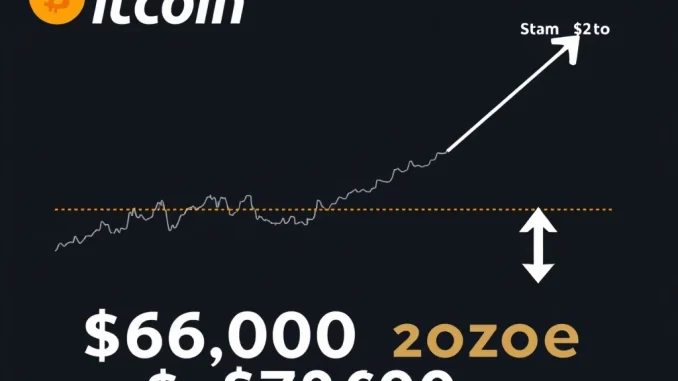
Global, May 2025: The Bitcoin market is exhibiting a classic technical pattern that veteran traders watch closely: price compression. For weeks, the flagship cryptocurrency has traded within a narrowing band between $66,000 and $72,000, with neither bulls nor bears able to establish decisive control. This consolidation, marked by declining volatility and steady positioning, is what analysts refer to as a tightening range—a condition that historically precedes significant momentum moves. The current bitcoin price action suggests the market is coiling, building potential energy for its next major directional shift.
Understanding Bitcoin’s Current Trading Range
Bitcoin’s price has established clear support and resistance levels that have defined its trading activity throughout this period. The $66,000 level has repeatedly acted as a floor, with buyers stepping in aggressively to defend this zone against downward pressure. Conversely, approaches toward the $72,000 mark have consistently met selling pressure, preventing a sustained breakout. This creates the defined bracket or channel within which the asset is rotating. Market data shows that trading volume within this range has remained steady, but volatility—as measured by metrics like the Average True Range (ATR)—has contracted significantly. This phenomenon is not unique to the current cycle; similar periods of compression have occurred before major moves in Bitcoin’s history, such as the prolonged consolidation before its rally in late 2020.
The Mechanics of Market Compression and Breakouts
Financial markets often enter phases where uncertainty and equilibrium between buyers and sellers lead to reduced price swings. This compression, visually represented by converging trend lines on a chart, signifies a buildup of latent energy. Several key factors contribute to the current BTC range scenario:
- Options Market Positioning: A large volume of Bitcoin options with strike prices near the range boundaries expires monthly, creating natural gravitational pull and hedging activity that can suppress volatility until expiration passes.
- Macroeconomic Hesitation: Traders are awaiting clearer signals on interest rate policies and inflation data, leading to a risk-averse, wait-and-see approach in capital allocation.
- On-Chain Data: Analysis of blockchain activity shows a decrease in the movement of older coins, suggesting long-term holders are not distributing their assets, which provides underlying stability.
- Liquidity Pools: Exchange order books show dense clusters of buy orders just below $66,000 and sell orders just above $72,000, effectively corralling the price.
This environment increases the probability of a volatility expansion. As noted by analyst DaanCrypto, when an asset trades in such a tight range for an extended period, the eventual break of either support or resistance tends to be powerful, as pent-up market orders are executed.
Historical Precedents and Analyst Perspectives
Technical analysis operates on the premise that market psychology repeats, creating recognizable patterns. Bitcoin has undergone similar compression phases multiple times. For instance, in the second quarter of 2023, BTC traded between $24,800 and $30,000 for nearly three months before breaking upward. The resulting move captured over 40% in gains within six weeks. Analysts monitor derivatives data for clues; the current funding rates in perpetual swap markets are neutral to slightly negative, which is atypical during strong bull markets and may indicate a lack of excessive leverage that could fuel a sharper move. The decreasing volume during this range-bound period is also a classic sign of consolidation before a trend.
Potential Catalysts for a Breakout Move
While technicals set the stage, fundamental catalysts often provide the spark. The market is currently balancing several opposing forces. On the supportive side, the continued adoption of spot Bitcoin ETFs provides a structural bid, while macroeconomic uncertainty regarding global liquidity acts as a headwind. A decisive break above $72,000 would likely require a catalyst such as unexpectedly positive inflation data, a dovish shift from a major central bank, or a significant institutional adoption announcement. Conversely, a breakdown below $66,000 could be triggered by a spike in geopolitical risk, regulatory concerns, or a sharp downturn in traditional equity markets. The direction of the breakout will depend on which set of catalysts gains dominance in the market narrative.
Implications for Traders and the Broader Market
For market participants, this environment presents both risk and opportunity. Range-bound markets can be profitable for short-term, mean-reversion strategies, but they carry the high risk of a false breakout. Many traders employ a “breakout confirmation” strategy, waiting for a daily or weekly close outside the range with accompanying high volume before committing capital directionally. The implications of a sustained move are significant. An upward breakout could reignite bullish sentiment across the entire cryptocurrency sector, potentially leading capital to rotate into altcoins. A downward break, however, could test the next major support zone near $60,000 and prompt a broader risk-off move in digital assets. The current market compression is therefore a critical juncture being watched by portfolio managers and retail investors alike.
Conclusion
Bitcoin’s price action is currently defined by a tightening range between $66,000 and $72,000, a technical condition that analysts agree cannot persist indefinitely. This period of compression and low volatility is a typical precursor to a strong momentum move. The fundamental landscape, combined with clear technical levels, sets the stage for the next major trend in the cryptocurrency market. Whether the breakout momentum carries the price upward or downward will depend on the interplay of macroeconomic data, institutional flows, and broader market sentiment in the coming weeks. For observers and participants, understanding this dynamic is key to navigating the potential volatility ahead.
FAQs
Q1: What does a “tightening range” or “price compression” mean in trading?
A tightening range occurs when an asset’s price oscillates between a defined support and resistance level, but the swings between them become progressively smaller over time. It indicates a period of consolidation and declining volatility, often before a significant price move.
Q2: How long can Bitcoin stay in this compressed range?
There is no fixed timeline. Historical consolidation phases for Bitcoin have lasted from several weeks to multiple months. The duration often depends on when a significant external catalyst emerges to shift the supply-demand balance.
Q3: What is a false breakout, and how can traders identify it?
A false breakout happens when the price moves beyond a key support or resistance level but quickly reverses back into the prior range. Traders often look for a sustained close (e.g., on a daily or weekly chart) above or below the level, accompanied by a surge in trading volume, to confirm a genuine breakout.
Q4: Does low volatility always lead to a big price move?
While not absolute, periods of exceptionally low volatility, especially following a trend, frequently precede periods of high volatility. This is a core concept in technical analysis known as “volatility compression,” which suggests that energy in the market is being stored and will eventually be released.
Q5: What other indicators should I watch alongside the price range?
Key indicators to monitor include trading volume (breakouts on high volume are more credible), derivatives data like funding rates and open interest, on-chain metrics such as exchange flows, and broader macroeconomic indicators like the U.S. Dollar Index (DXY) and bond yields.
Related News
- Ethereum Investment: Standard Chartered's Strategic Weekend Recommendation Reveals Bullish Signals
- Bitcoin (BTC) Tumbled to a 5-Month Low, Altcoins Perform Even Worse (Market Watch)
- Binance Alpha Unveils Pivotal VLR Crypto Listing on September 16
Related: Goldman Sachs CEO David Solomon Reveals: I Personally Own Bitcoin