Bitcoin Dominance Weakens as Ethereum Gains Momentum: A Critical 2025 Market Shift
Global, March 2025: A notable shift is unfolding across cryptocurrency markets as Bitcoin’s long-held market dominance shows signs of weakening. Concurrently, Ethereum is demonstrating significant momentum, attracting capital flows that analysts are closely monitoring. This potential rotation represents one of the most critical dynamics in digital asset markets this year, signaling evolving investor preferences and technical conditions.
Bitcoin Dominance Faces a Technical Breakdown
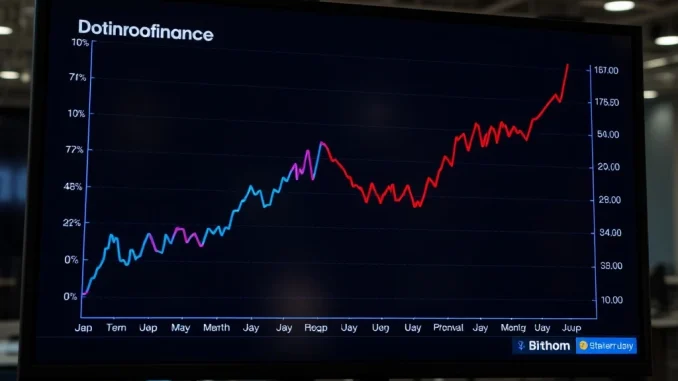
Bitcoin dominance, which measures Bitcoin’s market capitalization as a percentage of the total cryptocurrency market cap, has served as a key barometer of market sentiment for over a decade. Historically, periods of high dominance have correlated with risk-off environments, where investors retreat to the perceived safety of the original cryptocurrency. Conversely, declining dominance often signals growing appetite for alternative digital assets, commonly called altcoins. Throughout 2024, Bitcoin dominance remained relatively resilient, bolstered by institutional adoption through spot ETFs and its established store-of-value narrative. However, recent weeks have presented a different picture. Technical analysts note that the dominance chart has breached several key support levels that held firm throughout the previous year. This breakdown is not merely a minor fluctuation; it represents a sustained move that challenges the prevailing market structure. The metric has retreated from a peak above 55% in early 2025 to levels not consistently seen since before the last major altcoin market cycle, prompting a reassessment of capital allocation strategies across the sector.
Ethereum’s Sustained Momentum and Capital Inflows
On the opposite side of this equation, Ethereum is experiencing a pronounced influx of capital and positive technical momentum. Several fundamental factors underpin this shift. First, the successful completion of Ethereum’s transition to a proof-of-stake consensus mechanism, known as The Merge, continues to yield benefits, including reduced energy consumption and the establishment of a yield-generating asset through staking. Second, ongoing network upgrades aimed at improving scalability and reducing transaction costs are addressing long-standing user concerns. From a market perspective, anticipation surrounding potential regulatory clarity for spot Ethereum ETFs in key jurisdictions has created a bullish catalyst. This is not merely speculative trading; on-chain data reveals substantial movements of Ethereum off exchanges into long-term storage, a classic sign of accumulation. Furthermore, the total value locked in Ethereum’s decentralized finance ecosystem has begun to trend upward again, indicating renewed developer and user activity. The critical question analysts are asking is whether Ethereum can sustain these relative gains against Bitcoin, a pairing often watched via the ETH/BTC ratio. A sustained breakout in this ratio would confirm a genuine, longer-term rotation rather than a short-term correction.
The Analyst Perspective: Watching for Confirmation
Market analysts emphasize the need for confirmation before declaring a definitive, long-term trend change. “We are observing a clear migration of capital, but its durability remains the key unknown,” states a report from a major crypto research firm. Analysts are scrutinizing volume profiles, derivative market positioning, and macroeconomic conditions. They note that similar periods of declining Bitcoin dominance in the past have sometimes preceded broad-based altcoin rallies, but have also reversed sharply if Bitcoin reclaims its safe-haven status during market stress. The current environment is unique due to the maturation of both assets. Bitcoin is increasingly treated as a macro asset, sensitive to interest rates and liquidity conditions. Ethereum, while still correlated, is also driven by its own ecosystem growth and technological milestones. This decoupling, however partial, means the dominance metric now reflects a more complex interplay of factors than in earlier, more speculative market cycles.
Historical Context and Market Cycle Implications
To understand the potential significance of this shift, historical context is essential. Previous cycles have exhibited a rhythmic pattern: Bitcoin leads the initial charge in a bull market, followed by capital rotating into Ethereum and other altcoins as investor confidence grows. The 2020-2021 cycle provided a clear example, where Bitcoin dominance peaked before declining sharply during the altcoin season. The current scenario shares some similarities but operates within a fundamentally different landscape. The total market capitalization is larger, institutional participation is more profound, and regulatory frameworks are more defined. A sustained decline in Bitcoin dominance in 2025 would suggest that the market is entering a new phase where ecosystem utility and application growth, areas where Ethereum excels, are being valued more independently from Bitcoin’s pioneering status as digital gold. This does not diminish Bitcoin’s role but indicates a broadening and maturing of the entire asset class.
Broader Market Consequences and Investor Considerations
The implications of this capital rotation extend beyond just two assets. A weaker Bitcoin dominance often creates a more favorable environment for other layer-1 blockchains and decentralized application tokens. It can signal improved risk sentiment where investors seek higher growth potential, albeit with higher risk, across the crypto spectrum. For portfolio managers, this dynamic necessitates a review of allocation models. The traditional heavy weighting toward Bitcoin, based on its dominance and liquidity, may require adjustment if the trend persists. Furthermore, the volatility profiles of the overall market can change. While Bitcoin has historically stabilized during downturns, a market where capital is more evenly distributed might exhibit different correlation structures. Investors are advised to monitor not just price, but on-chain metrics, developer activity, and protocol revenue to gauge the health of any capital rotation.
Conclusion
The weakening of Bitcoin dominance coupled with Ethereum’s gathering momentum marks a pivotal moment for cryptocurrency markets in 2025. This shift reflects deeper currents of technological progress, evolving investment theses, and market maturation. While technical analysts rightly caution that the trend requires confirmation to be deemed sustainable, the movement of capital is a tangible and significant development. It underscores a market that is gradually moving beyond a single-asset narrative toward a more complex and diversified ecosystem. Whether this represents a temporary rebalancing or the beginning of a new, prolonged phase of Ethereum gains at the expense of Bitcoin dominance will be one of the defining stories of the year, with profound consequences for investors, developers, and the future structure of the digital economy.
FAQs
Q1: What is Bitcoin dominance?
Bitcoin dominance is a metric that expresses Bitcoin’s market capitalization as a percentage of the total market capitalization of all cryptocurrencies. It is used to gauge Bitcoin’s relative size and influence within the broader digital asset market.
Q2: Why is a decline in Bitcoin dominance significant?
A sustained decline often signals that investors are allocating more capital to alternative cryptocurrencies (altcoins), like Ethereum, which can indicate growing risk appetite and a focus on ecosystem growth and utility beyond Bitcoin’s store-of-value proposition.
Q3: What factors are contributing to Ethereum’s current momentum?
Key factors include the post-Merge benefits of proof-of-stake, ongoing scalability upgrades, anticipation of spot ETF approvals in some regions, rising on-chain activity, and increased total value locked in its DeFi ecosystem.
Q4: Has this happened before in crypto history?
Yes, cycles of declining Bitcoin dominance followed by altcoin rallies have occurred in previous market cycles, such as in 2017 and 2021. However, the current context features a more mature market with significant institutional involvement.
Q5: What should investors watch to confirm this trend?
Investors should monitor the ETH/BTC trading pair for a sustained breakout, on-chain data for continued capital flows into Ethereum, volume trends, and whether the decline in Bitcoin dominance holds through potential market corrections.
Related News
- Solana Co-Founder's Urgent Warning: Blockchains Must Evolve or Face Irrelevance
- Exciting Bybit LITKEY Listing Set for July 6: A Game-Changer for Spot Trading
- Binance MET Futures: Crucial Opportunity Arises with Meteora Perpetual Futures Listing
Related: Ambitious: The Graph's 2026 Technical Roadmap to Build Web3's Essential Data Backbone
Related: Ethereum Accumulation Surges: Why Long-Term Holders Are Buying the 2025 Dip
Related: Essential: Coinbase Expands Onchain Loans to Include XRP, DOGE, ADA, and LTC as Collateral