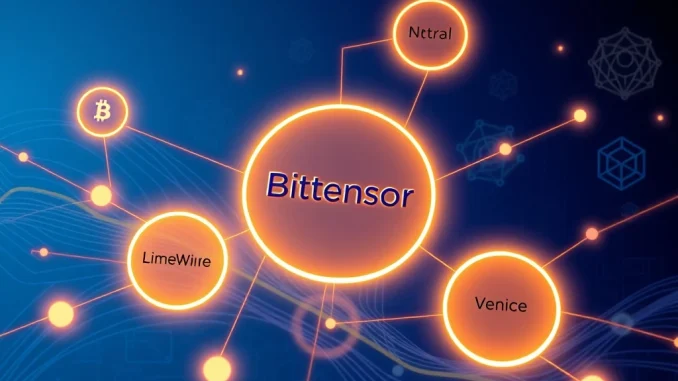
Bittensor Dominates AI Crypto Social Rankings as LimeWire, Virtuals, and Venice Compete for Voice
Global, May 2025: Recent social analytics data reveals a clear hierarchy within the artificial intelligence cryptocurrency sector. Bittensor has established a commanding lead in social engagement metrics, significantly outpacing other prominent projects. Meanwhile, platforms like LimeWire, Virtuals, and Venice demonstrate a clustered, competitive presence in the mid-tier, collectively shaping a significant portion of the online conversation. This distribution of “share of voice” offers critical insights into developer interest, community strength, and potential market trajectories for these decentralized AI networks.
Bittensor’s Commanding Lead in AI Crypto Social Engagement
Analysis of social media platforms, developer forums, and crypto-centric discussion boards over the last quarter shows Bittensor generating substantially more posts, comments, and interactions than its direct competitors. This social dominance is not merely a measure of popularity but often correlates with several key factors in the cryptocurrency space. A robust and active online community typically indicates strong developer engagement, which is vital for the iterative improvement of complex protocols. Furthermore, high social volume can signal sustained investor interest and a lower risk of community abandonment, a critical concern for long-tail crypto assets.
The concept of “share of voice” measures the percentage of total online conversation within a specific niche that a particular project captures. Bittensor’s high share suggests it is currently the central narrative in the decentralized AI discussion. This position allows it to set trends, attract talent, and maintain top-of-mind awareness among investors and builders. The project’s focus on creating a decentralized marketplace for machine intelligence, where models are trained and rewarded collectively, appears to resonate strongly with a community skeptical of centralized AI development. This philosophical alignment, combined with its technical architecture, fuels consistent discussion and debate.
Analyzing the Clustered Mid-Tier: LimeWire, Virtuals, and Venice
While Bittensor operates in a tier of its own based on raw social volume, the landscape beneath it is fiercely competitive. Projects like LimeWire, Virtuals, and Venice exhibit social metrics that are much closer to each other, forming a distinct cluster. This clustering effect is common in emerging technological sectors and indicates a market still evaluating multiple approaches to similar problems. LimeWire, leveraging its recognizable brand from the early file-sharing era, has pivoted to a creator-focused platform integrating AI tools. Its social conversation often revolves around digital ownership, creator economies, and nostalgia, attracting a different demographic segment.
Virtuals, typically associated with AI-generated digital personas or assets, drives discussion in the intersection of AI, identity, and the metaverse. Venice, often linked to decentralized data or content platforms, carves its niche around data sovereignty and AI training data provenance. The social activity for these projects, while lower in aggregate than Bittensor’s, is often more focused and passionate within their specific sub-niches. This creates pockets of high-intensity discussion that can translate into dedicated, albeit smaller, communities and user bases. Their clustered rankings suggest no single project has yet broken away as the definitive second-place contender, making this segment particularly dynamic to observe.
The Tangible Impact of Social Metrics on Blockchain Projects
For decentralized networks, social activity is more than just marketing noise; it can have direct technical and economic consequences. Active forums like GitHub discussions, Discord, and Telegram are where core developers troubleshoot, propose upgrades, and onboard new contributors. A project with low social engagement may struggle to recruit the necessary talent to maintain and advance its protocol, leading to stagnation. From an economic perspective, social sentiment can influence token volatility, staking participation rates, and governance proposal turnout. A strong, positive social presence can bolster investor confidence during market downturns and foster a sense of shared purpose.
However, analysts consistently warn that social metrics are just one lens. They must be evaluated alongside on-chain data like transaction volume, unique active wallets, total value locked (TVL) in associated dApps, and code commit frequency on repositories. A project can have high social volume driven by speculation or controversy without having substantive technical progress or user adoption. Therefore, while Bittensor’s social lead is significant, its long-term success will depend on translating that community energy into a robust, usable, and secure decentralized network that delivers on its promises of accessible machine intelligence.
Historical Context and the Evolution of Crypto Social Dynamics
The relationship between social activity and cryptocurrency project success has evolved dramatically since the 2017-2018 initial coin offering (ICO) boom. In that era, social hype on platforms like Twitter and Bitcoin Talk forums was often the primary driver for price appreciation, frequently detached from technical merit. The subsequent market maturation, led by the rise of decentralized finance (DeFi) and non-fungible tokens (NFTs), shifted focus towards measurable on-chain utility. Today, the AI crypto sector represents a synthesis of these phases. It requires deep technical discussion to understand its value proposition, yet it still relies on vibrant communities to bootstrap networks and achieve decentralization.
This current analysis mirrors patterns seen in earlier crypto sectors. In DeFi’s early growth, a single protocol like Uniswap often commanded the majority of social and developmental mindshare before the ecosystem diversified. The AI crypto space may be following a similar trajectory, with Bittensor currently holding the pole position as the most recognized and discussed framework. The clustered competition behind it is healthy, as it represents multiple teams experimenting with different models for decentralizing various aspects of artificial intelligence, from compute power to model creation to data validation.
Conclusion: Social Rankings as a Barometer for a Nascent Sector
The social ranking data, showing Bittensor far ahead with LimeWire, Virtuals, and Venice in a tight secondary group, provides a valuable snapshot of the current decentralized AI landscape. It highlights where developer and community attention is concentrated. Bittensor’s dominant share of voice positions it as the sector’s flagship project, bearing both the advantages of leadership and the scrutiny that comes with it. The competitive clustering in the mid-tier signals a fertile ground for innovation and potential breakout candidates. For observers, investors, and participants, monitoring these social dynamics, alongside rigorous technical and on-chain analysis, remains an essential practice for understanding the volatile and promising intersection of artificial intelligence and blockchain technology.
FAQs
Q1: What does “share of voice” mean in crypto?
Share of voice is a marketing metric that, in a crypto context, refers to the percentage of total online conversation (social posts, forum threads, news articles) about a specific sector, such as AI crypto, that is dedicated to a particular project. It measures relative mindshare and community engagement.
Q2: Why is social activity important for a decentralized project like Bittensor?
Decentralized projects rely on distributed communities of developers, validators, and users. High social activity often indicates an active community for troubleshooting, governance, proposal discussion, and development collaboration. It helps attract talent and can signal overall network health and interest.
Q3: Are social rankings a reliable indicator of a project’s technical quality or success?
Not directly. While strong social engagement is positive, it is a supplemental metric. Technical quality must be assessed through code audits, peer-reviewed research, on-chain activity, and protocol usage. Social hype can sometimes exist independently of technical merit.
Q4: What are LimeWire, Virtuals, and Venice in the context of AI crypto?
These are distinct projects within the broader AI and blockchain space. LimeWire is a revived brand focusing on AI tools for creators. “Virtuals” typically refers to platforms for AI-generated digital entities. “Venice” is often associated with decentralized data and content protocols. Each tackles a different facet of the decentralized AI problem.
Q5: How might the social ranking landscape change in the future?
The landscape is highly dynamic. A major technical breakthrough, a successful mainnet launch, or a strategic partnership from a mid-tier project could rapidly alter its social standing. Conversely, network issues or security vulnerabilities at a leading project could diminish its share of voice. The sector is still in its early, formative stages.
Related News
- Crypto Market Bottom: Bitwise CIO Reveals Bullish Evidence for Q4 2023 Turning Point
- Bithumb Siacoin Users Alerted to Urgent Suspension
- Changpeng Zhao Stuns Crypto Community by Unfollowing Solana Founder After Critical Post
Related: Crypto Market's Stark Reality: Mixed Momentum Amid Overwhelming Fear Grips Investors
Related: Crypto Shift: Coinbase CEO Reveals Why Wall Street Is Missing the Bigger Picture
Related: Centrifuge and Pharos Forge Pivotal Alliance to Scale Institutional Assets Onchain