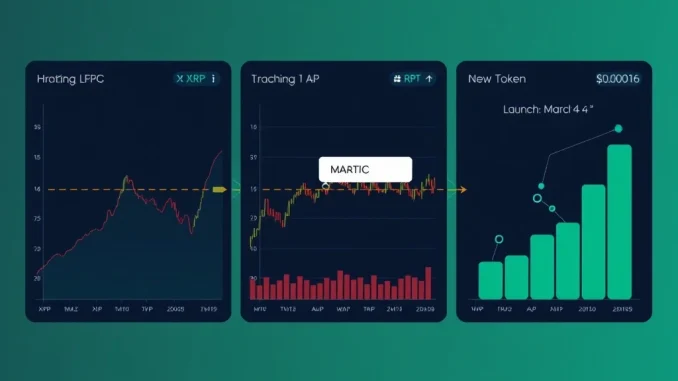
XRP Price Nears Critical Breakout as Polygon Faces Resistance; BlockDAG Trading Commences March 4 at $0.00016
Global, February 28, 2025: The cryptocurrency market enters a pivotal period with several assets at technical inflection points. XRP approaches a key breakout level that could determine its medium-term trajectory, while Polygon (MATIC) contends with significant resistance. Concurrently, the BlockDAG network prepares for its official trading debut on multiple exchanges, scheduled for March 4th, with an initial reference price of $0.00016. These developments highlight the diverse phases and challenges within the digital asset ecosystem, from established layer-1 tokens to emerging network protocols.
XRP Price Analysis: Navigating a Critical Juncture
XRP, the digital asset native to the XRP Ledger, has consolidated within a narrowing price range for several weeks. Market analysts now identify a symmetrical triangle pattern on its daily chart, with the converging trendlines signaling an impending volatility expansion. A decisive close above the upper trendline, approximately at the $0.62 level, would constitute a textbook breakout. Such a move historically precedes significant upward momentum, potentially targeting resistance zones last seen in late 2024.
This technical setup occurs against a backdrop of ongoing developments for Ripple, the company closely associated with XRP. The resolution of its major litigation with the U.S. Securities and Exchange Commission in 2023 removed a substantial overhang, but the market now focuses on adoption metrics and utility. Transaction volume on the XRP Ledger, particularly for cross-border payments and other use cases like tokenized assets, provides fundamental context for price movements. The current technical pattern suggests traders are awaiting a catalyst, which could stem from broader market sentiment, a specific announcement, or a surge in network activity.
Polygon Confronts Formidable Resistance Levels
Meanwhile, Polygon’s MATIC token faces a formidable technical barrier. After a sustained recovery from its 2023 lows, the price has approached a long-term resistance zone between $1.05 and $1.15. This area acted as strong support throughout early 2024 before a breakdown, and it now represents a psychological and technical hurdle for bulls. Repeated failure to break and hold above this level could signal exhaustion and lead to a retracement towards lower support.
The fundamental narrative for Polygon remains centered on its evolution as a layer-2 scaling solution and its broader ecosystem development. The network continues to onboard developers and applications, particularly in the decentralized finance (DeFi) and gaming sectors. However, the token’s price must contend with macro factors affecting the entire Ethereum ecosystem and competitive pressures from other scaling solutions. Analysts monitor on-chain metrics such as active addresses, total value locked (TVL) in Polygon-based DeFi protocols, and network revenue to gauge underlying strength against the purely technical resistance.
Understanding Resistance and Support in Crypto Markets
Resistance and support levels are core concepts in technical analysis. Resistance refers to a price level where selling pressure has historically overcome buying pressure, halting or reversing an uptrend. It often forms at previous highs or areas of concentrated sell orders. Support is the opposite—a price level where buying interest is sufficiently strong to prevent further decline. These levels are not absolute but represent zones of increased probability for a change in price direction. For assets like Polygon, overcoming a major resistance zone requires significant new demand, often driven by a shift in fundamentals, broader market momentum, or a reduction in available sell-side liquidity.
BlockDAG Network Prepares for Trading Debut
In a separate segment of the market, the BlockDAG network has announced the commencement of trading for its native token (ticker: BDAG) on March 4th, 2025. The token will be listed on several centralized and decentralized exchanges with an initial reference price of $0.00016. BlockDAG distinguishes itself through its underlying data structure—a Directed Acyclic Graph (DAG)—which theoretically allows for higher transaction throughput compared to traditional linear blockchains.
The project has undergone a development and testing phase, with its mainnet launch preceding the token’s exchange listing. The focus for observers will be on initial liquidity, trading volume, and how the market prices the token relative to its technological propositions and competitive positioning within the crowded layer-1 and layer-0 landscape. New token listings often experience high volatility as an initial equilibrium price is discovered through market action.
The Significance of Network Architecture: Blockchain vs. DAG
Most cryptocurrencies, like Bitcoin and Ethereum, utilize a blockchain structure where transactions are grouped into blocks that form a single, linear chain. A Directed Acyclic Graph (DAG) offers a different approach. In a DAG-based system, transactions can be attached to multiple previous transactions, creating a web-like structure. This can enable parallel processing of transactions, potentially increasing speed and scalability. However, DAG architectures also present unique challenges in achieving consensus and security comparable to the most robust blockchains. BlockDAG’s market reception will partially reflect investor confidence in its solution to these challenges.
Comparative Market Context and Investor Considerations
The simultaneous occurrence of these events—a potential breakout for XRP, a resistance test for Polygon, and a new token listing for BlockDAG—illustrates the multi-speed nature of the cryptocurrency industry. Investors and traders often categorize assets by their lifecycle stage, risk profile, and correlation to broader market trends.
Established assets like XRP and MATIC are subject to deep liquidity and analysis from a wide array of market participants. Their price movements are influenced by macroeconomic conditions, regulatory news, and sector-wide trends. Newer entrants like BlockDAG face a different set of initial valuation drivers, often centered on technological differentiation, team credibility, initial community growth, and exchange support. The following table outlines key differentiating factors:
| Asset | Market Stage | Current Price Focus | Primary Value Driver |
| XRP (XRP) | Established | Breakout from consolidation pattern | Cross-border payment utility, adoption by financial institutions |
| Polygon (MATIC) | Established Scaling Solution | Overcoming key resistance zone | Ethereum scaling adoption, DeFi & gaming ecosystem growth |
| BlockDAG (BDAG) | New Listing | Initial price discovery at $0.00016 | DAG technology performance, mainnet adoption, developer activity |
For market participants, these scenarios demand distinct analytical approaches. Technical analysis plays a strong role in gauging momentum for XRP and Polygon. For BlockDAG, fundamental analysis of its technology, tokenomics, and early-stage traction becomes paramount, as historical price data is nonexistent.
Conclusion
The cryptocurrency market presents a dynamic landscape where established assets and new protocols evolve simultaneously. XRP’s approach to a technical breakout and Polygon’s struggle with a defined resistance level highlight the continuous price discovery process in liquid markets. The launch of BlockDAG trading at $0.00016 on March 4th introduces a new variable, reflecting ongoing innovation in blockchain and DAG architectures. Together, these developments underscore the importance of context-specific analysis, distinguishing between short-term technical signals and long-term fundamental value propositions across different layers of the digital asset ecosystem. Market observers will monitor these situations closely for signals regarding broader sector health and the reception of new technological approaches.
FAQs
Q1: What does a “breakout” mean for XRP’s price?
A breakout occurs when an asset’s price moves decisively above a well-defined resistance level or chart pattern boundary, like the top of a triangle. For XRP, a confirmed breakout above its current pattern could signal the start of a new upward trend, attracting momentum traders and potentially leading to significant price appreciation.
Q2: Why is the $1.05-$1.15 level so important for Polygon (MATIC)?
This price zone acted as major support for MATIC for an extended period before breaking down. In technical analysis, previous support often turns into future resistance. Reclaiming this area is psychologically and technically significant, as it would suggest the prior breakdown has been invalidated and buying pressure has returned in force.
Q3: What is BlockDAG, and how is it different?
BlockDAG is a distributed ledger protocol that uses a Directed Acyclic Graph (DAG) structure instead of a linear blockchain. This aims to allow for higher transaction throughput by enabling parallel processing. Its success depends on solving the security and consensus challenges inherent to DAG designs.
Q4: What typically happens during a new token’s first day of trading?
The first day of trading is a period of extreme price discovery. Volatility is often high as initial buy and sell orders meet on the open market. The price can deviate significantly from any pre-listing reference price (like $0.00016) based on initial demand, liquidity depth, and broader market sentiment.
Q5: Should technical analysis for XRP and Polygon be considered in isolation?
No. While technical patterns are important, they should be considered alongside fundamental developments, overall cryptocurrency market trends, and macroeconomic factors. A breakout or breakdown is more reliable when supported by positive or negative fundamental news and strong market-wide volume.
Related News
- Crucial OKX Delisting Update: Seven Margin Trading Pairs Removed
- SuperScale Case Study Highlights Aethir’s Impact on Gaming User Acquisition
- XRP Traders Show Remarkable Optimism as Santiment Data Reveals Diverging Market Sentiment Amid Bitcoin and Ethereum Declines
Related: Zircuit Finance Unveils Groundbreaking Institutional-Grade Onchain Yield Platform
Related: Real-Time Crowd Gaming Revolution Begins as Weaver Labs Joins Piing at MK Dons Stadium
Related: Spartans Winter Olympics Crypto Betting Dominates with 33% CashRake as NY Spins and Betfair Struggle