Essential Guide: How Sidechains and Payment Channels Reduce Congestion in Crypto Networks
Global, March 2025: Network congestion remains a persistent challenge for major cryptocurrency networks, often leading to slow transaction times and high fees during peak usage. This essential guide explores how two critical scalability solutions—sidechains and payment channels—directly reduce congestion in crypto networks by processing transactions separately from the main blockchain. These technologies represent fundamental architectural shifts that address the core limitations of first-generation blockchains.
Understanding the Congestion Problem in Crypto Networks
Blockchain congestion occurs when transaction demand exceeds network processing capacity. Major networks like Ethereum and Bitcoin have faced significant congestion events, most notably during bull markets, NFT minting frenzies, and popular decentralized application launches. The 2017 CryptoKitties phenomenon, for instance, famously slowed the Ethereum network to a crawl by consuming approximately 13% of its total gas capacity. Similarly, Bitcoin’s 2017 scaling debate centered around its limited block size and resulting transaction backlog during periods of high demand.
Congestion manifests through several measurable indicators: pending transaction queues, escalating gas fees or transaction costs, and increased block space competition. These symptoms create user experience barriers and limit blockchain adoption for everyday transactions. The fundamental constraint stems from the consensus mechanism itself—most blockchains require every node to validate every transaction, creating an inherent throughput ceiling. This architectural reality necessitates innovative scaling approaches that move beyond simple parameter adjustments like increasing block size.
How Sidechains Function as Congestion Relief Valves
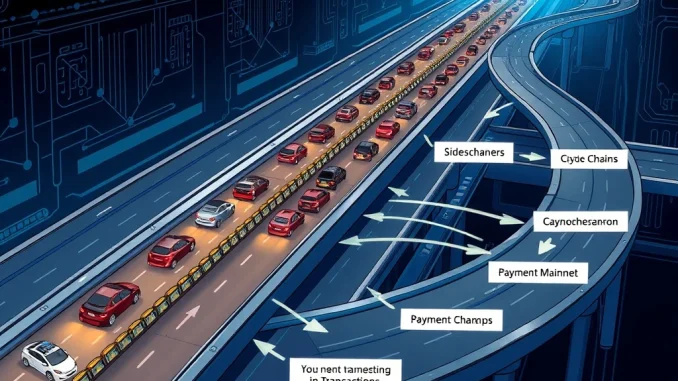
Sidechains operate as independent blockchain networks connected to a main blockchain through a two-way peg mechanism. This connection allows assets to move securely between the main chain and the sidechain. When users transfer assets to a sidechain, those assets are effectively locked on the main chain, with equivalent representations created on the sidechain. This process enables transactions to occur on the sidechain’s separate ledger, utilizing its own consensus rules and validators, thereby bypassing the main chain’s congestion entirely.
Several prominent sidechain implementations demonstrate this congestion-reduction capability in practice. Polygon PoS, formerly Matic Network, processes Ethereum-compatible transactions on its proof-of-stake sidechain while maintaining security through periodic checkpoints to the Ethereum mainnet. Similarly, Rootstock (RSK) operates as a Bitcoin sidechain that enables smart contracts while leveraging Bitcoin’s security model. These implementations share a common architectural principle: they handle transaction execution independently while periodically settling finality or security assurances with the main chain.
- Independent Consensus: Sidechains operate with their own validator sets and consensus mechanisms, enabling higher throughput.
- Customizable Parameters: Each sidechain can optimize block times, sizes, and gas limits for specific use cases.
- Application-Specific Design: Sidechains can be tailored for gaming, decentralized finance, or enterprise applications with predictable traffic patterns.
- Periodic Settlement: Final transaction batches settle on the main chain, reducing its continuous load.
Payment Channels: Instant Off-Chain Transaction Networks
Payment channels represent a different architectural approach to congestion reduction. These technologies enable participants to conduct numerous transactions off-chain while only settling the net result on the main blockchain. The Lightning Network for Bitcoin and various state channel implementations for Ethereum exemplify this model. Two parties open a payment channel by creating a multi-signature transaction on the main chain, then conduct unlimited transactions between themselves by updating signed balance sheets, and finally close the channel with a single settlement transaction.
This approach dramatically reduces main chain congestion because only two transactions—opening and closing—appear on the main blockchain, regardless of how many transactions occur within the channel. Network effects amplify this efficiency as channels connect to form payment channel networks, allowing users to transact with anyone in the network through routing. The Lightning Network currently processes millions of transactions daily while adding only minimal load to the Bitcoin blockchain, demonstrating the profound congestion-reduction potential of this model.
The Historical Evolution of Scaling Solutions
The development of sidechains and payment channels represents a natural evolution in blockchain scalability thinking. Early approaches focused on layer-one improvements like increasing block sizes (Bitcoin Cash) or transitioning consensus mechanisms (Ethereum 2.0). While valuable, these fundamental changes require extensive coordination and carry significant implementation risks. Layer-two solutions like sidechains and payment channels emerged as complementary approaches that could deliver immediate congestion relief without requiring changes to the underlying base layer protocol.
The 2015 sidechain whitepaper by Blockstream researchers formally introduced the sidechain concept with the two-way peg mechanism. Simultaneously, Joseph Poon and Thaddeus Dryja’s 2016 Lightning Network whitepaper outlined the payment channel architecture. These parallel developments created the foundation for today’s congestion-reduction ecosystem. Subsequent years saw practical implementations, with the Lightning Network launching on Bitcoin mainnet in 2018 and various Ethereum sidechains gaining traction during the 2020-2021 DeFi expansion period.
Comparative Analysis: Sidechains vs. Payment Channels
While both technologies reduce congestion, they employ distinct mechanisms with different trade-offs. The following table illustrates their key characteristics:
| Characteristic | Sidechains | Payment Channels |
|---|---|---|
| Architecture | Independent blockchain with two-way peg | Off-chain bilateral/multilateral agreements |
| Transaction Finality | Immediate within sidechain | Instant between channel participants |
| Security Model | Separate validator set with optional main chain checkpoints | Cryptographic enforcement with main chain dispute resolution |
| Use Case Optimization | General-purpose or application-specific chains | High-frequency, small-value payments |
| Main Chain Load Reduction | Bulk transaction processing with periodic settlement | Only opening/closing transactions on main chain |
This comparative analysis reveals that sidechains typically offer more flexibility for complex applications like decentralized exchanges or gaming platforms, while payment channels excel at high-volume micropayment scenarios. Many modern blockchain ecosystems implement both approaches simultaneously, recognizing their complementary strengths in addressing different aspects of network congestion.
Real-World Implementation and Adoption Metrics
Quantitative data demonstrates the tangible congestion-reduction impact of these technologies. According to blockchain analytics platforms, Polygon PoS regularly processes between 3-5 million daily transactions—approximately 3-5 times Ethereum mainnet’s daily volume—while settling only checkpoint data to Ethereum. Similarly, the Lightning Network capacity has grown to over 5,000 BTC (approximately $300 million at current valuations) across more than 70,000 public channels, creating an off-chain payment network that processes transactions worth millions of dollars daily without congesting the Bitcoin blockchain.
Enterprise adoption further validates these technologies’ congestion-management capabilities. Major payment processors and financial institutions now utilize sidechain implementations for settlement layers, while content platforms and gaming companies leverage payment channels for microtransactions. This institutional adoption creates network effects that further distribute transaction load away from congested main chains, establishing a positive feedback loop for congestion reduction.
Technical Mechanisms and Security Considerations
Both sidechains and payment channels employ sophisticated cryptographic mechanisms to ensure security while reducing congestion. Sidechains typically use federated multi-signature schemes or more advanced cryptographic accumulators for their two-way pegs. These mechanisms must carefully balance security with efficiency—overly conservative security models can reintroduce congestion through frequent main chain interactions, while overly optimistic models may compromise asset safety.
Payment channels rely on hashed timelock contracts (HTLCs) for routing payments across channel networks and penalty mechanisms to discourage fraudulent channel closures. The security model assumes participants monitor the blockchain for fraudulent closure attempts, creating different trust assumptions than sidechains. These technical considerations directly impact each solution’s congestion-reduction effectiveness, as more complex security mechanisms typically require more main chain interactions, potentially offsetting some congestion benefits.
Future Developments and Interoperability Trends
The congestion-reduction landscape continues evolving with emerging technologies that build upon sidechain and payment channel foundations. Rollups—both optimistic and zero-knowledge—represent a hybrid approach that processes transactions off-chain like sidechains but posts compressed data to the main chain for security. Cross-chain communication protocols enable assets and data to move seamlessly between different sidechains and layer-two solutions, creating interconnected networks that further distribute transaction load.
Standardization efforts through organizations like the InterWork Alliance and Blockchain Interoperability Alliance aim to create frameworks for cross-sidechain communication. Meanwhile, payment channel networks are expanding beyond simple payments to support more complex operations through technologies like Lightning Network’s Taproot adoption and Ethereum’s state channel networks for generalized computation. These developments suggest that future blockchain architectures will increasingly rely on multi-layered approaches where congestion-sensitive applications operate on specialized sidechains or payment channels while settling periodically to secure base layers.
Conclusion
Sidechains and payment channels provide essential mechanisms for reducing congestion in crypto networks by enabling transaction processing outside constrained main chains. These technologies address fundamental scalability limitations through architectural innovation rather than simple parameter adjustments. Sidechains offer independent blockchain environments with customizable characteristics, while payment channels facilitate instant off-chain transactions between participants. Together, they form a multi-layered approach to blockchain scalability that maintains security while dramatically increasing throughput. As cryptocurrency adoption continues growing, these congestion-reduction technologies will play increasingly critical roles in enabling blockchain networks to support global-scale transaction volumes without compromising decentralization or security principles.
FAQs
Q1: What exactly is a sidechain in blockchain technology?
A sidechain is an independent blockchain that operates parallel to a main blockchain, connected through a two-way peg mechanism that allows assets to move securely between chains. This architecture enables transactions to process on the sidechain, reducing load on the main chain.
Q2: How do payment channels differ from traditional blockchain transactions?
Payment channels allow participants to conduct numerous transactions off-chain through signed updates to a shared balance sheet, settling only the final net result on the main blockchain. This approach requires only two on-chain transactions regardless of how many off-chain transactions occur.
Q3: Are sidechains and payment channels secure compared to main chain transactions?
Both technologies implement security mechanisms appropriate to their architectures. Sidechains may have independent security models with optional main chain checkpoints, while payment channels use cryptographic enforcement with main chain dispute resolution. Each involves different trade-offs between security, decentralization, and efficiency.
Q4: Can sidechains and payment channels work together in the same ecosystem?
Yes, many blockchain ecosystems implement both technologies simultaneously. Sidechains often handle complex applications like decentralized exchanges, while payment channels manage high-frequency micropayments. Cross-chain communication protocols enable interaction between these different layer-two solutions.
Q5: What are the main limitations of sidechains and payment channels for reducing congestion?
Sidechains require their own security models and may involve trust assumptions different from the main chain. Payment channels require channel funding and management, with liquidity constraints for routing. Both solutions add complexity to user experience and may involve withdrawal delays when moving assets back to the main chain.
Related News
- Pundi AI and Bullshot Partner to Fuel the Explosive Meme and AI Economy on BNB Chain
- Bitcoin Crash Target Lowered: Peter Brandt Revises BTC Forecast to $54K Amid Deepening Sell-Off
- OrbiMount Unveils Powerful New Trading Insights to Elevate Trader Success
Related: Address Poisoning Attack: How a Sophisticated Scam Stole $600K in USDT