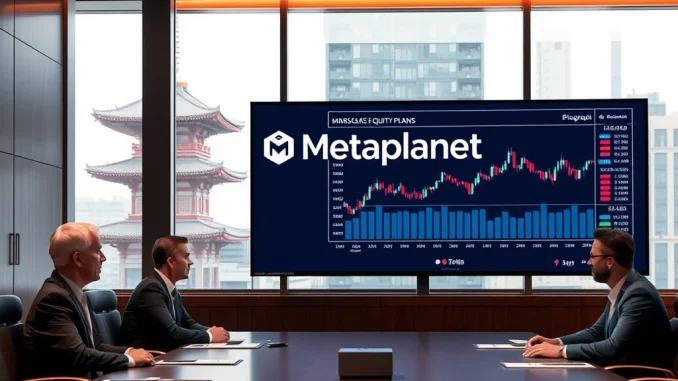
Metaplanet’s Bold Bitcoin Strategy: Doubling Down with New MARS and MERCURY Equity Plans
Tokyo, Japan – April 2025: In a decisive move signaling unwavering conviction, the Japan-listed investment firm Metaplanet has unveiled a sophisticated new equity funding strategy designed to dramatically accelerate its accumulation of Bitcoin. Dubbed the MARS and MERCURY plans, this structured approach aims to systematically grow the company’s digital asset treasury, publicly targeting a holding of 100,000 BTC by 2026. This expansion persists even as the company navigates significant unrealized losses on its existing Bitcoin position, highlighting a long-term, strategic bet on the premier cryptocurrency’s value proposition.
Metaplanet’s Bitcoin Strategy Enters a New Phase
Metaplanet’s announcement marks a pivotal evolution from a company holding Bitcoin as a treasury reserve asset to one actively structuring its entire corporate financing around its acquisition. The firm, which began its foray into digital assets in early 2024 as a hedge against Japan’s persistent yen weakness and national debt, is now leveraging its public listing to create dedicated capital vehicles. The MARS (Metaplanet Accelerated Reserve Strategy) and MERCURY (Metaplanet Equity Recapitalization for Currency Yield) plans are not simple share issuances. They represent a calibrated, multi-pronged equity approach designed to provide sustained capital for Bitcoin purchases while managing shareholder dilution and market impact.
This strategy draws clear parallels to the early adoption playbook of companies like MicroStrategy but adapts it for the Japanese market and regulatory context. By moving beyond one-off bond issuances or balance sheet conversions, Metaplanet is institutionalizing Bitcoin accumulation as a core operational function. Analysts view this as a significant maturation in the corporate Bitcoin adoption narrative, shifting from opportunistic buying to programmed acquisition.
Decoding the MARS and MERCURY Equity Plans
The technical details of the new plans reveal a nuanced funding model. While the full prospectuses are pending regulatory filings, company statements and financial disclosures outline their core mechanics.
- The MARS Plan: This initiative involves the periodic issuance of new equity shares, with the explicit, legally-bound mandate that the proceeds are allocated directly to purchasing Bitcoin. This creates a transparent, direct link between equity market participation and Bitcoin’s network. The plan includes timing mechanisms and volume controls intended to minimize negative price impact on Metaplanet’s own stock during issuance.
- The MERCURY Plan: A more complex instrument, MERCURY is understood to be a structured equity derivative or convertible note program. It is designed to attract capital from institutional investors seeking exposure to Metaplanet’s Bitcoin strategy without direct cryptocurrency ownership. The capital raised here is also funneled into the Bitcoin treasury, but it may offer investors different risk/return profiles compared to common stock.
The dual-track approach allows Metaplanet to tap into different investor pools: traditional equity buyers through MARS and sophisticated financial institutions through MERCURY. This broadens the capital base and potentially stabilizes funding flows.
The Context of Unrealized Losses and Strategic Conviction
Metaplanet’s aggressive expansion comes despite the company reporting substantial unrealized losses on its existing Bitcoin holdings, a result of the cryptocurrency’s price volatility since its initial purchases. This fact underscores the strategic, non-speculative nature of the firm’s approach. In its communications, management has consistently framed Bitcoin not as a short-term trading asset but as a superior long-term store of value and a fundamental strategic hedge.
The company’s rationale is rooted in macroeconomic analysis. Japan’s government debt-to-GDP ratio exceeds 250%, one of the highest globally, creating persistent pressure on the yen. By converting yen-denominated equity into Bitcoin, Metaplanet is effectively executing a corporate-level hedge against domestic currency debasement. The unrealized losses are treated as an accounting volatility to be endured, not a signal to abandon the strategy. This “through-cycle” commitment is what differentiates treasury adoption from speculative investment.
Implications for Corporate Finance and the Bitcoin Ecosystem
Metaplanet’s move has ramifications beyond its own balance sheet. It provides a potential blueprint for other publicly-listed companies, particularly in economies with similar macroeconomic pressures.
- New Funding Model: It demonstrates how equity markets can be systematically leveraged to fund Bitcoin acquisition, creating a novel feedback loop between public capital markets and the Bitcoin network.
- Regulatory Navigation: As a Tokyo Stock Exchange-listed firm, Metaplanet’s ability to launch these plans suggests a level of regulatory acquiescence or clarity in Japan regarding corporate Bitcoin holdings, setting a precedent.
- Network Effect: Each Bitcoin purchased and held in a corporate treasury reduces the available liquid supply, a factor long-term Bitcoin proponents cite as fundamentally bullish for the asset’s price discovery.
The ambitious target of 100,000 BTC by 2026 would place Metaplanet among the largest corporate holders globally, alongside names like MicroStrategy. Achieving this would require the successful deployment of hundreds of millions, if not billions, of dollars through the MARS and MERCURY mechanisms, testing both investor appetite and execution capability.
Conclusion: A Calculated Bet on a Digital Future
Metaplanet’s launch of the MARS and MERCURY equity plans represents a bold and calculated deepening of its corporate Bitcoin strategy. It moves the firm from a participant in the digital asset space to an architect of a new funding paradigm. By publicly targeting 100,000 BTC and engineering specific financial vehicles to get there, Metaplanet is making a definitive statement about its long-term vision for Bitcoin’s role in global finance. While market volatility and unrealized losses present headline risks, the company’s structured, equity-driven approach suggests a commitment to look beyond quarterly price fluctuations. The success or failure of this aggressive Bitcoin strategy will be closely watched as a case study in corporate digital asset adoption, risk management, and innovative treasury finance.
FAQs
Q1: What are Metaplanet’s MARS and MERCURY plans?
Metaplanet’s MARS and MERCURY plans are structured equity financing strategies specifically designed to raise capital for the sole purpose of purchasing and holding Bitcoin. MARS involves direct equity issuance, while MERCURY is a more complex structured equity or convertible note program aimed at institutional investors.
Q2: Why is Metaplanet buying more Bitcoin despite having unrealized losses?
Metaplanet’s leadership views Bitcoin as a long-term strategic hedge against macroeconomic factors like yen weakness and high Japanese national debt, not a short-term trading asset. They are willing to endure price volatility and accounting losses to accumulate what they believe is a superior store of value over a multi-year horizon.
Q3: What is Metaplanet’s Bitcoin holding target?
The company has publicly stated a goal of holding 100,000 Bitcoin (BTC) in its corporate treasury by the end of 2026. This is an aggressive target that would place it among the world’s largest corporate holders.
Q4: How does this strategy differ from other companies like MicroStrategy?
While similar in objective, Metaplanet is formalizing the funding process through dedicated, named equity plans (MARS/MERCURY). MicroStrategy has primarily used convertible debt and excess cash. Metaplanet’s approach creates a more institutionalized, repeatable pipeline for converting equity capital into Bitcoin.
Q5: What are the risks of Metaplanet’s Bitcoin strategy?
Key risks include continued Bitcoin price volatility leading to further losses, inability to raise sufficient capital through the equity plans, shareholder dilution, regulatory changes in Japan, and execution challenges in managing such a large, volatile asset on the corporate balance sheet.
Related News
- XRP Whales Quietly Accumulate 42 New Million-Token Wallets as Price Stalls
- Aster DEX Trading Competition: Unlock $75K in Prizes via Spot and Futures Events
- Grayscale Investment Products: The Strategic Expansion into ARIAIP and GEOD Tokens
Related: Kraken's Strategic Move: Funding Wyoming's Trump Accounts for Newborn Savings
Related: Morph USDT0 Settlement: How Bitget Expansion Transforms Global Crypto Liquidity