Galxe Migration to GravityChain: The Critical Guide for Every Crypto Trader and GAL Holder
Global, March 2025: The Galxe ecosystem has officially completed one of the most significant technical transitions in its history: the migration of its native GAL token to its proprietary layer-1 blockchain, GravityChain (G). This move, announced in 2024 and now fully executed, marks a pivotal evolution from a project built on external infrastructure to a self-sustaining blockchain network. For cryptocurrency traders and the thousands of GAL token holders worldwide, this migration carries substantial implications for asset management, utility, and the future trajectory of the Galxe platform. Understanding the mechanics, rationale, and required actions is no longer optional—it’s essential for informed participation in this reshaped ecosystem.
Galxe Migration to GravityChain: Decoding the Technical Shift
The core of this announcement is a fundamental change in technological foundation. Previously, the GAL token operated as an ERC-20 standard asset on the Ethereum blockchain. GravityChain represents Galxe’s departure from this model to a dedicated, purpose-built layer-1 network. A layer-1 blockchain serves as the base protocol, like Bitcoin or Ethereum itself, governing its own consensus mechanism, security, and transaction execution. The development of GravityChain, which began in earnest throughout 2024, was driven by specific goals that the team identified as limitations within the multi-chain environment.
Galxe’s leadership cited several key drivers for this ambitious undertaking:
- Enhanced User Experience: Controlling the base layer allows Galxe to optimize transaction speed and cost specifically for its suite of applications, including credential-based campaigns and loyalty programs.
- Greater Sovereignty: Operating an independent chain reduces reliance on the congestion and fee markets of other networks, providing predictable economics.
- Focused Innovation: The GravityChain architecture can be tailored to support Galxe’s core identity infrastructure—digital credentials (Galxe ID) and on-chain proof—without competing for block space with unrelated applications.
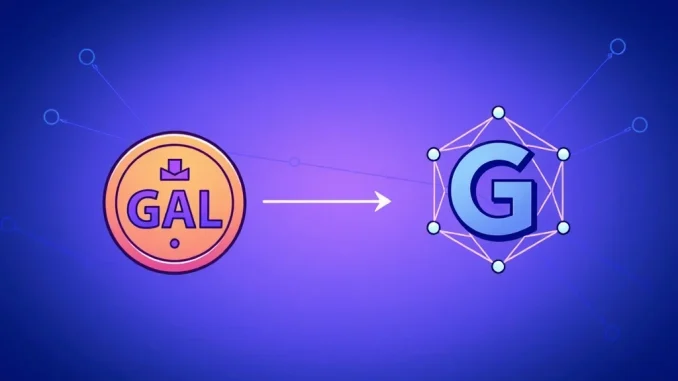
This migration is not merely a token swap; it is the activation of an entirely new economic and technical layer for the Galxe ecosystem. The native token of GravityChain is now ‘G,’ which replaces the former ‘GAL’ ERC-20 token at a 1:1 ratio. All economic activity, governance, and gas fee payments on the new network will be conducted with G.
Immediate Implications for GAL Token Holders
For existing holders of the GAL token, the migration necessitates specific actions to ensure their assets reflect the new reality on GravityChain. The process was not automatic; it required users to actively bridge or swap their assets within a designated timeframe announced by the Galxe Foundation. Holders who missed the official migration window likely now possess a deprecated ERC-20 token (old GAL) on Ethereum, which no longer holds the utility or value of the new G token on GravityChain.
The critical steps that were communicated involved:
- Connecting a Web3 wallet (like MetaMask) to the official Galxe migration portal.
- Approving the bridge contract to lock the old GAL tokens on Ethereum.
- Receiving the new G tokens on the GravityChain network, which required adding the new chain’s RPC details to their wallet.
For decentralized exchange (DEX) liquidity providers and those staking GAL in various DeFi protocols, separate instructions were issued to unwind positions pre-migration. The table below outlines the fundamental change in the asset’s properties:
| Property | Old GAL (ERC-20) | New G (GravityChain Native) |
|---|---|---|
| Blockchain | Ethereum | GravityChain |
| Primary Use | Governance, Fees (on Galxe app) | Governance, Network Gas, Fees |
| Token Standard | ERC-20 | Native Layer-1 Token |
| Transaction Finality | Subject to Ethereum’s ~13 seconds | Determined by GravityChain Consensus |
The Trader’s Perspective: Liquidity, Volatility, and New Markets
From a trading and market structure viewpoint, the migration creates a clear before-and-after scenario. Initially, liquidity for the old GAL token on Ethereum-based centralized and decentralized exchanges has become obsolete. The new G token establishes its own liquidity pools on GravityChain-native DEXs and on centralized exchanges that have chosen to support the new network. Traders must now look for trading pairs labeled ‘G’ and ensure their exchange or wallet supports withdrawals and deposits on the GravityChain network itself.
Such a transition often introduces short-term volatility due to:
- Market Fragmentation: Temporary confusion between old and new tokens can lead to price discrepancies.
- Liquidity Bootstrapping: New pools on GravityChain need time to build depth, which can increase slippage for large orders.
- Exchange Support Timeline: Not all exchanges enable trading for G simultaneously, potentially concentrating volume on a few platforms initially.
Astute traders monitor the velocity of tokens moving to the new chain, the growth of Total Value Locked (TVL) in GravityChain’s DeFi ecosystem, and the integration of major price oracles as key health indicators post-migration.
The Strategic Rationale Behind Building GravityChain
To understand the long-term play, one must view this move within the broader trend of application-specific blockchains, or “appchains.” Projects like dYdX (moving to its own chain) and Cosmos’s app-chain ecosystem demonstrate a growing belief that complex, high-throughput applications benefit from dedicated infrastructure. For Galxe, whose business revolves around issuing, verifying, and utilizing millions of digital credentials, the ability to guarantee low-cost, fast transactions is a competitive necessity.
GravityChain allows Galxe to embed its core logic—like verifying a user’s on-chain history for a campaign—directly into the chain’s state transition function. This can make credential checks more efficient and secure than relying on smart contracts on a general-purpose chain. Furthermore, it opens the door to custom fee models, such as sponsoring transaction fees for users during promotional campaigns, a common practice in web2 marketing that is cumbersome to implement on Ethereum.
Network Security and the Validator Ecosystem
A critical question for any new layer-1 is security. GravityChain employs a Proof-of-Stake (PoS) consensus mechanism, where validators stake G tokens to participate in block production and network security. The success of this model hinges on attracting a robust, decentralized set of validators. The Galxe Foundation likely initiated a validator incentive program to bootstrap this ecosystem. For holders, this presents a new opportunity: staking G tokens to earn rewards as a delegator, thus participating directly in network security and earning yield, a utility not directly available to the old ERC-20 GAL token.
Conclusion: A Foundational Upgrade with Lasting Impact
The Galxe migration to GravityChain is far more than a ticker symbol change. It represents a strategic bet on vertical integration, where control over the full technology stack is deemed vital for scaling and innovation. For the crypto trader, it demands attention to new market dynamics, liquidity venues, and chain-specific tools. For the GAL holder—now a G holder—it unlocks new utilities like staking and promises a user experience tailored to the ecosystem’s needs. While the technical risks of launching a new chain are non-zero, the completed migration positions Galxe not just as an application, but as a foundational protocol in the digital identity landscape. The coming months will be crucial in observing GravityChain’s adoption, stability, and its ultimate success in delivering the enhanced user experience that motivated this ambitious transition.
FAQs
Q1: I still hold old GAL tokens on an exchange. What should I do?
Contact the exchange’s support immediately. Reputable exchanges that supported the migration should have provided a process to swap tokens for users. If the exchange did not support it, you may be holding a valueless legacy token, and you should consult the official Galxe migration archive for any possible recovery options.
Q2: How do I add the GravityChain network to my MetaMask wallet?
You need the network’s RPC (Remote Procedure Call) details. These should be available on the official Galxe or GravityChain documentation website. Typically, you add a new network in MetaMask by entering the Chain ID, RPC URL, currency symbol (G), and block explorer URL provided by the project.
Q3: Will my G tokens have the same value as my old GAL tokens?
The migration was executed at a 1:1 ratio, meaning you received one G token for every one GAL token you migrated. However, the market price of G on GravityChain is determined by supply and demand on the new network and may diverge from the final trading price of the old GAL token on Ethereum.
Q4: What happens to Galxe’s partnerships and integrations on other chains?
Galxe has stated that its credential data layer remains multi-chain. GravityChain serves as its new home base and settlement layer, but the protocol will likely continue to read and verify activity from Ethereum, Polygon, BNB Chain, and others, bringing that data onto GravityChain for application use.
Q5: Can I stake my new G tokens, and if so, how?
Yes, staking is a core function for securing the GravityChain PoS network. Details will be available through the official Galxe governance portal or dedicated staking interface. You can typically delegate your G tokens to a validator of your choice to earn staking rewards.
Related News
- xHaven Launches XVN Token
- Coinbase Unveils 'The Blue Carpet': Streamlined Crypto Listing Process for Blockchain Projects
- Bitcoin Bull Run: Crypto Analyst Publishes Guide On How To Know The Market Top
Related: Euro Stablecoins Endorsed: Bundesbank President Signals Pivotal Shift in European Digital Finance
Related: GameFi Infrastructure Transformed: PlayZap's Strategic Partnership with PVPFUN AI
Related: Metaplanet's Bold Bitcoin Strategy: Doubling Down with New MARS and MERCURY Equity Plans