BlockDAG’s Potential and Market Momentum: Analyzing XRP, Zcash, and Solana’s Position in the Evolving Crypto Landscape
Global, May 2025: The cryptocurrency market continues to evolve beyond its initial phases, with investor attention shifting toward projects demonstrating tangible technological progress and clear utility. Recent developments surrounding BlockDAG, alongside notable rebounds and strategic advancements from established assets like XRP, Zcash, and Solana, highlight a market segment focused on foundational innovation and real-world application. This analysis examines the technical and market factors contributing to their current positions.
Understanding the BlockDAG Protocol and Its Market Position
BlockDAG, or Block Directed Acyclic Graph, represents a distinct architectural approach to distributed ledger technology. Unlike traditional blockchains that organize data in a single, linear chain of blocks, a BlockDAG structure allows blocks to reference multiple predecessors. This design aims to address inherent challenges in earlier systems, primarily scalability and transaction throughput. The theoretical potential for higher transaction per second (TPS) rates forms a core part of the project’s value proposition to developers and enterprises seeking efficient settlement layers.
Market discussions often reference significant return potential for emerging technologies in their early stages. For BlockDAG, analyst projections of substantial growth are frequently tied to the successful deployment of its mainnet—a fully operational, independent network. The transition from testnet or conceptual phase to a live mainnet is a critical milestone for any protocol, as it moves from theoretical capability to practical, stress-tested utility. The market’s assessment of BlockDAG will likely hinge on the performance, security, and developer adoption following this launch.
XRP: Navigating Regulatory Clarity and Institutional Adoption
XRP, the digital asset native to the XRP Ledger, has experienced significant market movements correlated with legal and regulatory developments. Following a protracted legal case with the U.S. Securities and Exchange Commission, a series of judicial rulings provided clearer boundaries for its trading and use. This increased regulatory clarity has been a primary factor cited by analysts observing its recent price stability and renewed institutional interest.
The core utility of XRP remains centered on cross-border payments and liquidity provision for financial institutions. Companies like Ripple continue to partner with banks and payment providers, leveraging the XRP Ledger’s fast settlement times and low transaction costs. This focus on solving a specific, large-scale problem in traditional finance—inefficient international money transfers—provides XRP with a defined use case that differs from more generalized smart contract platforms. Its market performance is increasingly viewed through the lens of adoption in this niche, rather than broader speculative crypto trends.
Technological Distinctions: A Comparative Framework
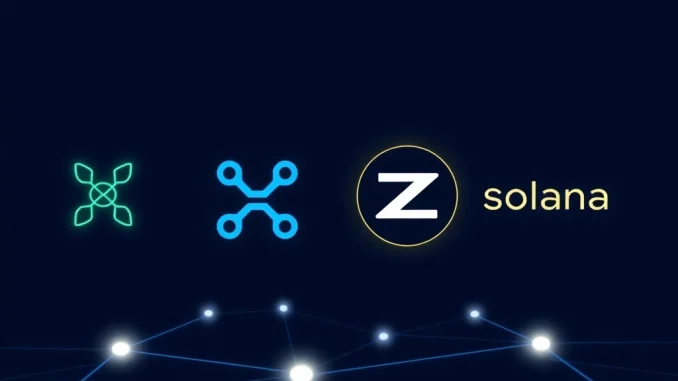
It is crucial to distinguish the technological aims of these assets. BlockDAG proposes a novel base-layer consensus and data structure. XRP utilizes a consensus protocol with a known set of validators for speed. Zcash offers privacy through advanced cryptography. Solana prioritizes high throughput via a unique proof-of-history mechanism. Their concurrent market activity does not signify they are direct competitors, but rather that they represent different answers to various limitations in digital asset design.
Zcash’s Rebound: Privacy Features and Evolving Use Cases
Zcash (ZEC) is a cryptocurrency that emphasizes privacy and selective transparency. It uses zero-knowledge proofs, specifically zk-SNARKs, to allow users to shield transaction information, including sender, receiver, and amount, while still maintaining a verifiable network. After a period of consolidation, Zcash has seen increased market attention, which analysts often attribute to a broader resurgence of interest in privacy-preserving technologies within digital finance.
The rebound coincides with ongoing technical upgrades and discussions about digital privacy rights. In an era of increased financial surveillance, assets offering optional privacy present a specific value proposition. However, this same feature has led to complex regulatory dialogues. The future trajectory of Zcash is tied not only to technological robustness but also to how regulatory frameworks in key jurisdictions adapt to include privacy coins. Its development team and community actively engage in these conversations, aiming to demonstrate compliant use cases for shielded transactions.
Solana’s Recovery and Ecosystem Strength
The Solana network experienced significant challenges in recent years, including notable outages that tested network reliability. However, a concerted effort by the Solana Foundation and core developers focused on enhancing network stability and client diversity. The subsequent period of sustained uptime and robust performance has contributed to a recovery in investor confidence and developer activity.
Solana’s value proposition remains its high throughput and low transaction costs, which support a wide range of decentralized applications (dApps), particularly in decentralized finance (DeFi) and non-fungible tokens (NFTs). Key metrics watched by analysts include:
- Total Value Locked (TVL): The amount of capital deposited in DeFi protocols on the network.
- Daily Active Addresses: A measure of user engagement with the network.
- Developer Activity: The number of commits and new projects building on Solana.
Recent growth in these metrics suggests the ecosystem is regaining momentum, positioning Solana as a leading platform for high-frequency dApps.
The Role of Mainnet Launches and Upgrades
For newer projects like BlockDAG, a mainnet launch is a genesis event. For established networks like XRP, Zcash, and Solana, ongoing upgrades are vital. These upgrades, often called hard forks or network enhancements, introduce new features, improve security, and boost efficiency. For instance, Zcash’s network upgrades regularly enhance its privacy technology, while Solana’s upgrades aim to increase throughput and resilience. These scheduled technical evolutions are critical drivers of long-term viability and market perception, providing tangible checkpoints for progress beyond mere price action.
Conclusion: A Market Driven by Differentiation and Execution
The current activity around BlockDAG, XRP, Zcash, and Solana underscores a maturation in the cryptocurrency sector. Investors and observers are applying more granular analysis, evaluating each project based on its unique technological path, regulatory standing, and real-world utility. The speculative potential for new architectures like BlockDAG exists alongside the measured reassessment of established assets like XRP and Solana as they overcome past hurdles. Ultimately, the trajectory of these crypto assets will be determined less by short-term market sentiment and more by their teams’ ability to execute their roadmaps, foster developer communities, and navigate an increasingly defined global regulatory landscape. Success will belong to projects that deliver reliable, useful, and compliant technology.
FAQs
Q1: What is a BlockDAG and how is it different from a blockchain?
A BlockDAG (Directed Acyclic Graph) is a data structure where blocks can link to multiple previous blocks, creating a web-like pattern. This differs from a linear blockchain, where each block points to only one predecessor. The design aims to allow for higher transaction throughput and scalability.
Q2: Why is regulatory clarity important for XRP?
Regulatory clarity removes significant uncertainty for institutions, exchanges, and payment firms considering using XRP. Clear rules define how it can be listed, traded, and utilized in financial products, which encourages adoption and integration into traditional finance systems.
Q3: How does Zcash provide transaction privacy?
Zcash uses a form of zero-knowledge cryptography called zk-SNARKs. This allows the network to verify that a transaction is valid without revealing the sender’s address, the receiver’s address, or the transaction amount, when users select the shielded transaction option.
Q4: What was the main challenge Solana faced, and how has it addressed it?
Solana faced several network outages due to overwhelming transaction traffic and technical bugs. The core development response involved optimizing network software, improving validator client diversity, and implementing more robust fee markets and transaction scheduling to enhance overall stability and resilience.
Q5: What does “mainnet launch” mean for a cryptocurrency like BlockDAG?
A mainnet launch is the official release of a fully operational, independent blockchain network. It moves the project from a test environment (testnet) to a live network where real transactions occur, and the native token obtains its utility within the active ecosystem. It is a major milestone indicating the technology is ready for public use.
Related News
- BlueVault Crypto Donations: How the Democratic Party's Groundbreaking Platform Aims to Transform 2026 Midterm Fundraising
- Astar TGE: Historic ASTER Token Launch Set for September 17
- Nordic Pension Funds Reassess US Asset Holdings Amid Soaring Geopolitical Uncertainty
Related: Quantra Partners with Chain Intelligence to Revolutionize Web3 Infrastructure and Analytics
Related: Ethereum Trader's Stunning $94M Long Bet Precedes Major Market Announcement
Related: Bitcoin and Ethereum Face Intense Pressure as Crypto Whale Garrett Jin Offloads $900 Million