ZKP Presale Auction Enters Final 5-Day Countdown as Monero and Cardano Show Parallel Market Activity
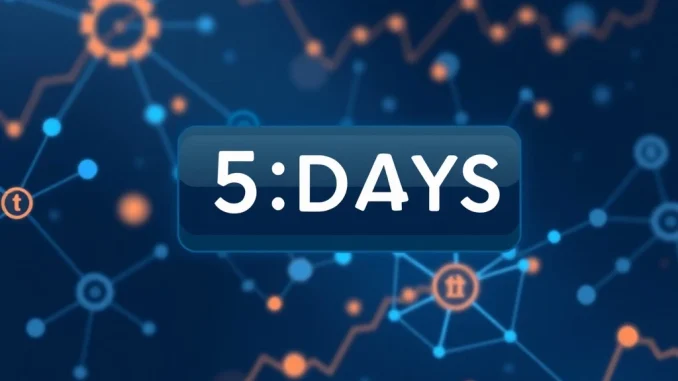
Global, April 2025: The second-stage presale auction for the ZKP protocol token is entering its final five-day phase, a development that coincides with notable price movements for established cryptocurrencies like Monero and Cardano. This convergence of events highlights the ongoing evolution of token distribution models and their interplay with broader market trends.
Understanding the ZKP Stage 2 Presale Auction Mechanism
The ZKP project, focused on zero-knowledge proof scalability solutions, is conducting its token distribution through a multi-stage presale model. The current “Stage 2” employs a descending-price auction, sometimes called a Dutch auction. In this system, the token price starts at a set ceiling and decreases incrementally over a defined period until all allocated tokens sell or the timer expires. This method aims to discover a market-clearing price organically, contrasting with fixed-price sales. The conclusion of this phase in five days will trigger a scheduled reduction in the total token supply, a process commonly referred to as a “supply drop” or burn event for unsold tokens, which is coded into the project’s smart contract.
The Broader Cryptocurrency Context: Monero and Cardano Trends
Activity around the ZKP auction occurs within a wider market environment. Analysts observe that privacy-focused cryptocurrency Monero (XMR) has recently experienced upward price pressure. This movement is often attributed to its established use case and ongoing network upgrades. Simultaneously, Cardano (ADA), a proof-of-stake blockchain platform, maintains a trajectory that several market analysts describe as steady, citing its methodical development roadmap and growing decentralized application ecosystem. These are independent projects with different fundamentals, but their concurrent activity provides a snapshot of a diverse and active digital asset landscape where new token launches like ZKP’s occur.
Token Distribution Models: A Historical Perspective
The evolution of fundraising and token distribution in the blockchain space informs current practices. Early models like Initial Coin Offerings (ICOs) often faced criticism for a lack of fairness and price discovery. Subsequent innovations include:
- Initial DEX Offerings (IDOs): Launching tokens directly on decentralized exchanges.
- Liquidity Bootstrapping Pools (LBPs): Using automated market makers for price discovery.
- Fair Launches: Distributing tokens through mining or staking with no pre-sale.
The descending-price auction model used by ZKP’s Stage 2 seeks to incorporate lessons from these predecessors, emphasizing transparent and algorithmic price discovery before a token lists on public markets.
Analyzing the Implications of the Upcoming Supply Drop
The scheduled token burn at the end of the ZKP presale auction is a significant economic event. If a portion of the auction tokens remains unsold, the protocol’s smart contract will permanently remove them from the maximum supply. Basic economic principles suggest that reducing the available supply of an asset, all else being equal, can create upward pressure on its price, assuming demand remains constant or increases. However, the practical impact depends heavily on broader market sentiment, the project’s subsequent technological progress, and adoption metrics. This mechanism is designed to align early participant incentives with long-term project health by mitigating excessive initial supply.
Technical Foundations: Zero-Knowledge Proofs and Market Relevance
The underlying value proposition of the ZKP project rests on zero-knowledge proof technology. This cryptographic method allows one party to prove to another that a statement is true without revealing any information beyond the validity of the statement itself. In blockchain, this enables:
- Enhanced Scalability: Bundling transactions into succinct proofs.
- Improved Privacy: Shielding transaction details while verifying correctness.
- Interoperability: Facilitating secure cross-chain communication.
The market’s interest in the token presale is intrinsically linked to the growing demand for these scaling and privacy solutions across the industry.
Conclusion
The final countdown for the ZKP Stage 2 presale auction presents a live case study in modern token distribution, set against a backdrop of activity from major cryptocurrencies like Monero and Cardano. The auction’s design, culminating in a supply-adjusting burn mechanism, reflects ongoing industry efforts to create more transparent and equitable launch models. While the immediate auction activity captures attention, the long-term significance for ZKP will be determined by the protocol’s adoption and its contribution to advancing zero-knowledge proof applications. The coming days will conclude this specific phase of price discovery, after which focus will shift to the project’s technological milestones and market performance.
FAQs
Q1: What is a descending-price auction in a cryptocurrency presale?
A descending-price auction, or Dutch auction, starts tokens at a high price that automatically lowers over time until buyers purchase all units or the time ends. It aims to find a fair market price.
Q2: How does Monero’s price activity relate to a new project’s presale?
There is no direct technical relation. However, rising prices for established assets like Monero can indicate broader positive market sentiment, which may influence investor interest in new projects across the sector.
Q3: What is a token supply drop or burn?
A token burn is the permanent removal of coins from the maximum circulating supply, typically by sending them to a verifiable, unspendable address. This is often done to reduce inflation or adjust supply based on presale results.
Q4: Why is Cardano often cited in discussions about steady growth?
Cardano has a reputation for peer-reviewed, academic development and a phased rollout plan. This methodical approach leads some analysts to describe its growth potential as steady or gradual compared to more volatile assets.
Q5: What are zero-knowledge proofs (ZKPs) used for?
Zero-knowledge proofs are a cryptographic tool that enhances blockchain scalability and privacy. They allow transaction validation without exposing underlying data, enabling faster networks and confidential transactions.
Related News
- Why BlackRock Is Investing $680 Million in Bitcoin This Week
- Unleashing Opportunities: Binance to Launch CUDIS USDT Perpetual Contract with 50x Leverage
- KCGI 2025: Team Buylow Achieves Remarkable Fourth Place in Global Trading Competition
Related: Smart Cashtags: X's Pivotal Move into Integrated Trading as Product Lead Cracks Down on Crypto Spam
Related: APRO Oracle and 42Space Launch Revolutionary On-Chain Prediction Platform for 2026 CCTV Gala