BlockDAG’s Mainnet Launch: Analyzing the 500x Speed Claim Against Ethereum and Market Pressures on Zcash & Sui
Global, February 2025: The cryptocurrency sector continues to evolve with significant developments in blockchain infrastructure. Recent technical benchmarks from the newly launched BlockDAG mainnet have drawn attention for their claimed performance metrics, while established projects like Zcash and newer entrants like Sui navigate distinct market and technical challenges. This analysis examines the factual basis of these developments, their technical context, and their potential implications for the broader digital asset ecosystem.
Understanding BlockDAG’s Architecture and Performance Claims
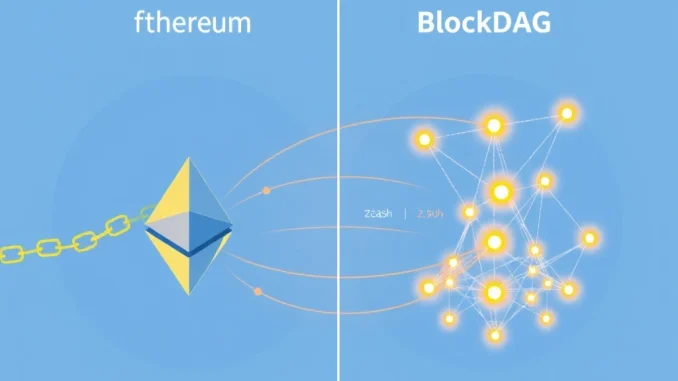
BlockDAG represents a departure from the traditional linear blockchain model used by networks like Bitcoin and Ethereum. A Directed Acyclic Graph (DAG) structure allows for blocks to reference multiple predecessors, enabling parallel transaction processing. Proponents argue this design inherently reduces bottlenecks and increases throughput. The project’s recent mainnet launch has been accompanied by performance data suggesting transaction finality speeds significantly exceeding those of the current Ethereum mainnet. Independent verification of these specific “500x” claims requires scrutiny of the testing environment, network conditions, and the exact metrics being compared, such as transactions per second (TPS) versus time to finality.
Historical context is crucial. Ethereum itself has undergone multiple upgrades, from Proof-of-Work to Proof-of-Stake with The Merge, with future scalability hinging on layer-2 rollups and the full implementation of sharding. Comparing a new, unproven at scale, mainnet to the heavily utilized and decentralized Ethereum network involves contrasting a controlled launch with a mature, global system supporting billions in value. The real test for any new architecture like BlockDAG’s will be maintaining security, decentralization, and performance under real-world load and adversarial conditions over an extended period.
Zcash Price Analysis: Examining Support Levels and Privacy Coin Dynamics
Zcash (ZEC), a pioneering privacy-focused cryptocurrency utilizing zk-SNARKs, has recently demonstrated resilience at specific price levels. Technical analysts observe these support zones as areas where buying interest historically meets selling pressure. However, price action does not occur in a vacuum. The performance of privacy coins is influenced by a complex matrix of factors beyond simple chart patterns.
- Regulatory Environment: Global regulatory scrutiny on privacy-enhancing technologies in digital assets creates persistent uncertainty, impacting investor sentiment.
- Technological Adoption: The adoption of Zcash’s shielded transactions for actual use, versus speculative trading, is a key metric for long-term value.
- Competitive Landscape: Zcash competes with other privacy protocols like Monero and with the integration of privacy features into more general-purpose blockchains.
- Macro-Financial Conditions: Like all cryptocurrencies, ZEC is susceptible to broader market trends, interest rate policies, and institutional capital flows.
Therefore, while holding technical support is a positive short-term signal, Zcash’s trajectory remains tightly coupled to these broader, less chartable fundamentals.
Sui Network: Assessing Technical Promise and Market Pressure
Sui, a high-throughput Layer 1 blockchain developed by Mysten Labs, launched with ambitions to rival other smart contract platforms through its novel object-centric model and the Move programming language. The network has faced what observers term “pressure,” which can be deconstructed into several areas:
| Challenge Area | Description | Current Status |
|---|---|---|
| Network Adoption | Growth of active addresses, daily transactions, and total value locked (TVL) in decentralized applications. | Gradual growth phase; competing for developer mindshare against established ecosystems. |
| Token Economics | Market valuation, circulating supply dynamics, and staking yields relative to network utility. | Subject to typical volatility of newer assets; staking provides base-level demand. |
| Technical Differentiation | Real-world performance delivering on promises of parallel execution and low latency. | Early benchmarks are positive, but sustained performance under load is key. |
| Ecosystem Development | Quality and diversity of applications built on Sui, from DeFi to gaming. | Early-stage development; several notable projects have launched or are in development. |
This pressure is not unique to Sui but is characteristic of any new blockchain entering a crowded field. Its resolution depends on execution, community building, and demonstrating clear use cases that are difficult to replicate on incumbent networks.
The Infrastructure Race: Beyond Simple Speed Metrics
The narrative of “faster than Ethereum” is a common trope in cryptocurrency marketing. A more nuanced industry perspective focuses on the trade-offs in the blockchain trilemma: decentralization, security, and scalability. A network can optimize for one or two, but excelling in all three simultaneously remains the industry’s holy grail.
Ethereum’s path prioritizes decentralization and security at the base layer, pushing scalability to Layer 2 solutions. Newer networks like BlockDAG, Sui, and others often design from the ground up with scalability as a primary goal, but they must then prove their designs do not compromise the other two pillars over time. The long-term success of any protocol will be determined not by a single speed metric at launch, but by its resilience, developer activity, security audit history, and the genuine economic activity it secures.
Conclusion
The cryptocurrency landscape in 2025 is defined by intense competition at the infrastructure layer. The emergence of architectures like BlockDAG highlights continuous innovation in consensus and data structures, though their long-term viability requires rigorous, independent validation. Meanwhile, assets like Zcash operate within specialized niches shaped by technology and regulation, and newer smart contract platforms like Sui face the formidable challenge of ecosystem building. For participants, from developers to investors, a focus on verifiable data, fundamental technological trade-offs, and sustainable adoption metrics provides a more reliable compass than sensationalized performance comparisons or short-term price movements.
FAQs
Q1: What is a BlockDAG, and how is it different from a blockchain?
A Directed Acyclic Graph (DAG) is a data structure where blocks can point to multiple previous blocks, forming a web-like graph rather than a single chain. This allows for more parallel transaction processing, potentially increasing throughput compared to a linear blockchain sequence.
Q2: How is Zcash’s price “support level” determined?
Support levels are price zones identified through technical analysis where an asset has historically stopped falling and reversed direction. They are derived from past trading data, indicating areas where buyer demand has previously emerged.
Q3: What are the main challenges facing the Sui network?
Sui’s primary challenges are common to new Layer 1 blockchains: attracting developers and users away from established ecosystems, proving its novel technology under real-world, adversarial conditions, and building a robust economy of decentralized applications.
Q4: Why is comparing a new mainnet’s speed to Ethereum’s considered complex?
Ethereum is a massively decentralized network securing hundreds of billions of dollars, with thousands of nodes globally. A new mainnet often launches with fewer nodes, less usage, and in a controlled environment. Comparisons must account for these differences in decentralization, security assumptions, and real-world load.
Q5: What is the “blockchain trilemma”?
Coined by Ethereum founder Vitalik Buterin, the trilemma suggests it is difficult for a blockchain to achieve optimal levels of decentralization, security, and scalability simultaneously. Most designs involve trade-offs, prioritizing two of the three properties.