BlockDAG Mainnet Launch Contrasts Stagnant Stellar and Solana’s Uncertain 2026 Path
Global, May 2025: The cryptocurrency market presents a study in contrasts. While established assets like Stellar (XLM) show minimal price movement and Solana (SOL) faces questions about its long-term trajectory, the successful launch of BlockDAG’s mainnet and its Token Generation Event (TGE) introduces a new variable into the ecosystem. This analysis examines the technical and market factors behind these divergent paths, providing context on network fundamentals, adoption challenges, and the implications of a new blockchain architecture going live.
Stellar XLM Price Analysis and Network Fundamentals
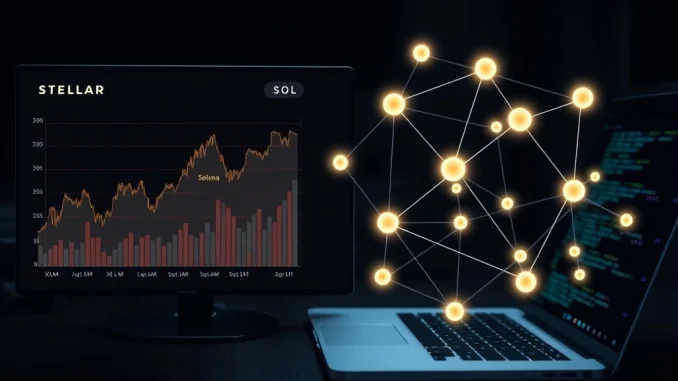
Stellar Lumens (XLM) has experienced a period of notable price stability, which market participants often describe as “flatlining.” This trend requires examination beyond simple price charts. The Stellar network, founded in 2014, was designed primarily for cross-border payments and financial asset issuance. Its consensus protocol, the Stellar Consensus Protocol (SCP), uses a federated Byzantine agreement system that is energy-efficient and offers fast settlement times.
Recent network metrics provide context for its market performance. According to public blockchain explorers, Stellar maintains a consistent transaction volume, primarily driven by its use cases in remittances and tokenized asset transfers. However, the growth in new, unique addresses and developer activity on the network has plateaued relative to other smart contract platforms. This stagnation in ecosystem expansion often correlates with a lack of speculative momentum in the token’s price. Analysts point to the network’s focused, but narrow, use case as a double-edged sword, providing stability but limiting the explosive growth narratives that drive significant price appreciation in the broader crypto market.
Solana Price Prediction for 2026: Technical and Ecosystem Considerations
Projecting Solana’s price for 2026 involves analyzing its technological resilience, competitive landscape, and adoption curves. Solana’s value proposition centers on its high throughput, achieved through a unique combination of Proof of History (PoH) and Proof of Stake (PoS). After overcoming significant network outages in 2022 and 2023, the Solana Foundation has prioritized stability, leading to a period of improved uptime throughout 2024.
Several factors will influence its 2026 valuation. First is the continued growth of its decentralized finance (DeFi) and non-fungible token (NFT) ecosystems, which have shown resilience. Second is the development of Solana’s layer-2 scaling solutions and the integration of privacy features like confidential transfers. Third, and perhaps most critically, is its ability to attract and retain developer talent away from competitors like Ethereum, Aptos, and Sui. Market analysts use models that factor in network revenue (transaction fees), total value locked (TVL) in DeFi, and the inflation schedule of its token supply. Most institutional forecasts for 2026 present a range of scenarios, from conservative growth based on current adoption to more optimistic projections should Solana capture a dominant share of the consumer-facing Web3 application market.
The Mechanics of a Token Generation Event (TGE)
A Token Generation Event is a critical milestone for any blockchain project, representing the official launch and distribution of its native token. Unlike an Initial Coin Offering (ICO), which is primarily a fundraising mechanism, a TGE often coincides with the mainnet launch, where the token becomes functional within its own live blockchain environment. The process involves deploying the token’s smart contract, distributing tokens to early backers, team members (typically subject to vesting schedules), and establishing initial liquidity on decentralized and centralized exchanges. A well-executed TGE focuses on fair distribution, clear utility definition for the token, and robust security audits to prevent exploits. The subsequent price discovery phase is influenced by initial demand, the token’s economic model, and the immediate utility it provides on the live network.
BlockDAG’s Live Mainnet: A New Architectural Approach
The launch of BlockDAG’s mainnet introduces a distinct blockchain data structure to the market. Unlike traditional blockchains that organize data in a single, linear chain, a Directed Acyclic Graph (DAG) allows for multiple chains of blocks to exist simultaneously and be validated in parallel. This architecture aims to solve the blockchain trilemma—balancing decentralization, security, and scalability—by theoretically enabling higher transaction throughput without compromising security.
The successful transition from testnet to mainnet is a significant technical achievement. It requires all network components—consensus mechanisms, wallet software, block explorers, and often bridging protocols—to operate seamlessly in a live, value-bearing environment. For BlockDAG, the live mainnet means its native token now has operational utility for paying transaction fees, participating in governance, or securing the network through staking, depending on its specific design. The market’s assessment of its “potential” will be based on tangible metrics post-launch, including:
- Network Throughput: Actual transactions per second (TPS) achieved under real load.
- Decentralization: The number and distribution of independent validators.
- Ecosystem Growth: The pace at which developers build and deploy applications.
- Security Audit Results: Public reports from reputable third-party auditing firms.
Historical analysis of past launches shows that long-term success depends less on initial hype and more on sustained technical execution and community building over the following 18-24 months.
Evaluating “Potential” in Cryptocurrency Projects
The term “potential” in crypto investing carries specific meaning. Analysts differentiate between price potential and utility potential. Price potential is speculative, based on supply-demand models and comparative market capitalization analysis. Utility potential is fundamental, assessing whether the technology solves a real problem better than existing solutions. For a new network like BlockDAG, its utility potential lies in proving its DAG architecture can offer scalable, secure, and decentralized transactions for specific use cases. Its price potential, conversely, is a function of market sentiment, adoption rates, and broader capital flows into the crypto sector. Disentangling these two forms of potential is crucial for informed analysis, as many projects with strong technological utility may not see immediate price appreciation, and vice versa.
Comparative Market Dynamics and Investor Considerations
The current market phase highlights a maturation in investor approach. The simultaneous observation of a stagnant Stellar, a cautiously projected Solana, and a newly launched BlockDAG reflects a market that is no longer moving in uniform sync. Capital allocation decisions are becoming more nuanced, based on project-specific fundamentals rather than blanket sector-wide trends.
For investors and observers, this environment demands a focus on verifiable data. Key performance indicators (KPIs) now carry more weight than promotional narratives. These KPIs include GitHub commit activity, protocol revenue, fee burn mechanisms, governance participation rates, and on-chain user growth. The narrative around any single asset, whether it’s an established player like Solana or a newcomer like BlockDAG, must be backed by transparent, on-chain evidence of usage and development progress. This shift towards fundamental analysis, while still evolving, represents a healthier long-term trajectory for the entire digital asset industry.
Conclusion
The cryptocurrency landscape in mid-2025 is defined by differentiation. Stellar’s flat price action reflects its mature, niche position in payments. Solana’s path to 2026 hinges on its ability to maintain technical robustness while expanding its ecosystem. The launch of BlockDAG’s mainnet and its TGE presents a new test case for an alternative blockchain architecture, with its long-term viability dependent on demonstrable scalability and adoption. For market participants, this period underscores the importance of moving beyond hype and conducting thorough, fundamental analysis based on network data, technological merit, and clear utility propositions. The evolving story of these projects will be written not by price speculation alone, but by their tangible contributions to the broader blockchain infrastructure.
FAQs
Q1: What does it mean that Stellar is “flatlining”?
In market terms, “flatlining” refers to a period of minimal price volatility and low trading volume. For Stellar (XLM), this often correlates with steady but unspectacular network usage focused on its core cross-border payment use case, lacking the growth narratives that drive major price swings.
Q2: What are the main factors analysts consider for Solana’s 2026 price prediction?
Analysts typically evaluate network stability and uptime, growth in Total Value Locked (TVL) in DeFi, developer activity and new project launches, competitive positioning against other smart contract platforms, and broader macroeconomic conditions affecting crypto asset valuations.
Q3: What is a mainnet launch, and why is it important?
A mainnet launch is the deployment of a fully operational, independent blockchain network where transactions involving real value are processed. It is the final product after the testnet phase, signifying the project is live for public use and its token has functional utility.
Q4: How is a Directed Acyclic Graph (DAG) different from a traditional blockchain?
A traditional blockchain orders transactions into single, linear blocks. A DAG structure allows multiple chains of blocks (or transactions) to be created and confirmed in parallel, which can potentially increase transaction speed and throughput. BlockDAG utilizes this alternative architecture.
Q5: What should investors look for after a new project’s Token Generation Event (TGE)?
Post-TGE, focus should shift to on-chain metrics: the number of active wallets, transaction volume, governance participation (if applicable), the pace of new smart contract deployments, and the results of any ongoing security audits. Liquidity and trading volume on reputable exchanges are also key health indicators.
Related News
- Here's The Key To Reviving Bitcoin's Bull Market: Analyst
- Cryptocurrency Trends: Unveiling Astounding Opportunities in the Crypto Market
- Silencio Network Breaks Records: $112 Million in Allocation Requests, Surpassing Target by 220x
Related: Crypto ETFs Achieve Measured Gains as U.S. Net Inflows Signal Cautious Institutional Confidence
Related: Bitcoin News: Historic $2.3B Capitulation Rocks BTC as Crypto PACs Mobilize in February 2026
Related: Prediction Markets Warning: Ethereum Co-Founder Decries 'Corposlop' Drift