Low-Risk Crypto Investments: Why Steady Yield and Real-World Assets Dominate 2025
Global Financial Markets, March 2025: A fundamental shift is underway in digital asset markets. The narrative of cryptocurrency as a purely speculative, high-volatility gamble is being systematically dismantled. In its place, a new framework focused on low-risk crypto investments and predictable returns is gaining dominance, driven not by retail sentiment but by institutional capital and regulatory maturation. This evolution centers on two interconnected concepts: tokenized real-world assets (RWAs) and next-generation structured stablecoins, which together are building a foundation for sustainable, steady yield.
The Institutional Mandate Reshapes Crypto Markets
The entry of pension funds, asset managers, and corporate treasuries into the digital asset space has introduced a new set of requirements. These entities operate under strict fiduciary duties, risk management protocols, and compliance frameworks. Their primary objective is capital preservation and reliable income, not exponential, unpredictable gains. This institutional thinking is now the primary architect of market structure. Analysts point to the growing allocation mandates from firms like BlackRock and Fidelity, which explicitly target yield-generating, asset-backed protocols rather than naked cryptocurrency speculation. The consequence is a rapid reallocation of capital within the crypto ecosystem, favoring infrastructure that provides auditability, legal clarity, and cash-flow visibility.
Real-World Assets: The Bridge to Tangible Yield
Tokenization of real-world assets represents the most direct translation of traditional finance principles into blockchain efficiency. An RWA is a digital token on a blockchain that represents ownership or a claim on a physical or traditional financial asset. This is not a new concept, but its execution and scale have reached critical mass in 2025.
- U.S. Treasury Bonds: Protocols like Ondo Finance and Matrixdock allow users to purchase tokenized versions of short-term U.S. Treasuries, offering yields that directly mirror the traditional financial system with the added benefit of 24/7 settlement and blockchain transparency.
- Private Credit and Loans: Platforms such as Maple Finance and Centrifuge tokenize pools of institutional-grade private credit, enabling decentralized funding for real-world businesses like fintech companies or trade finance. Investors earn yield from the underlying loan interest.
- Real Estate: While more complex, fractional ownership of commercial real estate through tokens is expanding, providing access to rental income streams previously inaccessible to smaller investors.
The implication is profound. Yield is no longer manufactured purely from crypto-native mechanisms like liquidity provider fees, which are tied to volatile token prices. Instead, it is derived from the interest payments of a loan to a solar farm company or the coupon payment of a U.S. government bond. This links crypto returns directly to the established, global economy.
From Algorithmic to Asset-Backed: The Stablecoin Evolution
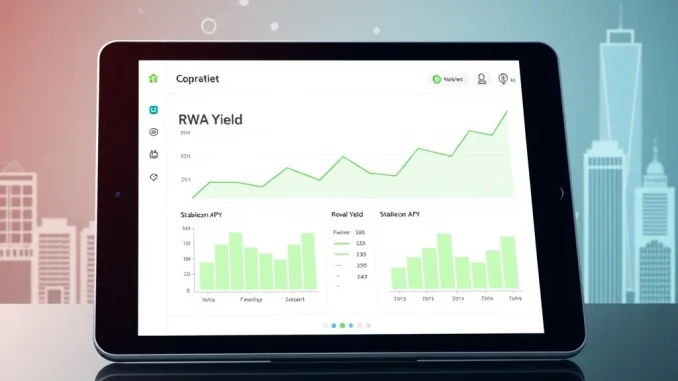
The stablecoin sector vividly illustrates the shift toward low-risk frameworks. The era of purely algorithmic stablecoins, which failed spectacularly in 2022, is over. The current dominance lies with structured, yield-bearing stablecoins that are over-collateralized by high-quality assets. These instruments serve a dual purpose: providing a stable medium of exchange and a vehicle for earning a steady yield.
For example, a stablecoin like Mountain Protocol’s USDM is directly backed by U.S. Treasury bills held in regulated custody. Holders automatically earn a yield that is passed through from the interest on those T-bills. Similarly, Ethena’s USDe, while using a different synthetic dollar model, generates yield through a combination of staking Ethereum and hedging derivatives positions, creating a structured return profile that is calculated and transparent. The key difference from past models is the focus on verifiable reserves, institutional-grade custodians, and clear, sustainable yield mechanisms rather than Ponzi-like incentives.
Analyzing the Risk-Return Profile
The appeal of this new paradigm is its transformed risk-return profile. The table below contrasts traditional high-risk crypto yield farming with the current RWA and structured stablecoin approach.
| Metric | Traditional DeFi Yield Farming (c. 2021) | RWA / Structured Stablecoin Yield (2025) |
|---|---|---|
| Yield Source | Inflationary token emissions, trading fees | Real-world interest, bond coupons, loan payments |
| Primary Risk | Smart contract exploit, token hyperinflation & collapse, impermanent loss | Counterparty risk (custodian, borrower), regulatory change, traditional market rates |
| Yield Stability | Extremely volatile, often declines rapidly | Relatively stable, tied to traditional finance benchmarks |
| Correlation | High correlation to crypto market sentiment | Lower correlation, higher linkage to TradFi rates |
This shift does not eliminate risk. It exchanges the wild, unquantifiable risks of unaudited smart contracts and tokenomics for the more familiar, measurable risks of credit and regulation. For institutional capital, this is a preferable and manageable trade-off.
The Regulatory and Infrastructure Foundation
This maturation is impossible without parallel developments in regulation and infrastructure. Jurisdictions like the European Union with its MiCA framework, the UK’s detailed cryptoasset regime, and evolving guidance from the U.S. SEC and CFTC are providing the clarity needed for institutional participation. Clear rules around custody, asset classification, and disclosure allow large firms to build compliant on-ramps. Furthermore, the infrastructure of custody—with firms like Coinbase Institutional, BitGo, and traditional banks like BNY Mellon offering digital asset services—provides the security blanket required for managing billions in RWAs and stablecoin reserves. The timeline from the 2022 market collapses to the 2025 landscape shows a clear pattern: crisis, regulatory response, infrastructure build-out, and finally, institutional adoption focused on utility over speculation.
Conclusion
The cryptocurrency market is undergoing a decisive maturation. The hottest investments of 2025 are not the most speculative altcoins, but rather the instruments that provide low-risk crypto investments and a steady yield derived from the global financial system. The driving forces are institutional capital demanding compliant, yield-bearing products and the technological capability to tokenize real-world assets efficiently. This convergence marks a new chapter where blockchain’s efficiency meets traditional finance’s stability, creating a hybrid ecosystem focused on sustainable growth and risk-managed returns. The era of crypto growing up is defined by this pivot from gambling to calculated, income-generating investment.
FAQs
Q1: What exactly is a “low-risk” crypto investment?
In the current context, “low-risk” refers to digital asset products where the primary source of return and value is derived from established, off-chain financial assets like government bonds or private credit, not from the speculative trading of volatile cryptocurrencies. The risk profile shifts from smart contract failure and token collapse to more traditional financial risks like credit default or interest rate changes.
Q2: How does yield from a tokenized U.S. Treasury bond work?
A protocol purchases actual U.S. Treasury bills and holds them with a regulated custodian. It then issues digital tokens representing ownership in that pool of bonds. The interest (coupon) payments generated by the T-bills are collected by the protocol and distributed pro-rata to the token holders, typically on a daily or weekly basis, directly to their digital wallets.
Q3: Are structured stablecoins safer than older stablecoins like the original USDT or USDC?
They represent a different design philosophy. USDT and USDC are primarily meant as stable mediums of exchange and are backed by reserves (cash & equivalents). Yield-bearing structured stablecoins are designed as investment vehicles that also maintain stability. Their safety depends heavily on the quality and transparency of their underlying collateral and the robustness of their yield-generation mechanism. They often carry different risk profiles focused on the yield strategy.
Q4: What is the main challenge for the growth of Real-World Asset (RWA) tokenization?
The primary challenges are legal and regulatory. Perfectly replicating legal ownership rights (like foreclosure on a defaulted loan) on-chain across different global jurisdictions is complex. It requires robust legal frameworks, oracles for real-world data, and trusted intermediaries for off-chain enforcement. Scaling also depends on widespread institutional adoption of the blockchain rails for settlement.
Q5: Is this trend making crypto more like traditional finance, and is that a good thing?
Yes, it is creating significant convergence. For proponents, this is a positive evolution that brings much-needed stability, scalability, and trillions of dollars of institutional capital into the space, validating blockchain’s utility. For some decentralization purists, it risks recreating the opaque, intermediary-heavy systems that crypto aimed to disrupt. The likely outcome is a hybrid system leveraging blockchain’s efficiency for traditional asset settlement.
Related News
- DePHY Network: Unleashing DePIN's Potential with Binance Alpha's Landmark Listing
- New OPEN Ticketing Module Revives the Bowie Bond
- Stunning: Trump Nominates Kevin Warsh as Next Federal Reserve Chair, Signaling Hawkish Shift
Related: Altcoins Face Grim Reality: 99% May Never Reclaim Past Highs, Analyst Warns
Related: Essential Blockchain Security: Lunar Strategy and SolidProof Forge Critical Alliance for Web3 Growth
Related: Snowball MNS Integrates With Monad: The Essential Guide to Human-Readable Blockchain Identity