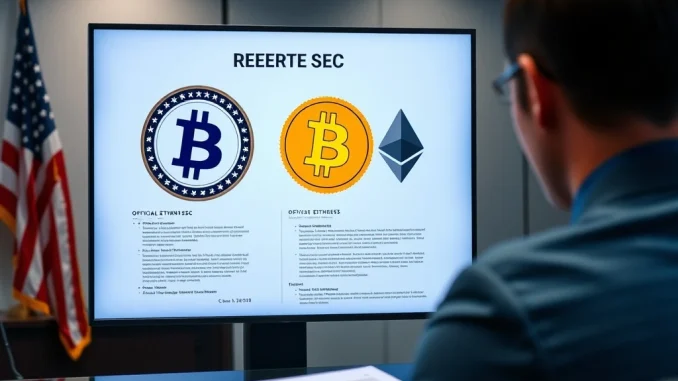
Trump Media Bitcoin ETF: The Crucial Refiling for Staking-Enabled Funds
Washington, D.C., April 2025: In a significant move within the digital asset investment space, Trump Media and Technology Group Corp. has formally refiled its application with the U.S. Securities and Exchange Commission (SEC) to launch exchange-traded funds (ETFs) tracking Bitcoin and Ethereum. This latest filing, which also includes a fund for Cronos, notably incorporates a mechanism for staking rewards, a feature aimed at attracting both retail and institutional capital. The action represents a renewed push for regulatory approval in an evolving financial landscape, following previous attempts that did not gain traction. The market now watches closely to see if this revised proposal can navigate the SEC’s stringent review process.
Trump Media Bitcoin ETF: Details of the New Proposal
The core of the new filing centers on creating publicly traded vehicles that provide exposure to Bitcoin (BTC) and Ethereum (ETH) without requiring investors to directly purchase or custody the cryptocurrencies. The proposed structure is similar to the spot Bitcoin ETFs approved in early 2024, where the fund holds the underlying asset. However, the Trump Media proposal introduces a key differentiator: staking rewards for the Ethereum ETF. Staking involves locking up cryptocurrency to support the operations of a proof-of-stake blockchain network, like Ethereum, in return for rewards. By integrating this feature, the fund aims to generate a yield for shareholders, potentially making it more attractive than non-staking competitors. The inclusion of Cronos, a blockchain ecosystem compatible with Ethereum, signals a broader strategy to capture value from the decentralized finance (DeFi) sector.
The Regulatory Hurdle and SEC Approval Process
The path to approval remains fraught with regulatory scrutiny. The SEC, under Chair Gary Gensler, has historically expressed deep concerns about the cryptocurrency market, citing issues of investor protection, market manipulation, and custody. The approval of several spot Bitcoin ETFs in January 2024 marked a pivotal shift, but the agency has been more cautious regarding Ethereum. A primary point of contention is whether Ethereum constitutes a security, a classification that would subject it to much stricter regulations. The staking component adds another layer of complexity, as the SEC has previously suggested that staking-as-a-service offerings may qualify as investment contracts. The refiling indicates Trump Media’s legal team is attempting to structure the funds in a way that addresses these concerns, but analysts predict a lengthy review period filled with potential requests for clarification and modification from the SEC’s Division of Investment Management.
Historical Context and the Evolution of Crypto ETFs
The journey toward cryptocurrency ETFs in the United States spans nearly a decade. For years, firms like Grayscale Investments fought legal battles to convert their Bitcoin trust into an ETF, culminating in a court victory that pressured the SEC into approving the first batch of spot Bitcoin ETFs. This created a precedent but did not automatically greenlight funds for other digital assets. The Trump Media refiling must now be evaluated against this new, yet still cautious, regulatory paradigm. Its success would not only provide investors with new tools but could also set a template for how staking rewards are handled within a regulated investment product, influencing future filings from other asset managers.
Market Implications for Retail and Institutional Investors
The potential approval of these ETFs carries substantial implications for market participants.
- For Retail Investors: These funds would offer a familiar, brokerage-account-friendly method to gain exposure to crypto assets. The staking feature on the Ethereum ETF could appeal to those seeking income generation, a common strategy in traditional equity and bond investing.
- For Institutional Investors: Many institutions have mandates or internal policies that prevent direct investment in cryptocurrencies due to custody, regulatory, or operational risks. A regulated, SEC-approved ETF housed with a traditional custodian like Coinbase Custody, as referenced in similar filings, removes these barriers, potentially unlocking significant institutional capital.
- For the Crypto Market: Approval would likely increase overall demand for Bitcoin and Ethereum, as ETF issuers must purchase the underlying assets to back shares. It would also further legitimize the asset class within the traditional financial system.
Comparative Analysis: Staking vs. Non-Staking Crypto ETFs
The inclusion of staking creates a distinct product category. The table below outlines key differences.
| Feature | Staking ETF (Proposed) | Standard Spot ETF |
|---|---|---|
| Primary Return Driver | Asset price appreciation + staking yield | Asset price appreciation only |
| Risk Profile | Market risk + staking/slashing risk* + regulatory risk | Market risk primarily |
| Investor Appeal | Income-focused, total return seekers | Pure price speculation |
| Regulatory Complexity | High (novel structure) | Moderate (established precedent) |
*Slashing refers to a penalty where a portion of staked assets can be forfeited for network misbehavior, a risk managed by the fund’s chosen staking provider.
Expert Insight on the Filing’s Strategic Timing
Financial analysts note the refiling comes at a moment of heightened political and regulatory debate over digital assets. “This isn’t just a financial product application; it’s a strategic move within a broader conversation about innovation and regulation,” notes a policy analyst from a Washington-based think tank. “The inclusion of staking directly engages with one of the SEC’s active areas of concern. Whether this filing succeeds may depend as much on evolving legal interpretations as on its technical merits.” The outcome will serve as a critical test case for how far the current regulatory framework can stretch to accommodate the unique features of blockchain-based finance.
Conclusion
The refiling by Trump Media for Bitcoin and Ethereum ETFs with integrated staking rewards marks a bold next step in the maturation of cryptocurrency investment vehicles. While the prospect of earning yield on a regulated Ethereum product is compelling for investors, the proposal must first survive the SEC’s exacting scrutiny. The process will illuminate the boundaries of acceptable innovation within U.S. securities law and could pave the way for a new generation of hybrid financial products. Regardless of the immediate outcome, this filing underscores the persistent demand from both retail and institutional investors for accessible, regulated pathways into the digital asset ecosystem, keeping the Trump Media Bitcoin ETF proposal at the forefront of financial market developments.
FAQs
Q1: What is the main new feature in Trump Media’s latest ETF filing?
The key new feature is the inclusion of staking rewards for the proposed Ethereum ETF, which aims to provide investors with a yield on top of potential price appreciation.
Q2: Why does the SEC’s approval remain uncertain?
The SEC continues to scrutinize the crypto market for investor protection risks. Specific concerns for this filing include the regulatory status of Ethereum and the novel integration of staking within a registered investment product.
Q3: How would a staking ETF work for an investor?
An investor would buy shares of the ETF through a normal brokerage account. The fund’s manager would stake the underlying Ethereum holdings with a trusted provider, and the rewards generated would be used to increase the fund’s net asset value or potentially distributed as dividends.
Q4: What was the significance of the spot Bitcoin ETF approvals in early 2024?
Those approvals broke a long-standing regulatory logjam, proving a model for holding physical Bitcoin in a regulated fund. They set a precedent but did not guarantee approval for other crypto assets or for funds with additional features like staking.
Q5: Who is the target audience for these proposed ETFs?
The funds target two main groups: retail investors seeking easy, regulated access to crypto, and institutional investors (like pension funds or endowments) whose internal rules may have previously prevented direct cryptocurrency investment.
Related News
- CME FedWatch Reveals Stunning 95% Probability of Fed Rate Hold in January FOMC Meeting
- Upbit ENSO Listing: A New Opportunity for Crypto Traders
- WeFi Expands Global Reach with WFI Token Listing on BingX
Related: Snowball MNS Integrates With Monad: The Essential Guide to Human-Readable Blockchain Identity
Related: Yei Finance (CLO) Price Surge: Decoding the Ascending Triangle and Accumulation Signals