Tokenized Revolution: Bank of England, SWIFT, and Chainlink Launch Historic Synchronisation Lab
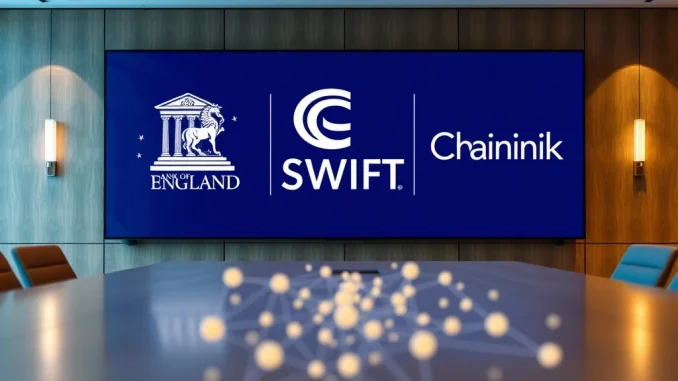
London, United Kingdom, April 2025: In a move signaling a profound shift in the architecture of global finance, the Bank of England (BoE) has formally partnered with the global financial messaging giant SWIFT and blockchain oracle network Chainlink. The collaboration centers on the BoE’s newly established Synchronisation Lab, a sandbox environment where 18 selected participants will rigorously test the settlement of tokenized assets. This initiative represents one of the most significant integrations of traditional central banking infrastructure with decentralized blockchain technology to date, focusing initially on cross-border foreign exchange (FX) transactions.
The Synchronisation Lab: A Bridge Between Two Financial Worlds
The Bank of England’s Synchronisation Lab is not a mere pilot program; it is a structured research and development initiative designed to solve one of finance’s oldest challenges: settlement finality and risk in cross-border transactions. The lab brings together a consortium of 18 institutions, including major commercial banks, fintech firms, and infrastructure providers. According to an official announcement from the SWIFT community on social media platform X, the lab’s first phase will test payment-versus-payment (PvP) mechanisms for FX trades. A subsequent phase will explore delivery-versus-payment (DvP) for tokenized securities like bonds and equities. This phased approach allows the BoE to methodically de-risk the process, ensuring systemic stability remains paramount.
Decoding the Key Players and Their Roles
Understanding the unique value each partner brings is crucial to grasping the lab’s potential. The Bank of England provides the ultimate regulatory and operational credibility. As the UK’s central bank and a pillar of the global financial system, its involvement lends immediate legitimacy and ensures the project aligns with core principles of monetary and financial stability. SWIFT brings its unparalleled network, connecting over 11,000 financial institutions in more than 200 countries. Its role is to act as the trusted messaging layer, facilitating communication and instruction between disparate legacy systems and new blockchain networks. Chainlink contributes its critical oracle technology. Oracles are secure middleware that reliably feed real-world data—like FX rates, interest rates, and proof of settlement—onto blockchains. Chainlink’s role is to ensure the smart contracts automating the PvP and DvP processes are triggered by accurate, tamper-proof information.
The Technical Imperative: Solving the Atomic Settlement Problem
The core innovation being tested is atomic settlement, a concept where two legs of a transaction (e.g., paying USD and receiving EUR) occur simultaneously and irrevocably. In today’s traditional systems, settlement can take days and involves counterparty risk—the danger that one party fulfills its obligation while the other defaults. Tokenization, the process of creating a digital representation of an asset on a blockchain, enables this atomic swap through smart contracts. The Synchronisation Lab is building the plumbing to connect tokenized versions of central bank money (like a potential digital pound), commercial bank money, and securities, ensuring they can be exchanged instantly and automatically upon agreed conditions.
Historical Context and the Path to Tokenization
This initiative did not emerge in a vacuum. It follows years of exploration by central banks worldwide into Central Bank Digital Currencies (CBDCs) and the rapid growth of the tokenized asset market. The Bank for International Settlements (BIS) has conducted multiple similar experiments, such as Project Mariana and Project Agorá. However, the BoE’s lab is distinct in its direct collaboration with an incumbent global utility (SWIFT) and a leading decentralized finance (DeFi) infrastructure provider (Chainlink). This tripartite structure acknowledges a key industry insight: the future financial system will likely be a hybrid, leveraging the security and scale of legacy systems with the efficiency and programmability of new technologies. The lab’s work directly addresses operational complexities highlighted in past financial crises, aiming to create a more resilient and transparent settlement backbone.
Implications for Global Finance and Cryptocurrency Markets
The implications of a successful Synchronisation Lab are far-reaching. For institutional finance, it promises reduced capital requirements (by lowering settlement risk), lower operational costs, and the potential for 24/7 market functioning. For the blockchain and cryptocurrency sector, it represents a monumental validation. The selection of Chainlink, a workhorse of the DeFi ecosystem, signals that central banks are looking to integrate proven, battle-tested crypto-native infrastructure rather than building everything from scratch. This could accelerate institutional adoption of tokenization for a wider range of assets, from real estate to private equity. Furthermore, it sets a potential global standard for how legacy and modern systems interoperate, influencing similar projects at the European Central Bank, the Federal Reserve, and across Asia.
Conclusion: A Cautious Step Toward a Transformative Future
The Bank of England’s Synchronisation Lab, in partnership with SWIFT and Chainlink, is a definitive step toward modernizing the foundational layers of global finance. While framed as a test, its composition and goals reveal a strategic commitment to understanding and shaping the tokenized asset landscape. The focus on solving practical, high-value problems like cross-border FX settlement demonstrates a use-case-driven approach that prioritizes stability and efficiency over hype. The success of this collaboration could redefine settlement risk, unlock new financial products, and create a more integrated and resilient global financial system for the digital age. The world will be watching as these 18 participants begin their work in the lab, potentially writing the next chapter in the history of money.
FAQs
Q1: What is the primary goal of the Bank of England’s Synchronisation Lab?
The primary goal is to test and develop secure, efficient mechanisms for settling tokenized assets, starting with cross-border foreign exchange transactions using payment-versus-payment (PvP) protocols, to reduce settlement risk and improve systemic efficiency.
Q2: Why is SWIFT involved in a blockchain project?
SWIFT operates the dominant global network for financial messages. Its role is to ensure seamless communication and interoperability between traditional banking systems and new blockchain networks, acting as a trusted connector rather than being replaced by the new technology.
Q3: What specific function does Chainlink provide in this collaboration?
Chainlink provides decentralized oracle networks. These oracles supply reliable, real-world data (like accurate FX rates and proof of funds) to the smart contracts on the blockchain that automate the settlement process, ensuring transactions execute based on verified information.
Q4: What are tokenized assets?
Tokenized assets are digital representations of traditional financial instruments (like currencies, bonds, or stocks) issued and recorded on a blockchain. They combine the characteristics of the underlying asset with the programmability and transfer efficiency of digital tokens.
Q5: How could this project affect the average person or business?
In the long term, successful tokenized settlement could lead to faster, cheaper, and more transparent international payments and investments. Businesses could see reduced costs and friction in global trade, while individuals might benefit from quicker remittances and access to new digital investment products.
Related News
- Resilient Strategy: Balance Sheet Can Withstand Major Bitcoin Decline, Executives Confirm
- Upbit 0G Hard Fork: Essential Guide to the Critical Network Upgrade and Service Pause
- Ethereum Price Holds $3,000 as Whales Accumulate: Critical Resistance and Support Levels Analyzed
Related: Yei Finance (CLO) Price Surge: Decoding the Ascending Triangle and Accumulation Signals
Related: World Mobile's Groundbreaking RWA Expansion: 3M+ Users and 100K AirNodes on Base Reshape Telecom
Related: Pivotal Crypto Market Structure Bill Takes Shape as Senate Banking Confirms Talks With SEC Chair