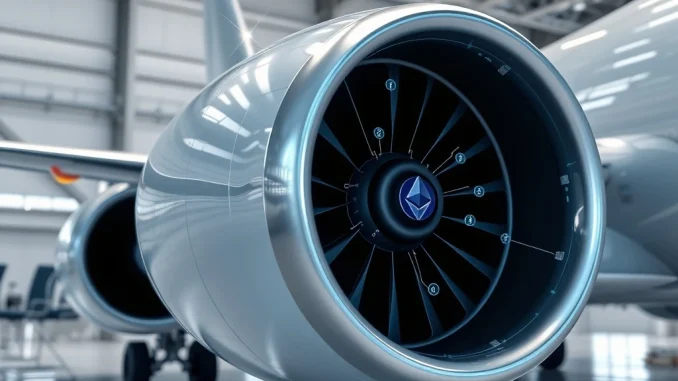
Tokenized Aviation Asset: Ethzilla’s Groundbreaking Ethereum Launch Unlocks Engine Leasing
Zug, Switzerland, March 2025: In a landmark move for both finance and aviation, blockchain firm Ethzilla has launched the first tradable tokenized aviation asset on the Ethereum network. The product, named Eurus Aero Token I, represents direct fractional ownership in a portfolio of Boeing 737-800 aircraft engines, offering investors a novel conduit to the historically stable yields of aviation leasing. This initiative signals a significant acceleration in the institutional adoption of real-world asset (RWA) tokenization, moving beyond theoretical concepts into tangible, high-value infrastructure.
Decoding Ethzilla’s Tokenized Aviation Asset
The core of Ethzilla’s offering is the Eurus Aero Token I (EATI). Each digital token functions as a security, representing a fractional, direct legal claim on the cash flows generated by a specific set of CFM56-7B engines, the powerplant for the ubiquitous Boeing 737-800. These engines are not speculative assets; they are under multi-year lease agreements to commercial airlines, generating predictable revenue from lease payments. Ethzilla’s structure utilizes an Ethereum-based smart contract to automate the distribution of these yields to token holders, effectively digitizing the ownership and profit-sharing mechanics of a highly specialized asset class. The legal framework typically involves a Special Purpose Vehicle (SPV) that holds the physical assets, with the tokens representing equity or debt in that entity, ensuring regulatory compliance and clear title.
The Mechanics and Appeal of Real-World Asset Tokenization
Tokenization is the process of converting rights to a physical or financial asset into a digital token on a blockchain. For aviation assets, this solves several long-standing market inefficiencies. Traditionally, investing in aircraft engines required immense capital, deep industry expertise, and involved illiquid, complex transactions. By breaking an engine worth millions into digital shares, Ethzilla dramatically lowers the entry barrier. Furthermore, the Ethereum blockchain provides a transparent, immutable ledger for ownership and transactions, potentially enhancing liquidity in a traditionally stagnant secondary market. This model follows a broader trend of tokenizing everything from real estate and treasury bills to fine art, but applies it to the massive, global aviation finance industry, estimated to be worth over $300 billion.
- Fractional Ownership: Enables investment with significantly lower capital outlay.
- Enhanced Liquidity: Tokens can be traded on compatible digital asset exchanges, unlike physical engines.
- Transparency and Automation: Smart contracts automate distributions and record ownership transparently.
- Access to Stable Yields: Taps into the consistent revenue from essential aviation infrastructure.
The Institutional Drive Behind RWAs
The launch is symptomatic of a powerful shift in the digital asset space. Following the 2022-2023 market contraction, institutional capital has increasingly sought blockchain applications with clear, real-world utility and yield, moving away from purely speculative cryptocurrencies. Major financial institutions like BlackRock, JPMorgan, and Franklin Templeton have publicly championed the tokenization of traditional assets. Aviation assets, with their long-term contracts and essential role in global trade, present a compelling use case. They offer a tangible hedge against crypto volatility while leveraging blockchain’s efficiency benefits. Analysts view this as a critical step towards a future where public blockchains act as the settlement layer for a vast array of global capital markets.
Regulatory Landscape and Risk Considerations
For such an offering to reach the market, navigating regulatory frameworks is paramount. Ethzilla’s structure likely treats the Eurus Aero Token as a security, falling under the purview of financial regulators in its jurisdiction, such as Switzerland’s FINMA or comparable bodies. This necessitates compliance with know-your-customer (KYC) and anti-money laundering (AML) regulations for investors. Potential risks for investors include the creditworthiness of the lessee airlines, the maintenance status and residual value of the engines, and broader macroeconomic factors affecting air travel. While the blockchain element adds transparency, it does not eliminate the fundamental operational and financial risks inherent in aviation leasing. Investors must perform due diligence on the underlying asset’s performance, not just the technology wrapper.
Implications for the Future of Aviation Finance
Ethzilla’s pioneering launch could catalyze a transformation in how aviation projects are funded. Airlines and leasing companies may find tokenization a more efficient way to raise capital for new aircraft or engine acquisitions, accessing a global pool of digital asset investors. It could also create a more dynamic secondary market for used aircraft parts. However, widespread adoption hinges on continued regulatory clarity, the development of robust custodial solutions for the link between the digital token and the physical asset, and the proven performance of these models through multiple market cycles. The success of Eurus Aero Token I will be closely watched by airlines, lessors, and investment banks as a potential blueprint for the industry’s digital future.
Conclusion
Ethzilla’s launch of the first tradable tokenized aviation asset on Ethereum represents a sophisticated convergence of blockchain innovation with the entrenched world of aviation finance. By tokenizing Boeing 737-800 engines, the project provides a tangible, yield-generating application for digital assets while addressing liquidity and accessibility issues in a vital industry. This move underscores the accelerating institutional trend towards real-world asset tokenization, positioning blockchain technology not as a disruptor in isolation, but as a powerful new infrastructure layer for global capital markets. The long-term trajectory of this tokenized aviation asset will offer critical insights into the practical scalability and regulatory maturation of the entire RWA sector.
FAQs
Q1: What exactly is Ethzilla’s Eurus Aero Token I?
It is a digital security token on the Ethereum blockchain that represents fractional ownership in a portfolio of leased Boeing 737-800 aircraft engines. Token holders are entitled to a share of the lease revenue generated by those physical engines.
Q2: How does a tokenized aviation asset differ from investing in an airline stock?
It is a direct asset-backed investment. You own a piece of the specific engines and their lease contracts, not a share in an airline company’s overall business performance, which includes fuel costs, labor, and competition.
Q3: What are the primary benefits of tokenizing an aviation asset?
The key benefits are fractionalization (lowering investment minimums), potential for greater liquidity through token trading, automated and transparent distribution of yields via smart contracts, and opening the asset class to a broader investor base.
Q4: What are the main risks associated with this type of investment?
Risks include the credit risk of the airline lessee defaulting on payments, the physical depreciation or maintenance needs of the engines, regulatory changes, and the overall health of the aviation industry. The blockchain component also carries smart contract and technology platform risks.
Q5: Is this product available to retail investors globally?
Typically, such security token offerings are restricted to accredited or institutional investors in compliant jurisdictions due to regulatory requirements. Availability depends entirely on the securities laws of the investor’s country of residence and Ethzilla’s specific offering structure.
Related News
- Strategic Bybit ART Listing Unveiled: What Traders Need to Know
- Sky Protocol Rating: S&P Global Unveils Crucial B- Assessment for Decentralized Lending Platform
- Urgent Binance Delisting: Six Margin Trading Pairs Removed
Related: Explosive: Binance Founder Denies 60,000 BTC BitMEX Profit Claims from 2020 Market Crash
Related: DOGEBALL Presale Analysis: Examining the Claims Behind Its Gaming L2 and 2026 Listing
Related: Crypto Market Decline: Fear Grips Sentiment as Bitcoin and Ethereum Slide