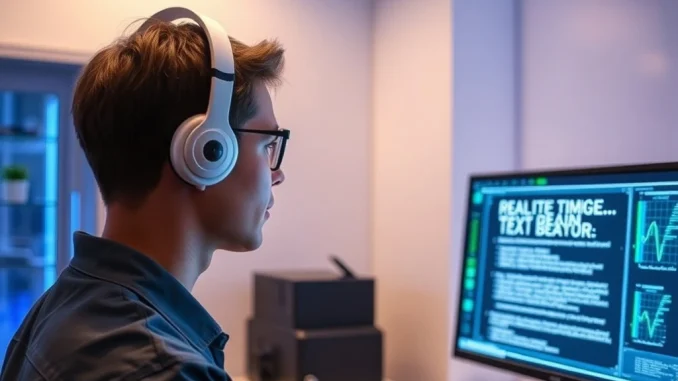
Tether EVO’s Brain-to-Text AI Breakthrough: Privacy-Focused Neural Tech Secures Top Global Ranking
Zurich, Switzerland, March 2025: Tether EVO, a research division of the Tether ecosystem, has secured a significant position in the competitive landscape of neural interface technology. The organization achieved two separate top-five finishes in the prestigious Brain-to-Text ’25 AI competition, a global benchmark for decoding speech directly from brain activity. This result highlights the maturation of Tether EVO’s distinctive approach, which prioritizes user privacy and local-first data processing in the rapidly evolving field of neural decoding.
Tether EVO’s Brain-to-Text AI Performance in Global Benchmark
The Brain-to-Text competition, organized by a consortium of leading neurological institutes and AI research bodies, serves as the definitive annual benchmark for evaluating non-invasive brain-to-speech technology. Teams from academia and industry worldwide submit their models to decode neural signals, typically captured via electroencephalography (EEG) or magnetoencephalography (MEG), into coherent text. Performance is measured by accuracy, latency, and vocabulary robustness. Tether EVO’s dual top-five placements, confirmed in the competition’s official results published this week, indicate a consistent and high-performing architecture. This achievement is notable not just for its ranking but for the underlying technological philosophy that enabled it.
The Core Innovation: Privacy-Focused Local-First Neural Decoding
While many competing models rely on cloud-based processing of sensitive neural data, Tether EVO’s foundational innovation is its commitment to a local-first paradigm. In this architecture, the primary decoding of brain signals into text occurs directly on a user’s local device, such as a specialized processor within a headset or a paired smartphone. Only anonymized, encrypted metadata or model updates—never the raw neural data—travel to external servers. This approach directly addresses growing ethical and regulatory concerns surrounding brain data, which is considered by many jurisdictions to be the ultimate biometric, warranting the highest level of protection. The technology demonstrates that high-accuracy decoding does not require compromising user privacy.
Technical Architecture and Historical Context
The field of brain-computer interfaces (BCIs) has evolved from simple motor command detection to complex linguistic decoding over the past two decades. Early systems, often invasive, helped paralyzed patients communicate but faced challenges with scalability and safety. The shift to non-invasive methods like EEG created a new problem: noisy signal data. Modern AI, particularly transformer-based models adapted for time-series data, has revolutionized interpretation. Tether EVO’s model reportedly uses a hybrid architecture. It combines a proprietary signal filtration algorithm to reduce noise with a lightweight neural network optimized for on-device inference. This design allows for real-time processing without the latency and privacy risks of cloud dependency, a significant divergence from the centralized models prevalent in earlier AI development cycles.
Implications for Medical and Assistive Technology
The most immediate and profound application of this technology lies in augmentative and alternative communication (AAC). For individuals with conditions like locked-in syndrome, advanced ALS, or severe paralysis, a reliable, private brain-to-text system could restore a fundamental human ability: conversation. Current solutions often rely on slow, laborious methods like eye-tracking. A non-invasive BCI that translates thought to text with high accuracy represents a paradigm shift. Tether EVO’s privacy focus is particularly critical here, as medical data sovereignty is a paramount concern for patients and healthcare providers. The local processing model ensures that a person’s most intimate thoughts—their attempted speech—are not stored or analyzed on corporate servers.
The potential applications extend beyond medical needs:
- Enhanced Human-Computer Interaction: Hands-free control of devices in environments where manual input is impractical, such as surgery, piloting, or industrial maintenance.
- Cognitive Research: Providing researchers with tools to study language processing in the brain with finer temporal resolution, while maintaining participant confidentiality through local data anonymization.
- Accessibility: Creating new interfaces for gaming, education, and workplace software that are more intuitive for a wider range of physical abilities.
The Competitive Landscape and Ethical Considerations
Tether EVO’s entry into this space intersects with projects from major tech firms and neurotech startups. The top rankings in the Brain-to-Text ’25 competition suggest its technical performance is competitive with these established players. However, its defining differentiator is its ethical framework. The industry faces increasing scrutiny from regulators like the FDA in the U.S. and the European Commission under the AI Act, which classifies certain BCIs as high-risk. A local-first, privacy-by-design approach may not only be a competitive advantage but a future regulatory necessity. It preemptively addresses issues of informed consent, data ownership, and protection against neural data being used for unauthorized surveillance or manipulation.
Challenges and Future Development Pathways
Despite the benchmark success, significant hurdles remain for widespread adoption. The accuracy of non-invasive systems, while improving, still needs to approach natural conversation speed and error rates for general use. Hardware also presents a challenge; comfortable, consumer-grade EEG headsets with high-fidelity signal capture are still in development. Furthermore, the “black box” nature of complex neural networks raises questions about interpretability—if a decoding error occurs, can engineers understand why? Tether EVO’s roadmap, inferred from its research publications, suggests a focus on personalization, where models continuously adapt to an individual’s unique neural patterns entirely on-device, further enhancing both accuracy and privacy.
Conclusion
Tether EVO’s top-five finish in the Brain-to-Text ’25 competition is more than a technical milestone; it is a validation of a principled approach to one of technology’s most sensitive frontiers. By proving that a privacy-focused, local-first neural decoding AI can compete with conventional cloud-based models, Tether EVO has shifted the conversation. It demonstrates that the trajectory of brain-computer interface development can prioritize user sovereignty without sacrificing performance. As this brain-to-text AI technology matures, its impact will be measured not only in words per minute decoded but in the trust it earns by protecting the sanctity of human thought.
FAQs
Q1: What is the Brain-to-Text ’25 competition?
The Brain-to-Text ’25 is an annual, global benchmarking competition where research teams test their artificial intelligence models on the task of converting recorded brain activity directly into readable text. It is considered a leading standard for assessing progress in non-invasive neural speech decoding technology.
Q2: What does “local-first neural decoding” mean?
Local-first neural decoding means the primary AI processing that translates brain signals into text happens directly on a user’s device (like a headset or phone), not on a remote cloud server. This design keeps the raw, sensitive brain data private and under the user’s control, enhancing security and privacy.
Q3: Why is privacy so important for brain-to-text technology?
Brainwave data is considered uniquely sensitive biometric information. It could potentially reveal a person’s private thoughts, health conditions, and emotional states. Protecting this data from misuse, hacking, or commercial exploitation is an ethical imperative and a growing focus of health data regulations worldwide.
Q4: Who could benefit most from this technology?
The primary beneficiaries are individuals with severe communication impairments due to conditions like paralysis, locked-in syndrome, or late-stage ALS. It could restore their ability to communicate independently. Other applications include specialized professionals needing hands-free control and researchers studying the brain.
Q5: What are the main challenges facing brain-to-text AI?
Key challenges include improving the accuracy and speed of decoding to match natural conversation, developing comfortable and reliable wearable hardware to capture brain signals, ensuring the ethical use of the technology, and making the systems affordable and accessible for those who need them most.
Q6: How does Tether EVO’s approach differ from other companies in this field?
While many companies focus on maximizing accuracy through powerful cloud-based AI, Tether EVO’s core innovation embeds strong privacy protections from the start. Its system is engineered to perform high-accuracy decoding on a local device, minimizing data transmission and placing user control at the center of its design philosophy.
Related News
- Exciting Opportunity: Binance Launchpool Features Space and Time (SXT) as 69th Project
- Visa Crypto Cards: InterLink Labs and HPX Launch Revolutionary Payment Solution with Web3 Identity
- ZRO Surges: LayerZero Token Breaks $1.72 Resistance as Technical Pattern Signals Potential Momentum
Related: Binance RLUSD Deposits: A Strategic Move on the XRP Ledger as Liquidity Landscape Evolves
Related: Tokenized Aviation Asset: Ethzilla's Groundbreaking Ethereum Launch Unlocks Engine Leasing